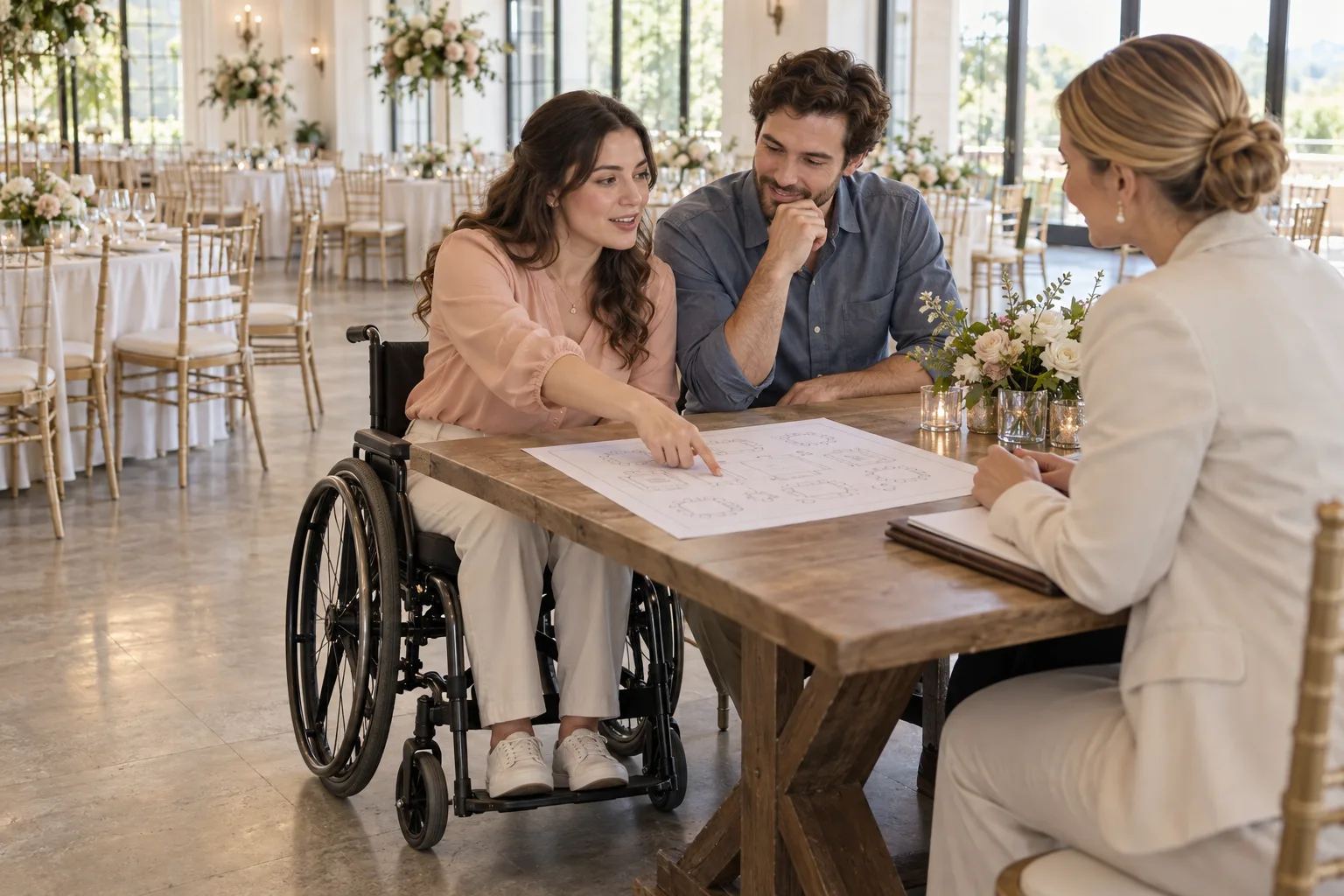
A venue says it has an accessible entrance. Ask where that entrance leads: to the ceremony, the dinner tables, the bathroom and the transport pickup, or only to one room? Put those connections into the wedding plan before furniture, flowers and guests arrive.
Ask what would help someone attend
Federal accessible-meeting guidance recommends invitations in an accessible format with a way to request individual accommodations. [1] That guidance addresses meetings in a federal context; the planning idea is useful for a wedding without treating every federal meeting rule as a wedding requirement.
Include a contact name and more than one way to reply, such as email and phone. Ask about the arrangements the guest wants to discuss. You do not need to make a diagnosis field part of your RSVP.
Replace the bracketed name and supply working contact information before using the note. Ask early enough to organize services, while keeping a way to discuss later requests. Needs and plans can change after an RSVP.
Agree what information the guest wants shared and with whom. The transport provider may need equipment and boarding details; the seating team may only need the agreed table position. Keep medical background out of the public seating chart.
Trace one continuous visit
The ADA National Network's temporary-event guide describes an accessible route connecting arrival and parking with activities and amenities. It should be smooth, unobstructed and avoid stairs, using the same route as other attendees where possible. [2]
Use a site plan to mark drop-off, entrance, ceremony seating, portraits, drinks, dinner, bathrooms and departure. Ask the venue to confirm the route between each point, including any lift, door, threshold or change in surface.
If a route uses a lift, ask who operates it, when it is available and what the backup is if it fails. If a different entrance is involved, ask how guests will find it and whether someone will be stationed there. Confirm that arrival does not depend on calling a staff member whose phone is unattended during the ceremony.
Walk the planned route with the coordinator. When a guest wants to assess a route or review photographs and measurements, arrange that with their permission and the venue. Their participation should help answer their questions, not make them responsible for solving every site problem.
Have the venue or a qualified access professional assess dimensions, ramps and any proposed temporary structures. Do not ask friends to improvise a ramp or carry someone as the standard access plan.
Check the furnished room
The temporary-event guide includes maneuvering space, seating, accessible tables and bathroom facilities in its planning considerations. [2] Ask for the wedding layout rather than relying only on a tour of an empty room.
Mark the cake table, bar queue, photo booth, gifts, flowers and entertainment equipment. Ask who checks the route once these are installed. A path shown on a floor plan needs to remain usable when guests pull out chairs or gather for drinks.
Discuss seating preferences with the guest. Ask whether they want to remain in a mobility device, use another chair, sit beside a companion or have a particular view. Do not put every guest who requests an arrangement at the same table by default.
Ask the caterer how the guest can use the dining position and receive food and drinks. Confirm any requested help directly rather than assuming someone wants a companion to collect everything.
For ceremony seating, check sightlines in the finished setup. A reserved position behind standing guests may lose its view as soon as the entrance starts. Tell the officiant and ushers about any agreed seated participation or change in the procession.
Confirm the bathroom during your booking hours
Request the location and route to the bathroom the venue proposes. Ask whether it will be open from guest arrival until departure and whether the same facilities serve the outdoor backup location.
Check that storage, decorations or supplies will not occupy required space. Ask how the door, fixtures and room arrangement have been assessed for access. A large-looking room or an accessibility symbol is not enough information for every guest to judge whether it meets their needs.
If a guest asks for more detail, provide the venue contact and verified information, with permission to connect them. Be candid about anything still awaiting confirmation. Avoid telling someone “you'll manage” when the question concerns a feature you have not checked.
Plan how people will follow the ceremony
Department of Justice guidance explains that effective communication depends on the person's usual communication method and the nature and context of the exchange. It describes options including interpreters, captions, assistive listening systems, accessible electronic text and large print. Sign language and Braille are useful only for people who use them. [3]
Ask the guest what works for them, then discuss delivery with the venue, officiant and audiovisual team. A microphone and a front-row seat do not answer every communication request.
If an interpreter or caption service is arranged, confirm booking hours, rehearsal or sound-check needs, positioning and who supplies the requested material. Ask how unscripted toasts or announcements will be handled. Give the provider the final running order and update it when speakers change.
Check that screens, flowers, lighting and the photographer's position will not obstruct the agreed view. Ask the service provider how to test the arrangement in the room.
For written directions and schedules, offer ordinary readable text as well as any decorative image. Federal meeting guidance recommends accessible shared materials and clear, well-paced speech. [1] Keep last-minute announcements available through the agreed communication method too.
Book the trip in both directions
Ask the transport provider to confirm the vehicle and boarding arrangement for the guest's stated needs. Check pickup points, times, space for equipment and the arrangement for accompanying people. Do not substitute a different vehicle without checking the effect on the agreed plan.
Confirm the return trip, including an earlier departure if one has been requested. Share a contact number with the guest and the person coordinating transport. Make sure the driver receives the correct entrance and pickup location, not just the venue's street address.
Include the indoor weather alternative. If moving the ceremony changes the entrance or walking distance, update the vehicle instructions at the same time. The outdoor heat guide can help coordinate shaded waiting and access to a cooled room.
Ask before helping
The ADA National Network advises speaking directly to the person, waiting for an answer when offering help and following their instructions. It also says not to lean on or move a mobility device without permission. [4]
Include those points in the usher and coordinator briefing. Name the access contact so a guest does not have to repeat a request to several people during dinner.
If a guest uses a service animal, discuss the practical arrangements with them and the venue. DOJ guidance says covered entities cannot require service-animal certification, a task demonstration or disclosure of the person's disability. [5] Have the venue resolve policy questions through its appropriate guidance before the wedding.
Do not turn a helpful conversation into an announcement about the guest. Share the instructions needed for the task and respect the person's choices about assistance.
These are planning steps, not a certification of legal compliance. Ask the venue to address its applicable obligations and unresolved technical questions. Send guests the confirmed details in advance so they can decide what works for them and tell you what still needs attention.

Physical Book (No Download)
Bridegenic: The Glow-Up Guide for Brides on GLP-1s
$12.95 + Free Shipping
Order NowThis article provides general education, not a diagnosis or an individual treatment plan. Medication information refers to US sources. Talk with your prescriber, pharmacist or dermatologist about decisions for your care.
Read next
Wedding WeekOutdoor Wedding Heat Planning: Shade, Cooling Breaks and When to Get Help→Food & EnergyFood Allergies at Your Wedding: The Caterer, Kitchen and Serving Handoff→Sources
- Accessible MeetingsSection508.gov, U.S. General Services Administration↩ Back to text
- A Planning Guide for Making Temporary Events Accessible to People with Disabilities, 2015ADA National Network↩ Back to text
- ADA Requirements: Effective CommunicationU.S. Department of Justice↩ Back to text
- ADA Quick Tips: Customer Service for Front Line Staff, 2017ADA National Network↩ Back to text
- Service AnimalsU.S. Department of Justice↩ Back to text