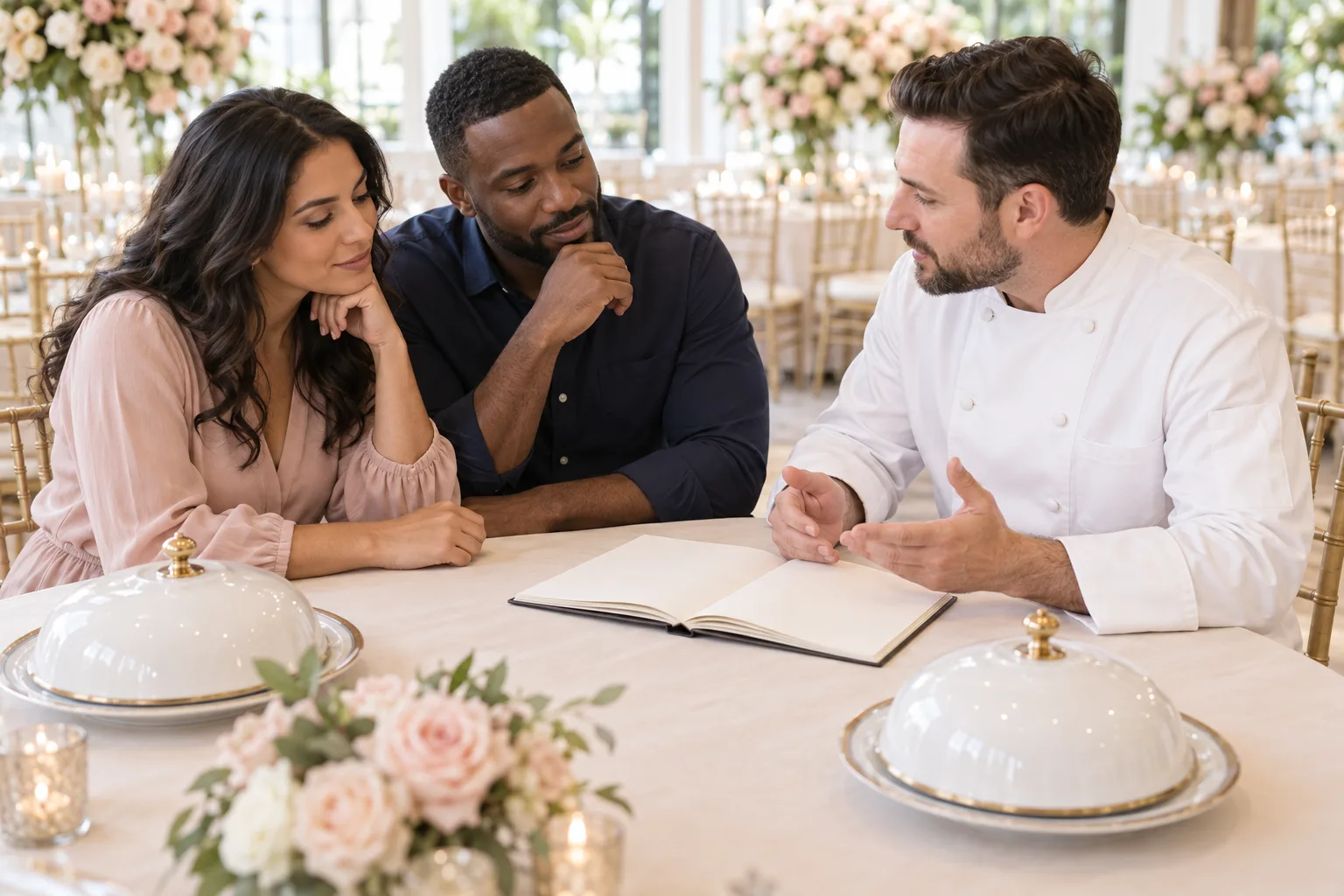
An RSVP note saying “nut allergy” has not yet explained which foods the guest avoids, who checks the sauce or how the meal reaches the correct seat. Before the menu is final, arrange a direct conversation between the person with the allergy and the caterer's responsible contact. Record the agreed preparation and service plan.
Ask for the exact allergy information
FDA identifies nine major food allergens under US law: milk, eggs, fish, Crustacean shellfish, tree nuts, peanuts, wheat, soybeans and sesame. Other foods can also cause allergic reactions. [1] Do not limit the RSVP form to those nine if a guest needs to describe another allergy.
Use an open field and a follow-up contact route. Ask guests to name the foods they avoid and whether they want to speak directly with the caterer. If someone writes “nuts,” ask them and the catering contact to clarify the specific requirement rather than interpreting it yourself.
Keep allergies, other medical dietary requirements and preferences accurately described. A vegetarian meal selection does not answer a food-allergy question. Give the caterer the guest's wording and let the guest confirm the plan.
Share information only with the people who need it for preparation, service and agreed assistance. Do not place a guest's full health history on a seating chart distributed to the entire wedding party.
Speak to the person responsible for preparation
Ask who can review recipes, supplier labels and kitchen procedures, and who holds that role on the wedding day. A sales coordinator may arrange the conversation but may not be the person preparing the meal.
CDC's restaurant guidance recommends staff training, ingredient lists and a plan for customers with food allergies. It also recommends separate equipment and preparation areas where feasible, or thorough cleaning and sanitizing before preparing the meal when separate areas are unavailable. [2]
Ask how those practices work in the kitchen serving your event. Include shared grills, fryers, work surfaces, utensils, storage and plating. Obtain a description rather than accepting only “we accommodate allergies all the time.”
A CDC study interviewed personnel at 278 restaurants across six selected sites in 2014 and found that few had separate equipment or preparation areas for allergy meals. [3] It was not a survey of your caterer or a current wedding-risk estimate. Its useful implication is to ask about the actual process.
If the caterer cannot accommodate a requirement, establish that before the event. Discuss an alternative with the guest and venue, including outside-food permission, receipt, storage and service. Do not ask a guest to accept an uncertain dish because the menu count has already been submitted.
Review the complete dish, including the finish
Ask for ingredient information for sauces, stocks, dressings, marinades, breading, garnishes and packaged components as well as the main ingredient. Confirm who checks the current supplier labels and how a substitution is handled.
For example, “grilled chicken with vegetables” does not describe the marinade, finishing butter or sauce. The guest and caterer need the complete preparation to assess the meal.
Food Allergy Research & Education (FARE) explains that cross-contact transfers allergen proteins between foods, sometimes in amounts that cannot be seen. Cooking does not remove the risk in the way people may expect when thinking about foodborne germs. [4]
Ask for a freshly prepared alternative under the agreed procedure if a problem ingredient has already touched the food. Picking off a garnish should not become the allergy plan.
Record what happens when an ingredient changes after the tasting. The wedding meal should be checked against the current recipe and supply, rather than treating the dish tasted months earlier as proof of what will be served.
Follow the plate to the correct guest
Agree on how the kitchen identifies the meal, who carries it and how the server confirms the recipient. Ask how the plate is protected from contact with other dishes during waiting and delivery.
FARE specifically recommends asking how an allergy meal will be labeled and delivered, preferably separately by the chef or manager. [4] Work with the caterer on a method their team can carry out consistently.
Give the serving lead the final seating information and a contact for last-minute changes. A seat swap should trigger an update to the meal record. Do not rely only on a colored place card whose meaning nobody has confirmed with the guest.
Ask the coordinator to leave time for that check before speeches or photographs move the guest away from the table. The guest should be able to ask a question without having to locate the couple during the first dance.
Discuss buffets, passed trays and cake separately
FARE notes that buffets can have a high risk of cross-contact because many foods are close together and guests serve themselves. Bakeries and premade foods can also present ingredient and cross-contact questions. [5]
If the reception uses a buffet, ask whether the guest's agreed meal can be prepared and served separately. Let the guest discuss the arrangement with the catering lead instead of suggesting they choose from whatever looks plain.
For canapés, ask how a server identifies ingredients and whether separate trays and utensils are part of the agreed service. A guest may decline a passed item while waiting for the confirmed meal. Nobody needs to persuade them to try a bite.
Speak to the cake supplier as well as the dinner caterer. Include filling, icing, decorations, display contact, cutting equipment and any separate dessert. Confirm which team serves it and who communicates the supplier's information.
Keep a clearly identified alternative under the agreed procedure if one is arranged. A special dessert placed among shared cakes and serving tools can lose the handling conditions you discussed.
Include the food outside the reception
List every food event: rehearsal dinner, getting-ready breakfast, transport snacks, welcome bags, reception, late food and next-day brunch. Each supplier needs the relevant information. A dinner note does not automatically reach the hotel kitchen or the friend buying pastries.
If the person with an allergy is the bride, keep familiar options available at the actual locations where she will be. Ask who receives deliveries and where food can be stored under the venue's food-safety procedures.
For bought snacks, keep original packaging so the person eating them can review the current label. Avoid decanting everything into matching wedding jars or assuming a product is unchanged because the brand was suitable before.
For welcome gifts, let guests decline or exchange food without an explanation to the group. Labeling a package “for everyone” does not establish suitability for an individual allergy.
Keep the personal emergency plan accessible
The American Academy of Allergy, Asthma & Immunology (AAAAI) advises that people prescribed epinephrine understand how and when to use it and carry it with them. Current guidance includes injectable and intranasal forms. [6] Follow the individual's prescribed product and action plan.
Before the event, ask the person what help they want and who may know where the medicine is. Keep it accessible under its storage instructions. A handbag locked in a car or sent to the hotel during portraits may not be reachable when needed.
AAAAI describes anaphylaxis as a medical emergency requiring immediate treatment. Breathing difficulty, loss of consciousness and low blood pressure are among the dangerous signs; it advises calling 911 and not waiting for symptoms to improve on their own. [6] Follow the person's emergency plan and obtain urgent care.
Tell the venue who calls for help, the exact address and how responders reach the room or outdoor area. For travel outside the United States, confirm the local emergency contact and arrangements with the relevant care team.
The couple and catering staff do not need to invent a medication dose or decide whether a previous reaction was “serious enough.” Their preparation should make the established plan easier to follow.
Reconfirm the final arrangement with the guest and the people who will carry it out. Keep the record current when the recipe, seating or serving team changes.

Physical Book (No Download)
Bridegenic: The Glow-Up Guide for Brides on GLP-1s
$12.95 + Free Shipping
Order NowThis article provides general education, not a diagnosis or an individual treatment plan. Medication information refers to US sources. Talk with your prescriber, pharmacist or dermatologist about decisions for your care.
Read next
Food & EnergyEating at Your Wedding on a GLP-1: A Food Plan for Your Happiest Day→Wedding WeekYour Wedding-Week Checklist: Food, Medicine and Named Handoffs→Sources
- Food Allergies: What You Need to KnowFDA↩ Back to text
- Food Allergy Reactions, reviewed September 2026CDC↩ Back to text
- Restaurant Food Allergy Practices: Six Selected Sites, United States, 2014CDC MMWR, 2017↩ Back to text
- Avoiding Cross-ContactFood Allergy Research & Education↩ Back to text
- Dining OutFood Allergy Research & Education↩ Back to text
- Anaphylaxis, updated June 2026American Academy of Allergy, Asthma & Immunology↩ Back to text