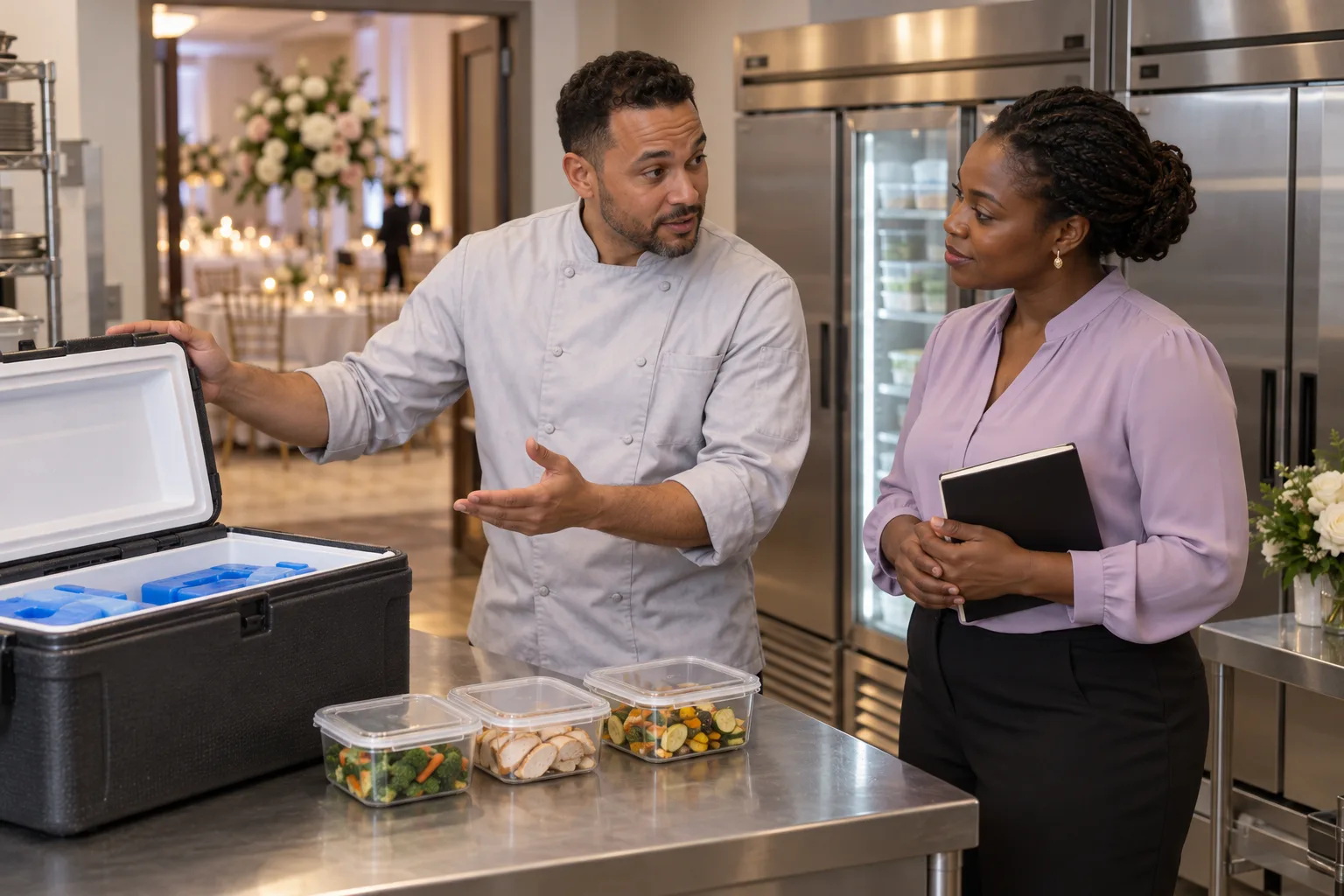
Decide what happens to reception food before the catering team begins clearing tables. Ask which food can be retained, who will package and chill it, where it will wait and how it will reach the person taking it home. Take-home boxes are useful only when the storage and transport arrangements work.
Ask what the caterer permits and can manage
USDA's July 2024 wedding-food guidance specifically recommends asking whether leftovers may be taken, how they will be packaged and where they will be stored until the event ends. It notes that some caterers do not allow leftovers to leave because of time and temperature concerns. [1]
Ask before buying personalized boxes or promising food to relatives. Confirm which dishes the company can retain and whether the plan concerns food held in the kitchen, buffet food or another category.
Identify the person who decides what remains suitable for release. The coordinator should not override the catering team's decision because a tray appears full or was expensive.
Confirm the available refrigeration, packaging, staff time and collection window. Ask whether these are included in the quote. If the caterer leaves before the reception ends, arrange the handoff while its responsible staff are still there.
Keep track of time outside temperature control
For household leftovers, USDA says perishable food left at room temperature for more than two hours should be discarded. The limit is one hour when the temperature is above 90°F. Its guidance describes keeping cold foods at 40°F or below and hot foods at 140°F or above. [2]
Those limits are not a fresh allowance beginning when the lid goes on a box. Include earlier time without proper temperature control when discussing whether food can be kept.
For example, a tray that sat on an unheated side table while staff cleared dinner has a history before a guest collects it. Ask the caterer to assess that history rather than writing a new time on the container and assuming the problem is solved.
USDA's buffet advice directs food-service operators to the FDA Food Code or local health-department regulations. [3] A caterer may use a documented commercial procedure with requirements different from this household summary. Ask the team to follow its applicable rules and provide suitable instructions for food released to guests.
If nobody can establish how the food was held, do not send it home with a reassuring label. Choose disposal or another appropriate route determined by the catering team.
Do not mix fresh food into an older serving dish
FDA's consumer buffet guidance recommends small serving portions and replacing dishes rather than adding fresh food to a partly filled dish. It also warns that some warmers hold food at only 110–120°F, below its recommended 140°F hot-holding temperature. [4]
Ask the caterer how serving batches are managed and monitored. A warming appliance being switched on is not proof of the food's temperature.
Keep the leftovers decision separate from a guest's personal plate. Ask staff which food can be packaged under their procedures instead of gathering partly eaten portions into a communal container.
For a family-run reception, give food handling to someone able to monitor it throughout service. They need time, suitable equipment and a clear instruction to remove food when necessary. This cannot depend on the couple noticing a tray between photographs.
Use small, shallow containers for food being chilled
USDA recommends dividing large amounts into shallow containers for rapid cooling and cutting large cooked items into smaller portions. Hot food can go directly into the refrigerator; it need not sit out until it reaches room temperature. [2]
Ask the catering team to manage cooling before collection. Do not place a deep, tightly packed catering tray in a guest's bag and leave that person to work out how to chill it after the party.
Confirm refrigerator capacity rather than assuming unused shelf space will appear at midnight. A room refrigerator full of drinks may not accommodate several containers, and a decorative cooler is not automatically suitable food storage.
Use the equipment and containers appropriate to the plan. Ask where chilled portions will remain until the named collector is ready to depart. Keep food handling away from the space used for cleaning products, discarded plates or garment repairs.
Arrange cold transport before packing
USDA's transport advice recommends an insulated cooler with ice or frozen gel packs and an appliance thermometer to verify 40°F or below. Cooked meat, chicken and potato or pasta salads also need refrigerator-cold transport. [5]
Bring the cooler and cold sources before the event and agree where they will be stored. Ask how much food can be accommodated while maintaining the required conditions.
Give collection to someone who can take the food directly to appropriate storage. A box left in a warm vehicle during the last dance or an after-party does not meet the plan because the trip home is short.
USDA advises chilling food before cold transport if it cannot be kept properly hot during the drive. [5] A few gel packs beside a large hot pan are not a substitute for a cooling procedure.
Tell guests the storage requirements before offering a perishable portion. Someone returning to a hotel without suitable refrigeration may reasonably decline. Do not send food on a morning flight merely because there is room in the luggage.
Send the handling information with the food
Ask for the dish name, preparation information relevant to its storage limit, collection time and the caterer's storage and reheating instructions. Keep allergen information with each dish rather than separating it from the boxes.
If food was prepared before the wedding date, ask how that affects the remaining storage time. Collection does not turn an older prepared dish into newly cooked food.
For household leftovers, USDA gives a general refrigerator limit of three to four days. Freeze suitable portions promptly if they will not be used within the applicable period, following any more restrictive food-specific instructions. [2]
The food-allergy catering guide covers ingredient and cross-contact questions. A container marked with a guest's name does not establish that the contents meet their allergy requirements.
Make the instructions legible and keep similar-looking dishes distinguishable. A person receiving several boxes should not need to guess which contains a sauce, a different ingredient or an earlier preparation batch.
Reheat properly handled leftovers thoroughly
USDA recommends reheating leftovers to at least 165°F, checked with a food thermometer, and bringing soups, sauces and gravies to a boil. For microwave heating, stir, cover and rotate food for even heating and allow standing time. [6]
Follow the instructions for the container and appliance. Transfer food to suitable cookware when necessary. Do not assume a catering box can go into an oven or microwave.
USDA does not recommend reheating leftovers in a slow cooker, steam table or chafing dish, because food may remain at unsafe temperatures too long. [6] Holding hot food and bringing cold leftovers up to temperature are different tasks.
Reheating does not rescue food whose handling was unsafe. CDC explains that cooking can kill Staph bacteria but does not destroy the toxin they may have produced in food. [7]
If food should have been discarded, do not retain it for someone willing to “heat it extra.” Make the disposal decision before it enters another person's refrigerator.
Arrange donation before the reception
FDA encourages donation of wholesome food under applicable state or local rules. Its retail-establishment guidance addresses labeling, hygiene, safe storage and transport, and records of what was donated, when, by whom and at what storage temperature. [8]
Contact the intended recipient through the caterer or venue in advance. Ask what foods it accepts, which packaging and records it requires, and who handles pickup. A charity's willingness to accept some food does not mean it can accept every reception tray late at night.
FDA's donation guidance uses commercial holding temperatures of 135°F or above for hot food and 41°F or below for cold food. [8] These differ from the consumer temperatures above; let the responsible food business apply the rules governing its procedure.
Keep any donation food under the agreed conditions until collection. Do not leave it beside the exit because a volunteer is expected later. If the pickup fails, contact the catering lead for the next decision.
A donation plan should identify suitable food and preserve its handling record. Do not use donation as the destination for food you would otherwise discard on safety grounds.
Give the final collection a named person
Put four details on the run sheet: catering contact, approved collection time, storage location and collector. Add the destination refrigerator or freezer and who will confirm arrival.
Decide what happens if the collector leaves early, the event runs late or the available amount exceeds the planned storage. It is better to change the arrangement while staff can assess the food than to distribute unplanned boxes at the door.
Keep the couple's own food access separate from the leftovers. The wedding-week handoff guide covers getting food to the preparation room and protecting planned breaks. Saving reception food does not replace those meals.
If you are leaving for the honeymoon, decide who wants and can manage the food. Do not fill your refrigerator with perishable leftovers that nobody will use while you are away.

Physical Book (No Download)
Bridegenic: The Glow-Up Guide for Brides on GLP-1s
$12.95 + Free Shipping
Order NowThis article provides general education, not a diagnosis or an individual treatment plan. Medication information refers to US sources. Talk with your prescriber, pharmacist or dermatologist about decisions for your care.
Read next
Food & EnergyFood Allergies at Your Wedding: The Caterer, Kitchen and Serving Handoff→Wedding WeekYour Wedding-Week Checklist: Food, Medicine and Named Handoffs→Sources
- Food Safety Tips for Catered and DIY Wedding Food, July 9, 2024USDA Food Safety and Inspection Service↩ Back to text
- Leftovers and Food SafetyUSDA Food Safety and Inspection Service↩ Back to text
- How Do I Keep Foods Safe at a Buffet?USDA Food Safety and Inspection Service↩ Back to text
- Serving Up Safe BuffetsU.S. Food and Drug Administration↩ Back to text
- Tailgating Food Safety Q&A, February 23, 2021USDA Food Safety and Inspection Service↩ Back to text
- What Methods of Reheating Food Are Safe? August 14, 2024USDA Food Safety and Inspection Service↩ Back to text
- About Staph Food Poisoning, April 16, 2024Centers for Disease Control and Prevention↩ Back to text
- Key Steps for Donating Food: For Retail Food EstablishmentsU.S. Food and Drug Administration↩ Back to text