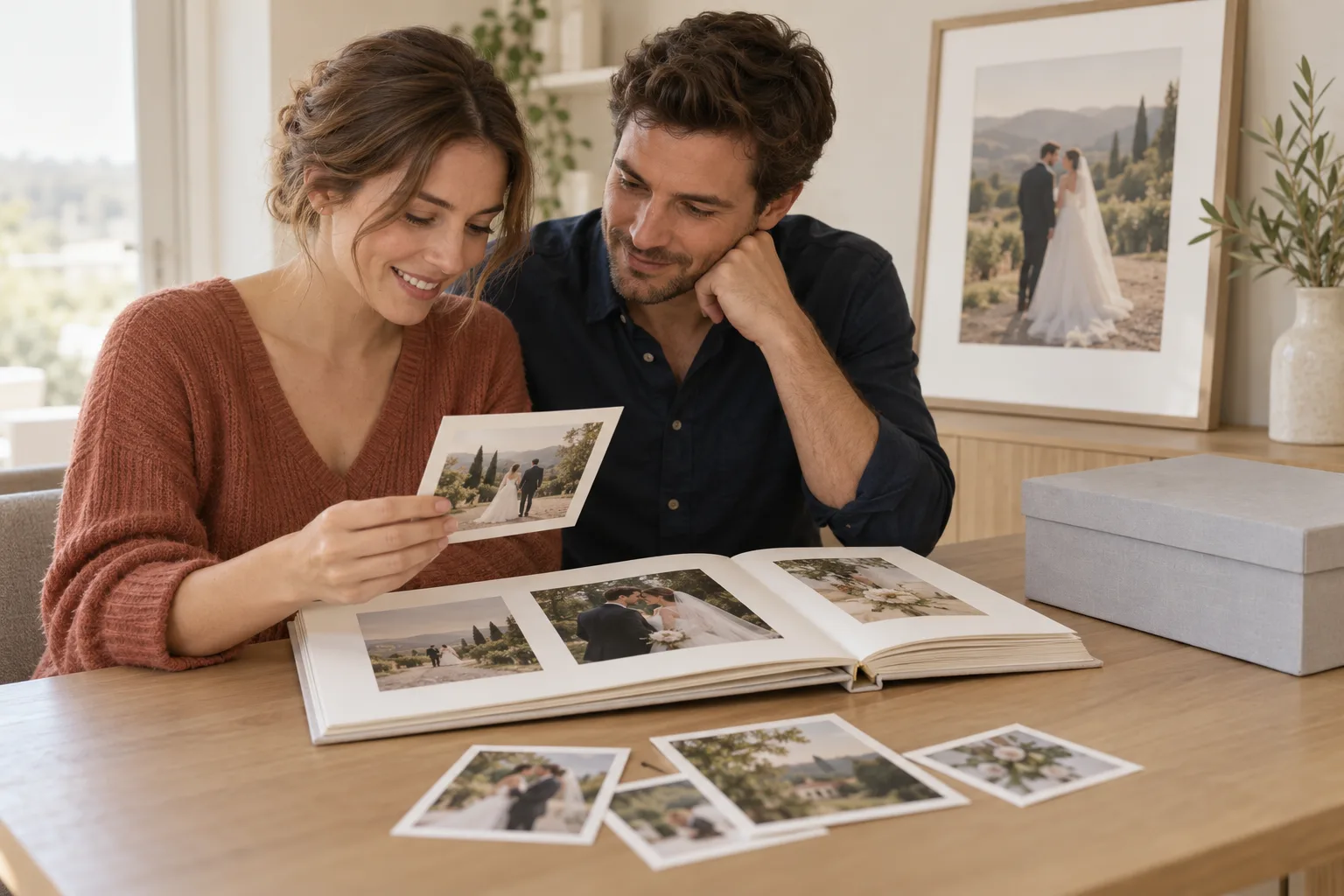
Before ordering a large wedding portrait, decide where it will hang and how the print will be mounted. Before buying an album for loose photographs, check the pages and pockets. The materials touching a picture deserve as much attention as the frame finish or cover color.
Identify what you are ordering
A photographic print, an inkjet print and a printed photo book can have different construction. Ask the supplier to identify the printing process, paper, coating and any mounting or lamination included. Request the care instructions for that product. Save the product name and order number so you can obtain the same information later.
Order a smaller sample before committing to a large wall print if the supplier offers that option. Check the crop, faces near the edges, paper finish and how the image looks in the intended room. Keep the approved file and print-order details together. This gives you a starting point if you later need another display copy.
Conservation guidance can help you select storage and framing materials, but it cannot supply a single lifespan for every modern print. Treat a claim such as “lasts generations” as a reason to ask what was tested, under which display conditions and for which ink-and-paper combination.
Ask for more than an “archival” label
The Image Permanence Institute explains that the Photographic Activity Test, or PAT, is ISO 18916. It examines possible chemical interactions between photographs and materials during prolonged contact. Its detectors look for reactions associated with image changes and yellowing. [1] This is a useful specification to request for an enclosure or mat; it does not promise that a finished photograph will survive any room or handling routine.
Ask the seller which exact product or component passed the PAT. A supplier selling several sleeve types should be able to identify the one described in its documentation. Save that description rather than relying on a shelf label that says “photo storage.”
The Library of Congress advises that products used to store photographs should pass the PAT. It identifies acid-free, lignin-free paper enclosures and suitable plastics, including polyethylene and polypropylene, while noting that image layers can stick to smooth plastic at high relative humidity. [2] A suitable sleeve still needs a suitable storage environment.
Choose the pages before the album cover
For loose prints, the Library of Congress describes polyethylene or polypropylene sleeves in ring binders as one option, or photo corners on paper album pages. It advises against colored-page, magnetic and no-stick albums, and against self-stick tape. [2] Ask how the prints are held before buying a personalized cover.
These recommendations concern housing separate photographs. For a professionally bound album with images printed directly onto its pages, ask the maker about its materials, handling and storage instructions. Do not assume that adding sleeves or corner mounts would improve a finished book.
Plan captions while names and places are easy to confirm. Write a separate index with the wedding date, venue, photographer and names of the people pictured. Associate captions with page or pocket numbers. Keep that index with the album so a future reader does not have to identify everyone from memory.
If you also keep invitations, pressed flowers or other wedding objects, ask about separate suitable housing. Avoid filling every album page with bulky keepsakes. The National Archives warns that overstuffing can damage pages and attached items and make an album difficult to use. [3]
Specify the mat, mounting and glass
The National Archives recommends mat board made from cotton rag or chemically purified pulp, with photo mats that have passed the PAT. It calls for a window mat or spacers to prevent contact between the image and the glass or acrylic. It also describes mounts that hold a photograph without adhesive on it. [4]
Take the actual print specifications to a framer. Ask which mat and backing they propose, what touches the picture and whether the mounting method allows future removal. If the print is signed, unique or difficult to replace, make that clear before work begins. Request the agreed materials on the order.
For display, the National Archives emphasizes that visible light as well as ultraviolet light can cause changes. It recommends displaying copies while storing originals, and limiting light exposure even when using ultraviolet-filtering glazing. [4] UV protection therefore does not make a sunny wall harmless.
For a replaceable wedding print made from a retained digital file, decide whether you are comfortable using it as the display copy. For a unique inherited photograph included in the wedding, discuss duplication and preservation before framing the original.
Find a storage shelf away from heat and water
The National Archives advises keeping family papers and photographs below 75°F and relative humidity below 65%, while avoiding very dry conditions below 15%. It recommends avoiding damp basements, garages and hot attics, keeping items away from leaks and storing them on shelves. Its guidance also says cold storage requires special packaging and procedures. [3] These figures are general preservation guidance, not an instruction to put an album in a household freezer.
Choose an indoor shelf where the box fits without bending or compressing the contents. Consider what is above the shelf as well as below it: a pipe, window or known roof leak changes the choice. Make the location easy enough to reach that you can enjoy the album without moving a tower of heavy boxes.
The Canadian Conservation Institute cautions that prints can become stuck to frame glass, especially when liquid cleaners are sprayed onto it. It also advises keeping photographs away from direct sunlight, bright lights, heat vents and damp places. [5] Ask the framer how to clean the exterior while protecting the photograph inside.
Get advice before attempting a repair
If a print becomes stuck, stained or damaged, photograph its condition and contact the printer, framer or a photograph conservator as appropriate. The Canadian Conservation Institute recommends professional help for extensive work because moisture and solvents can damage photographs. [5] Avoid turning an online cleaning tip into the first experiment on a print you value.
Chapter 15 of Bridegenic encourages choosing photographs that matter to you. Once you have selected them, give their physical care a defined task: confirm materials, choose a location and save the order details. You can then turn the pages without making every viewing session another sorting project.
Physical Book (No Download)
Bridegenic: The Glow-Up Guide for Brides on GLP-1s
$12.95 + Free Shipping
Order NowThis article provides general education, not a diagnosis or an individual treatment plan. Medication information refers to US sources. Talk with your prescriber, pharmacist or dermatologist about decisions for your care.
Read next
Honeymoon & BeyondWedding Photo Backups: Downloads, Originals and File Checks→Family & FriendsWedding Photo Sharing: Albums, Guests and Posting Preferences→Sources
- Photographic Activity TestImage Permanence Institute, Rochester Institute of Technology↩ Back to text
- How Do I Preserve My Photographs and Negatives?, updated March 3, 2025Library of Congress↩ Back to text
- Storing Family Papers and PhotographsU.S. National Archives↩ Back to text
- Displaying Family Papers and Photographs, reviewed July 1, 2025U.S. National Archives↩ Back to text
- Basic Care: Photographic Materials, September 15, 2017Canadian Conservation Institute↩ Back to text