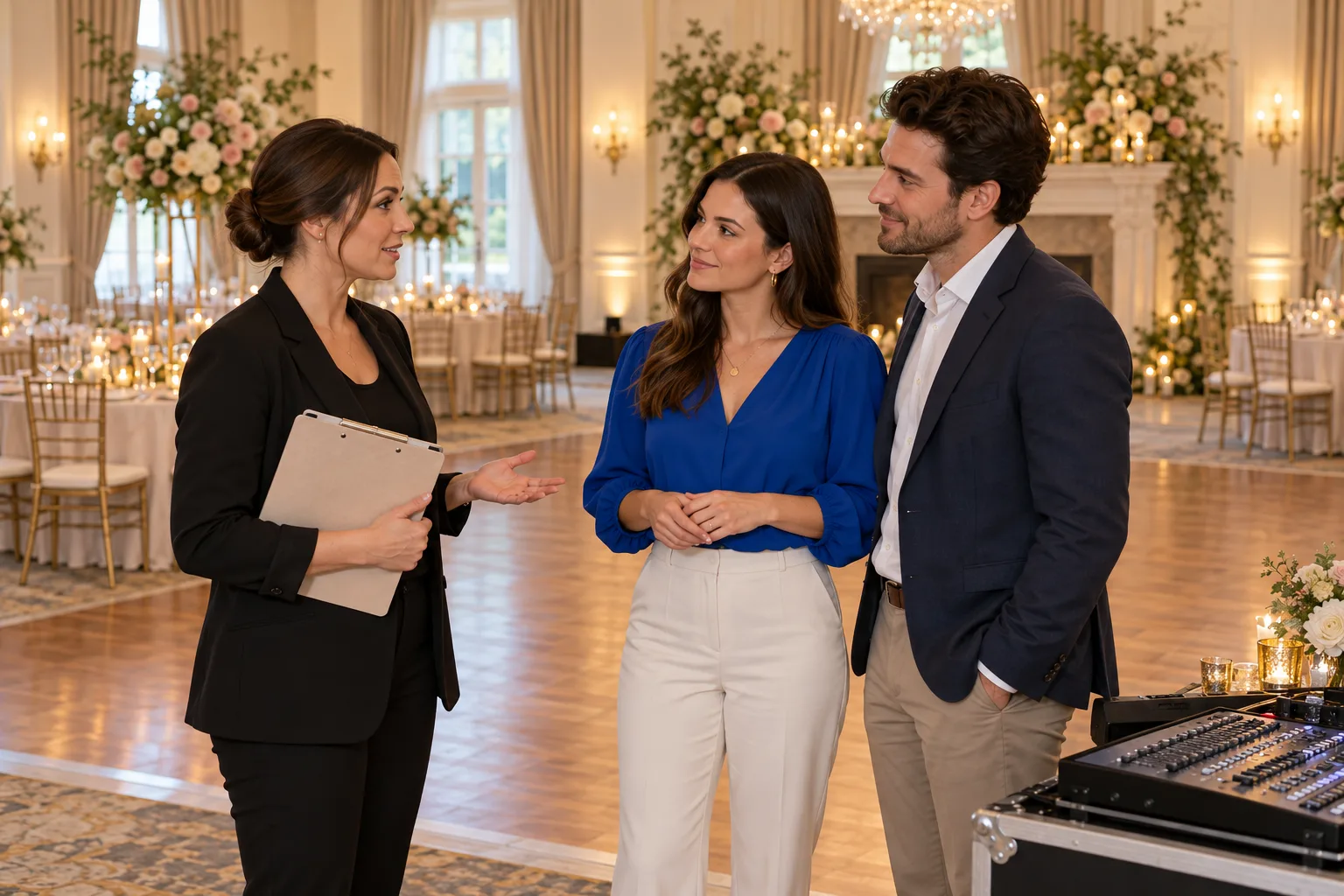
If you or a guest has photosensitive epilepsy, give the venue, DJ and photographer a shared lighting brief before the reception equipment is booked. Describe the effects to omit and name the person who can stop an unexpected effect. “No strobes” needs to reach every supplier controlling lights or screens.
Start with the person's requested arrangements
Photosensitive epilepsy involves seizures triggered by flashing lights or contrasting patterns. Epilepsy Society estimates that about 3% of people with epilepsy have this form. It also notes that visual effects can make people without photosensitive epilepsy uncomfortable or unwell. Do not assume everyone with epilepsy has the same triggers. [1]
Offer a private contact route for access requests. Ask what the person wants the suppliers to know and who may receive that information. A lighting instruction can often be shared without circulating a diagnosis or medical history.
If you are the person affected, discuss your own attendance and seizure plan with your clinical team. The wedding brief should put your agreed arrangements into practice. It cannot determine which effects you personally tolerate.
List every source of changing light
Epilepsy Society identifies rapid or multiple camera flashes, strobe effects, faulty flickering lights and high-contrast screen patterns among possible triggers. It also notes that several flashing decorative-light circuits can combine to increase the apparent flash rate. [1]
Review the entrance, first dance, party lighting, photo booth, slideshow, video messages and any surprise performance. Ask the venue which systems it controls and which belong to suppliers. Include guest-operated features such as a booth's automatic sequence.
Send the same instruction to the photographer and videographer. Ask how they will handle any planned rapid flash sequence and what alternative fits the brief. A steady room setup does not describe what a separate camera or projector will do.
Request a written description or static equipment list before reviewing promotional footage. Do not send an affected guest a flashing demonstration to see whether it causes symptoms.
Avoid turning a flash-rate number into clearance
Epilepsy Action says lights flashing 10–25 times per second are most likely to trigger photosensitive seizures, while some people are sensitive from 3 to 60 flashes per second. Brightness, the area of vision occupied and other features also matter. These ranges describe sensitivity; they do not supply a universal safe setting for your reception. [2]
If the supplier proposes slowing an effect instead of removing it, return to the agreed brief. Ask for a steady alternative and confirmation that sound-activated or automatic modes will not reintroduce flashing. A promise that a setting is “slow” is too vague to put on the order.
Do not try to assess frequency with your phone camera or count flashes by eye as a medical safety check. Ask the professional operator to identify the controls needed to deliver the agreed setup.
Give one person control of changes
Chapter 13 of the Bridegenic book puts care tasks and responsible people on the wedding-day run sheet. Apply that approach to the lighting brief: identify the operator, the coordinator who holds the instructions and the backup if either person leaves.
Confirm the brief again when equipment arrives. If a different DJ, booth, projector or lighting unit is substituted, require review before it is used. Ask who can prevent a guest request from overriding the arrangement during the party.
Have the venue identify a practical place to step away and the route to it. Epilepsy Foundation advises someone unexpectedly exposed to a strobe to cover one eye, turn away and try to leave the area. That response is a precaution, not a substitute for the planned lighting arrangement. [3]
Keep decorative-lighting controls separate from the venue's emergency systems. Any question about fire alarms belongs with the venue's responsible safety personnel; the wedding lighting brief should not request that alarms be disabled.
Know the first-aid contact before the music starts
CDC advises staying with someone having a seizure, clearing nearby hazards and timing it. For a person lying down, gently turn them onto their side. Do not restrain them or put anything in their mouth. Do not offer food or water until they are fully alert. [4]
Its U.S. guidance says to call 911 for a seizure lasting longer than five minutes, another soon afterward, trouble breathing or waking, injury, a seizure in water, a first seizure, pregnancy, or diabetes with loss of consciousness. Use the local emergency number elsewhere and follow any individual emergency plan. [4]
Ask the venue who is trained in first aid and how responders will be directed to the room. A guest's chosen support person may have additional instructions, but should not be assumed to be the event's only source of help.
For the broader venue discussion, see our guest-access planning guide. Confirm sound arrangements separately with our reception sound guide.
Physical Book (No Download)
Bridegenic: The Glow-Up Guide for Brides on GLP-1s
$12.95 + Free Shipping
Order NowThis article provides general education, not a diagnosis or an individual treatment plan. Medication information refers to US sources. Talk with your prescriber, pharmacist or dermatologist about decisions for your care.
Read next
Wedding WeekWedding Reception Sound: Hearing Protection, Earplugs and Breaks→Family & FriendsWedding Venue Access: Plan the Whole Visit for Your Guests→Sources
- Photosensitive epilepsy, updated September 8, 2026Epilepsy Society↩ Back to text
- Photosensitive epilepsy: visual triggers and flash ratesEpilepsy Action↩ Back to text
- Photosensitivity and SeizuresEpilepsy Foundation↩ Back to text
- First Aid for Seizures, May 15, 2024Centers for Disease Control and Prevention↩ Back to text