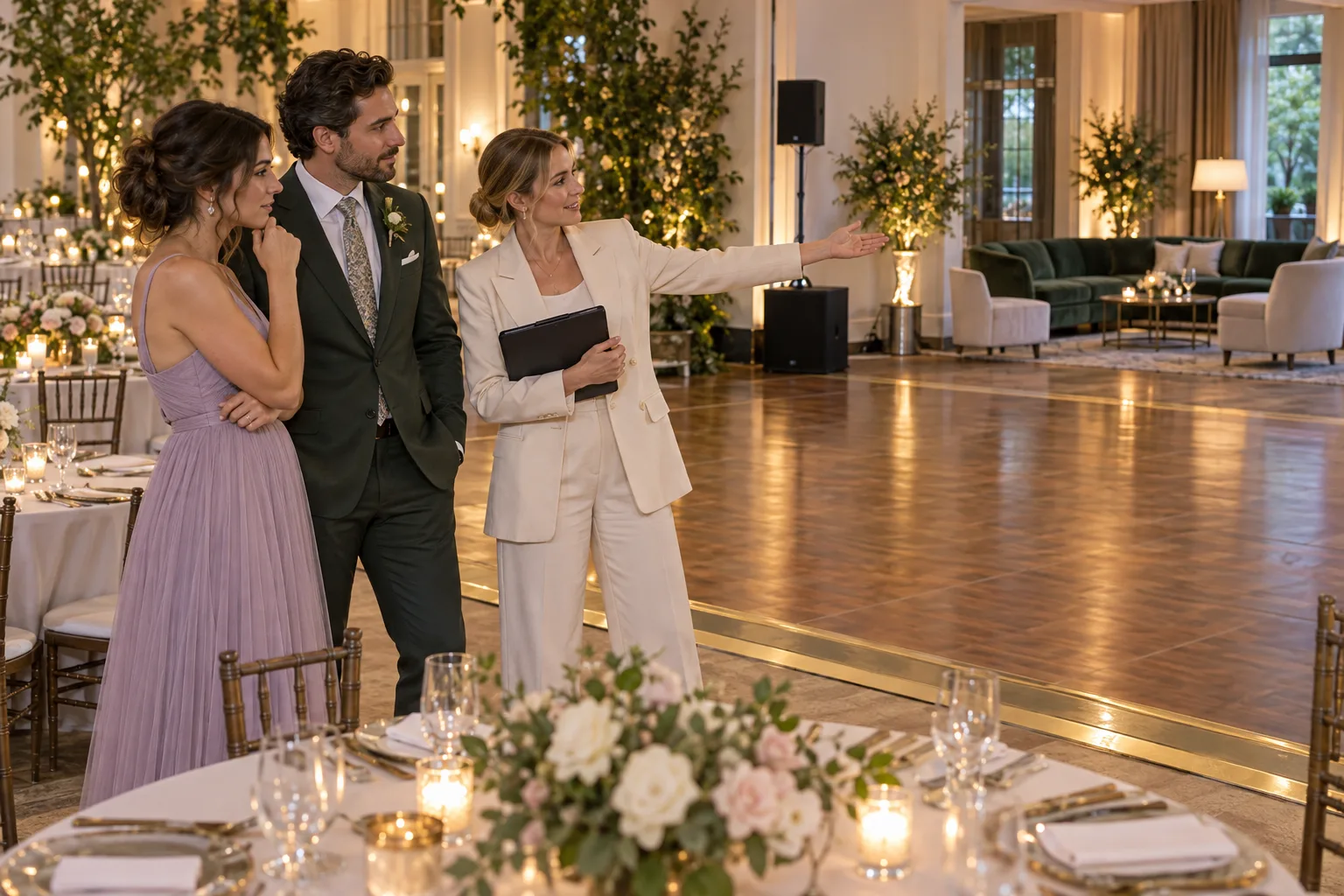
Ask about reception sound while the floor plan is still being drawn. Find out where the speakers will stand, where guests can talk away from amplified music and who can lower the volume during the evening. Put hearing protection and sound breaks into the plan before the first dance.
Count the whole evening of sound
The National Institute on Deafness and Other Communication Disorders explains that sound level, distance from its source and exposure duration all matter. Long or repeated exposure at or above 85 A-weighted decibels, or dBA, can cause hearing loss, with louder sound causing damage sooner. [1]
Do not use that number as a personal pass for an entire reception. Consider the ceremony music, cocktail-hour band, dinner amplification, dancing and after-party together. Tell the sound team how the event moves between spaces.
WHO's March 2026 guidance advises staying away from loudspeakers, using earplugs correctly and taking a ten-minute break in a less noisy place after each hour in a noisy environment. [2] Arrange somewhere people can actually go rather than leaving the break as an idea.
A guest may prefer less sound for reasons beyond hearing protection. Ask what arrangement would help and explain the choices available. You do not need to ask someone to prove why they want another seat.
Give the venue and music team the same brief
WHO's venue standard combines sound limits with monitoring, sound-system and acoustic design, hearing protection, places to rest from noise and staff information. [3] Treat those as connected planning questions.
Ask the DJ or band and venue to agree where the speakers go and how volume will be managed during dinner, speeches and dancing. Confirm who has control of the equipment if a guest or coordinator raises a concern.
Ask what monitoring equipment is used, where readings are taken and how the team responds. A measurement beside the sound desk does not describe every guest position, so ask about the tables and dance-floor areas too.
If the venue has a sound limiter, ask what it controls and how it relates to the event plan. Do not assume it addresses every sound source, such as acoustic instruments, a separate ceremony system or a special effect.
Put the agreed contact on the coordinator's running order. You should not have to locate a contract or negotiate the sound plan during your own dinner.
Do not turn a venue ceiling into a personal target
WHO's 2022 venue standard specifies a maximum average sound level of 100 dB LAeq, measured over fifteen minutes, alongside its other protective measures. [3] That is not a reason to request 100 dB throughout your wedding.
WHO's 2026 public guidance makes the exposure-time relationship explicit: its weekly listening table gives twenty minutes at 100 dB, compared with four hours at 90 dB. [2] These figures show why a loud setting's duration matters; they should not be turned into a countdown for how long each guest must remain on the floor.
Ask the sound professional to explain the measurement used and the operating plan for your room and audience. Decide how music can be enjoyable at a lower level, and confirm when the volume will be reduced for conversation.
Skip the idea that the party must grow louder with every hour. The final song does not need to be the highest-volume song.
Use the floor plan to provide choices
Mark speakers, dance floor, dinner tables, bar and the route to the break space on the same plan. Ask the venue to review seating near the sound system before assigning guests to those tables.
Keep the less noisy space open during dancing and make sure guests can reach it. Ask whether doors, music from another room or a nearby bar will change how it works. Check it during setup with the planned system in operation.
Tell ushers and coordinators where it is. Include clear directions in the guest information, and avoid placing all announcements exclusively in the loudest area.
If someone has requested communication support, coordinate it separately with them. A quieter seat does not automatically replace an interpreter, captions or a listening system. The venue-access guide covers those conversations.
Choose protection you can use comfortably
NIDCD describes foam plugs, pre-molded plugs, custom options and protective earmuffs. High-fidelity plugs reduce sound across pitches and may suit music listening. Fit and correct use determine protection; a noise reduction rating is not a promise for every wearer. [4]
Try your chosen protection before the wedding using its instructions. Check that you can put it in and remove it properly. If you cannot get a comfortable fit, ask a hearing professional about options instead of forcing the device.
NIDCD cautions against cutting foam plugs and says wearing earplugs should not hurt. It also warns that briefly removing protection in very loud surroundings can put hearing at risk. [4] Move to a less noisy place to have a conversation if you cannot communicate comfortably.
If supplying plugs for guests, choose an identified product with instructions, keep them easy to find and ask who replenishes the supply. A decorative basket at the far end of a closed room is not useful during dancing.
Tell guests where protection is available before the music starts. Allow people to bring their preferred devices. Do not ask them to remove protection for photographs or because it does not match the dress code.
Make a separate plan for children
NIDCD notes that plugs can be difficult to fit in children's ears and that protective earmuffs come in child sizes and are easier to use correctly, especially for young children. Hair, hats and glasses can interfere with an earmuff seal. [4]
Ask parents or carers what they plan to bring, and provide advance information about the room, music and break space. Do not assume an adult-size product from a guest basket fits a child.
For an infant or a child with particular hearing or medical needs, the parent can seek individual advice about attendance and protection. The host's practical job is to provide accurate information and workable choices, including leaving the loud area.
Use a phone reading as a prompt to act
NIOSH's Sound Level Meter app is free and available for iOS. Its stated accuracy is within ±2 dBA under its testing conditions, and meeting the cited Type 2 instrument requirements depends on a calibrated external microphone. NIOSH says it cannot currently verify Android-app accuracy across that device market. [5]
A guest's phone can help start a conversation about excessive sound. It does not replace the sound team's equipment, method and responsibility, or establish that the room is safe for every person.
If the sound feels excessive, move away, use appropriate protection and raise the concern with the named contact. Do not wait for a particular app result before leaving an uncomfortable setting.
Avoid calculating your exposure by simply subtracting a package rating from a phone reading. Ask the sound or hearing professional how protection and measurement apply to the situation.
Do not ignore a change in hearing
WHO advises hearing assessment for persistent ringing or difficulty following conversations. [2] Tell a clinician about the event, what you noticed and when it started. Do not conclude that repeated ringing after parties is harmless because it has improved before.
Sudden hearing loss is different from an ordinary follow-up question. NIDCD says to consider sudden deafness symptoms a medical emergency and see a doctor immediately. It may affect one ear and can occur with fullness, dizziness or ringing; waiting because you suspect wax or congestion can delay care. [6]
If hearing changes abruptly during the wedding or honeymoon, seek care at the time. Do not wait until you return home or try to resolve it by adding an ear-cleaning product.

Physical Book (No Download)
Bridegenic: The Glow-Up Guide for Brides on GLP-1s
$12.95 + Free Shipping
Order NowThis article provides general education, not a diagnosis or an individual treatment plan. Medication information refers to US sources. Talk with your prescriber, pharmacist or dermatologist about decisions for your care.
Read next
Family & FriendsWedding Venue Access: Plan the Whole Visit for Your Guests→Wedding WeekYour Wedding-Week Checklist: Food, Medicine and Named Handoffs→Sources
- Noise-Induced Hearing LossNIH National Institute on Deafness and Other Communication Disorders↩ Back to text
- Deafness and hearing loss: Safe listening, March 6, 2026World Health Organization↩ Back to text
- WHO hearing guidelines implemented at major arts festivalWorld Health Organization↩ Back to text
- Hearing Protectors, updated April 2025NIH NIDCD↩ Back to text
- Sound Level Meter App, February 2024CDC NIOSH↩ Back to text
- Sudden Deafness, updated September 2018NIH NIDCD↩ Back to text