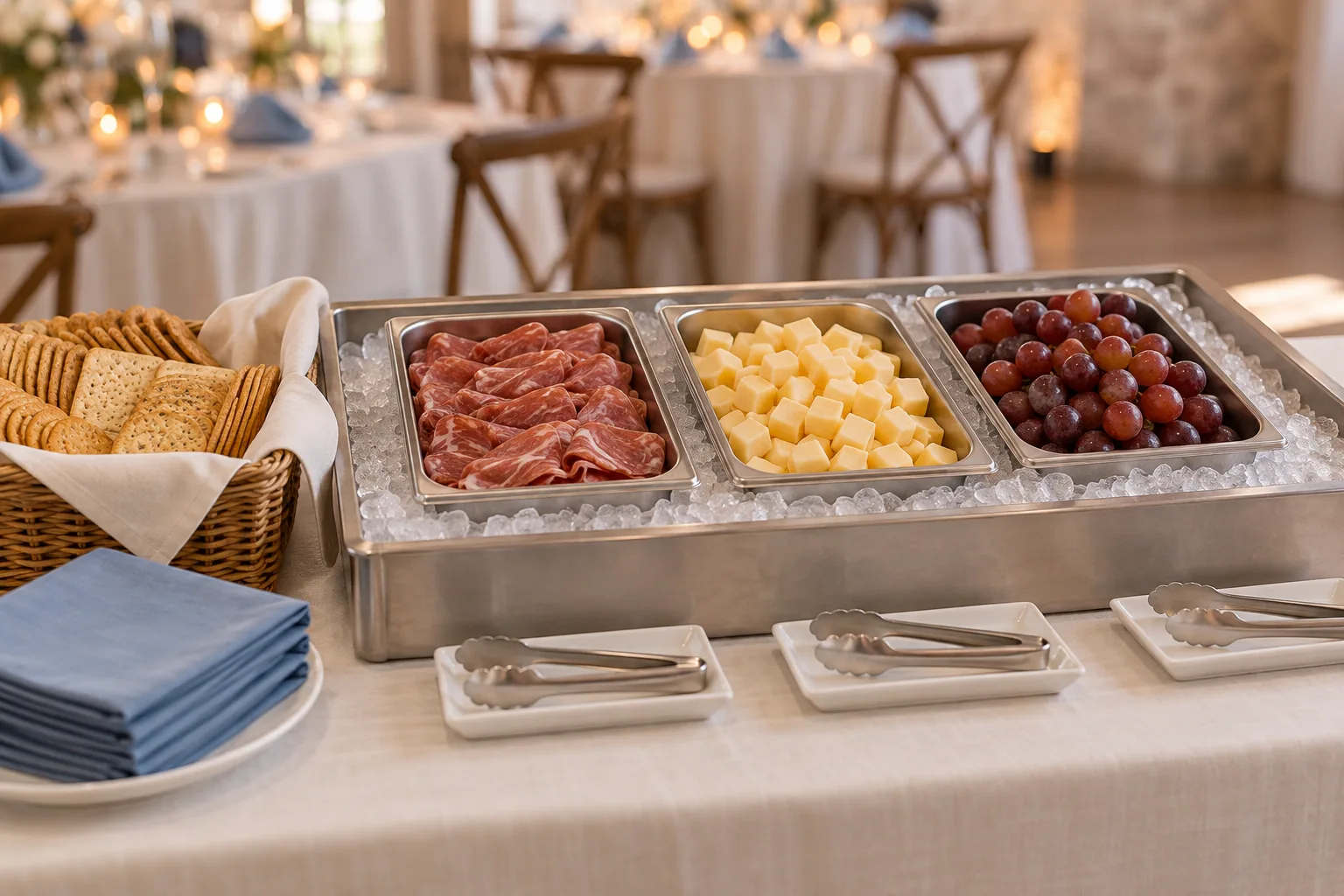
A grazing table can be laid out long before guests reach it: first the caterer finishes the arrangement, then the photographer takes a picture, then the ceremony runs late. Before approving the display, ask how its perishable foods will stay cold and who will replace or remove them. A photograph does not show the temperature history.
Identify the actual products on the table
Ask for a component list: the specific meats, cheeses, dips, fruit, crackers, spreads and garnishes. “Seasonal grazing table” is a style description, not enough information to assess storage, ingredients or a guest's dietary request.
USDA distinguishes uncooked from ready-to-eat sausages and explains that some dry sausages are shelf stable. Perishable products carry refrigeration instructions, and some shelf-stable sausages still require cooking. [1] Neither the word “cured” nor the absence of a refrigeration statement alone answers every handling question.
Ask the caterer to confirm that each meat is ready to eat and how it must be stored after opening and slicing. Keep the supplier's product information available. Do not use a general claim about dry salami to classify every deli meat or mixed platter as suitable for room-temperature service.
Request approval before substitutions. A different cheese, dip or sausage can change the ingredients and handling requirements after you have agreed on the menu.
Decide how cold holding will work
For a home buffet, FDA advises keeping cold foods at 40°F or below and refrigerated until service. It recommends small portions with fresh replacement dishes, rather than adding new food to an already filled dish. [2] Apply that practical approach to a family-hosted welcome party instead of covering an entire table hours ahead.
For professional catering, ask which local food rules apply. FDA's 2026 Food Code is a model offered for adoption by jurisdictions. Its general cold-holding provision for foods requiring time-and-temperature control is 41°F or below, with specified exceptions. [3] That professional framework is different from FDA's consumer buffet advice.
Have the caterer explain the equipment, transport and monitoring. Does the station use refrigerated equipment or an ice arrangement designed to keep the food cold? Where are replacement portions held? Who measures the food temperature and responds if the system fails?
Confirm that the venue has the agreed refrigerator space and power supply. If several vendors share a preparation room, establish who controls the storage area and when the grazing-table supplies can be delivered. An equipment plan is useful only if it can operate at the booked location.
Start the service clock before guests begin eating
FDA's home-buffet guidance says to discard perishables left at room temperature for more than two hours unless they are being kept hot or cold. Above 90°F, the period falls to one hour. [2] Include time out of temperature control during preparation, display and delays in the discussion rather than starting a fresh clock when the first guest takes a cracker.
A professional caterer proposing time instead of temperature control should explain the documented procedure allowed by the local rules. The model Food Code's time-control provisions include advance written procedures, initial-temperature conditions, time identification and required service or disposal. [3] “We always leave it out for four hours” is not that explanation.
Write the planned setup, opening and removal times into the event schedule. If the ceremony or speeches run late, assign someone to tell the catering lead. Agree in advance whether the display will open later, use replacement portions or close at its original removal time.
For a drop-off order, ask whether staffing and temperature control are included. If the supplier leaves after arranging the food, the host needs a clear handoff. Do not assume the venue coordinator has taken responsibility for an unstaffed board.
Refrigeration does not eliminate Listeria
CDC explains that deli meats, cheeses and prepared deli foods can carry Listeria, which can spread through equipment, surfaces, hands and food. Refrigeration does not kill it. Fermented and dry sausages can also become contaminated after processing; CDC's examples include salami, pepperoni, chorizo and summer sausage. [4]
Cold holding and pregnancy food choices need separate plans. A well-chilled board can still contain an item a pregnant guest has been advised to avoid. Do not describe everything on ice as suitable for every guest.
Ask guests to send dietary requirements through a private contact. They do not need to explain a pregnancy to the room or persuade a server at the table to redesign a shared display.
Offer a considered option for pregnant guests
CDC's pregnancy guidance lists unheated deli meat, cold cuts, hot dogs and fermented or dry sausages as riskier choices. Its safer choice is heating these meats to 165°F or until steaming hot. Refrigerated pâté and meat spreads also appear among the riskier choices. [5] A cold meat rose is not an equivalent substitute for a properly prepared alternative.
Cheese choices need detail too. CDC lists unheated deli-sliced cheese and queso fresco-type cheeses, including versions made with pasteurized milk, among riskier choices. Its safer options include pasteurized hard cheeses such as Cheddar or Parmesan, and pasteurized cottage cheese, cream cheese, feta and mozzarella. It also lists deli-sliced cheeses and pasteurized soft cheeses heated to 165°F or until steaming hot among safer choices. [5]
Ask the caterer to propose a specific alternative using the guest's requirements and current guidance. That might be a separately prepared plate with suitable ingredients or a freshly cooked option. Confirm the preparation, holding and service method; moving items from the shared board onto a separate plate does not change their history.
Provide the same route for any other guest with an individual care plan. Keep the arrangement in the catering notes and tell the service lead which plate goes where without announcing medical details.
Treat ingredient questions separately from the display design
Milk, wheat, tree nuts, peanuts, soy and sesame are among the nine major U.S. food allergens identified by FDA. [6] A grazing table may contain several across cheese, crackers, breads, dips and toppings. Ask for ingredient information for the products being served, including replacements.
Discuss the guest's allergy with the catering lead before deciding whether a shared station is suitable. Agree on separate preparation and utensils where needed, and how staff will identify the intended plate. A card reading “nuts on the left” does not explain how the food was prepared or handled.
Keep serving utensils with their assigned foods and name a staff member to replace utensils that are moved or dropped. Link this plan to the broader food-allergy catering handoff.

Physical Book (No Download)
Bridegenic: The Glow-Up Guide for Brides on GLP-1s
$12.95 + Free Shipping
Order NowThis article provides general education, not a diagnosis or an individual treatment plan. Medication information refers to US sources. Talk with your prescriber, pharmacist or dermatologist about decisions for your care.
Read next
Food & EnergyWedding Reception Leftovers: Cooling, Collection and Transport→Food & EnergyFood Allergies at Your Wedding: The Caterer, Kitchen and Serving Handoff→Sources
- Sausages and Food Safety, February 10, 2025USDA Food Safety and Inspection Service↩ Back to text
- Serving Up Safe BuffetsU.S. Food and Drug Administration↩ Back to text
- 2026 Food Code: Sections 3-501.16 and 3-501.19U.S. Food and Drug Administration↩ Back to text
- How Listeria Spreads: Deli Foods and Prepared Meats, August 11, 2024Centers for Disease Control and Prevention↩ Back to text
- Safer Food Choices for Pregnant Women, January 31, 2025Centers for Disease Control and Prevention↩ Back to text
- Food Allergies: What You Need to KnowU.S. Food and Drug Administration↩ Back to text