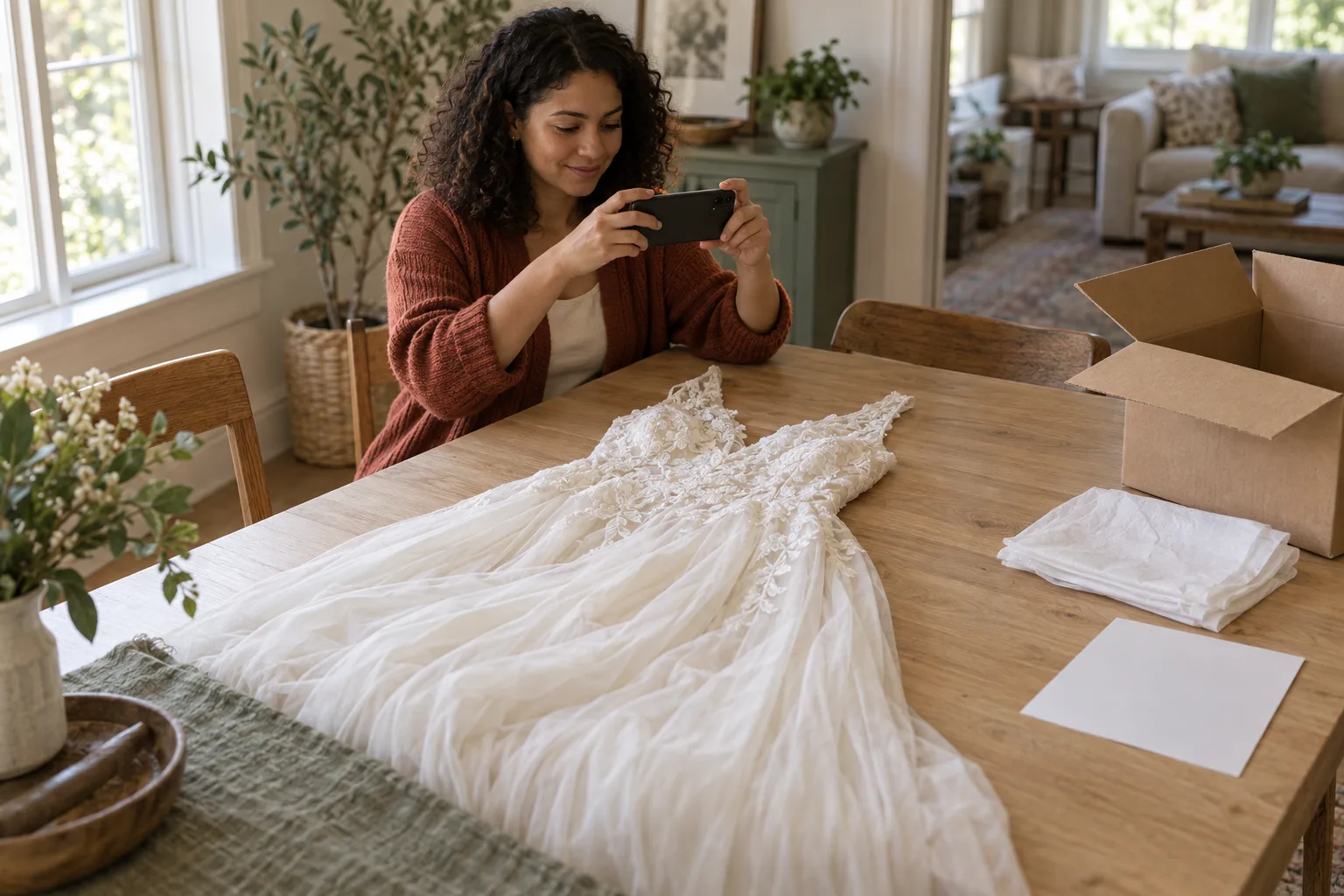
Before sending your wedding dress to a charity, check what the organization accepts and what it will do with the gown. Then prepare the handoff and any tax records while you still have the dress. A parcel tracking number, an original purchase receipt and a charity acknowledgment each document something different.
Choose the destination by what happens to the dress
Ask whether the organization resells donated gowns to raise money, gives them to selected recipients or uses the materials for another purpose. Decide which use you want to support before sending an item you cannot retrieve.
Brides for a Cause, for example, collects and resells wedding dresses to support charity. Its individual-donation page currently accepts gowns five years old or newer and says it is not accepting older or vintage dresses. It accepts worn, unworn, altered and sample gowns without a condition requirement. [1]
Those are that organization's rules as checked on October 16, 2026. They are not a universal age limit. For a different recipient, read its current donation page and ask about any uncertainty before making arrangements.
List the designer, style if known, purchase year, approximate gown age, label size and alterations. Add clear photographs of the full dress and any stains, tears or missing pieces. If you do not know the age, say so rather than presenting the wedding date as the manufacture date.
Ask about cleaning and packing before spending money
Brides for a Cause asks donors to include its completed donation form. Its page says clean gowns are appreciated but it can handle cleaning; an optional monetary contribution is not required. Dresses can be mailed or dropped off during store hours. [1]
Another recipient may require cleaning or approval first. Confirm its instructions, current delivery address, drop-off hours and the items it will take. A veil, detachable sleeves and a garment bag should each be checked rather than added because they were purchased together.
If cleaning is needed, give the cleaner the fabric and care information available and explain the destination's requirements. Do not make an expensive preservation purchase simply because you are donating. Ask the recipient what packaging it can receive and how it wants the gown prepared.
Before closing the parcel, photograph the gown and the included accessories. Keep a copy of the donation form and your contact details. Save the shipping record, then confirm receipt through the organization's stated process. Delivery tracking alone does not establish every tax requirement.
Check the recipient and the 2026 tax rules separately
For U.S. federal tax purposes, contributions must go to a qualified organization. A gift to an individual is not deductible, even when you want to help that person. The IRS directs donors to its Tax Exempt Organization Search to check organizations. [2] Use the recipient's legal name and identifying information, not only a familiar shop name.
A dress is a noncash contribution. The deduction introduced in 2026 for eligible cash gifts by people who do not itemize does not cover a donated gown. The IRS also identifies a new 2026 floor for itemizers: charitable contributions are deductible only to the extent they exceed 0.5% of adjusted gross income, with other limitations applying. [3]
Have your preparer consider the year's contributions together. Do not subtract that percentage separately from each dress or assume a donation receipt guarantees a tax saving. Keep your decision to give separate from an unconfirmed estimate of the deduction.
Document the gown's value on the donation date
IRS Publication 561 says used clothing is usually worth substantially less than its purchase price and has no fixed valuation formula. Prices buyers actually pay for comparable used clothing can help establish fair market value. [4]
Keep the original purchase information, but also record the gown's current condition, age, alterations and the evidence used for your valuation. Save dated comparable sales where available and explain important differences. An asking price for an unworn designer sample does not establish what a stained, shortened gown would sell for.
Brides for a Cause states that it cannot value your donation or provide tax advice. [5] Its shop pricing is not an automatic percentage to apply to your original bill. Ask your preparer how to document a defensible amount rather than asking a charity volunteer to approve a number.
Check before handoff if a qualified appraisal might be needed. The appropriate professional may need information about the garment that will be harder to collect once it has been sold or passed on.
Match the paperwork to the claimed deduction
For a contribution of $250 or more, the required written acknowledgment identifies the organization and describes the donated property without assigning its value. It must also address whether the charity supplied goods or services in return and, where applicable, describe and estimate them. [6]
Request the acknowledgment promptly and check its details. A form you filled in yourself should not be assumed to satisfy the charity's acknowledgment requirements.
IRS Publication 526 sets out these additional requirements:
- The acknowledgment must reach you by the earlier of the date you file the relevant return or its filing due date, including extensions.
- If your total claimed deduction for all noncash contributions for the year exceeds $500, Form 8283 is required.
- A deduction over $5,000 for an item or group of similar items generally requires a qualified appraisal and Section B of Form 8283. Similar items given to different organizations still count together. [7]
Include other clothing donations when reviewing the applicable grouping. Do not decide that the appraisal threshold is irrelevant by considering the gown alone.
Acceptance of a damaged gown does not settle deductibility
For a clothing deduction, the IRS generally requires good used condition or better. A special exception applies to a single item below that standard when the claimed deduction exceeds $500 and a qualified appraisal is attached to the return, together with Form 8283. [4]
That exception does not make every damaged dress worth more than $500. Discuss both condition and value with your preparer. Do not conceal a tear or cleaning problem because the charity is willing to receive the gown.
Keep the acceptance instructions, photographs, valuation evidence, acknowledgment and any forms together. Chapter 12 of Bridegenic recommends recording a decision, who confirmed it and where its instructions are kept. Apply that method here: name the recipient, the person handling delivery and the place your donation records will be stored.

Physical Book (No Download)
Bridegenic: The Glow-Up Guide for Brides on GLP-1s
$12.95 + Free Shipping
Order NowThis article provides general education, not a diagnosis or an individual treatment plan. Medication information refers to US sources. Talk with your prescriber, pharmacist or dermatologist about decisions for your care.
Read next
Dress & Fittings7 Checks Before Ordering a Wedding Dress Online→Dress & FittingsWedding Dress Cleaning and Storage: The Handoff After the Celebration→Sources
- Individual Donations: Wedding DressesBrides for a Cause↩ Back to text
- Topic 506: Charitable ContributionsInternal Revenue Service↩ Back to text
- Publication 505 (2026): New Charitable Contribution RulesInternal Revenue Service↩ Back to text
- Publication 561: Determining the Value of Donated PropertyInternal Revenue Service↩ Back to text
- Frequently Asked Questions: Donation ValuationBrides for a Cause↩ Back to text
- Charitable Contributions: Written AcknowledgmentsInternal Revenue Service↩ Back to text
- Publication 526 (2025): Noncash Records and ReportingInternal Revenue Service↩ Back to text