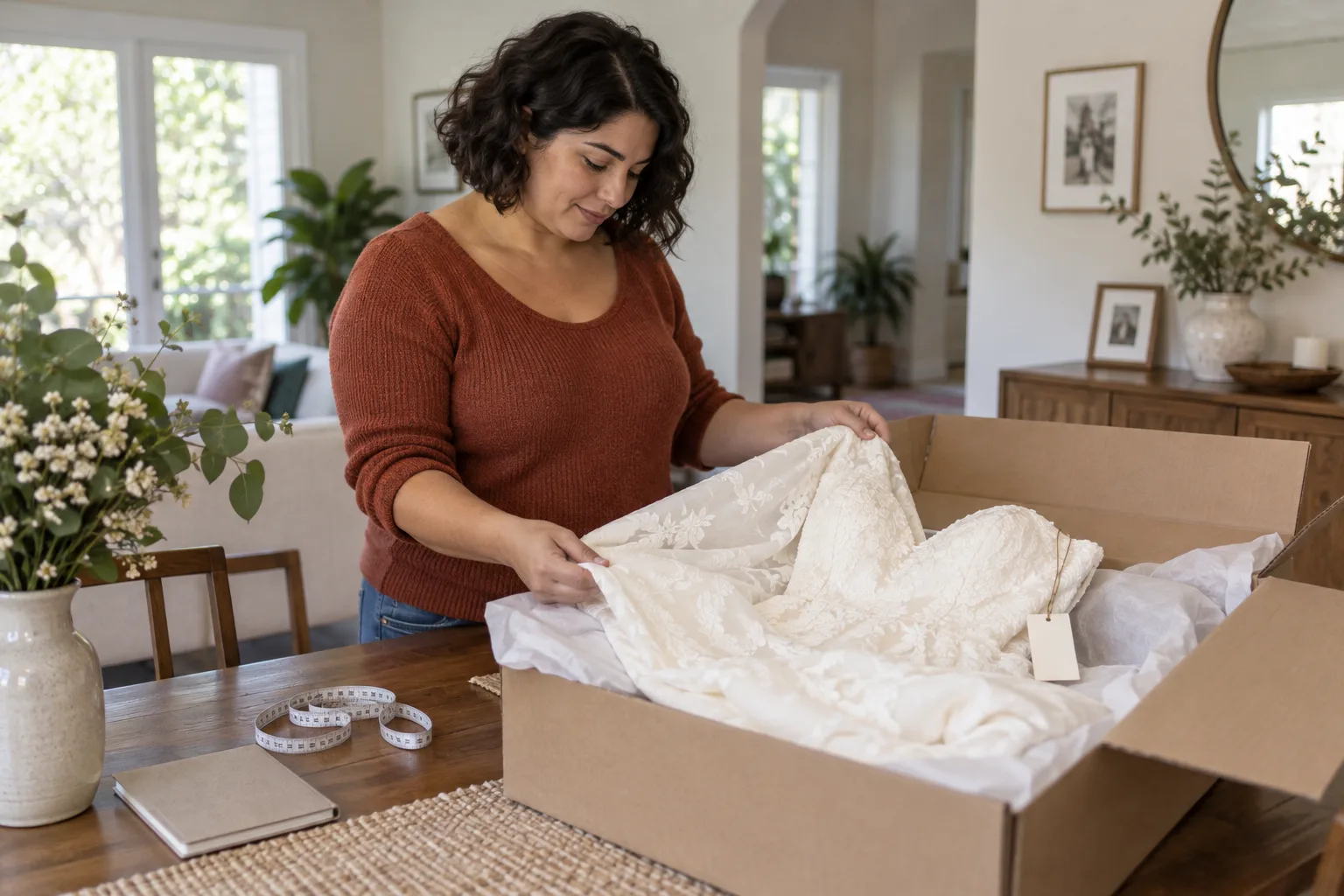
Before ordering a wedding dress online, save more than the inspiration photograph. You need the exact style, measurements, order terms and promised shipment date, plus enough time for inspection and any alterations. A lower dress price can be difficult to compare if return shipping, rush charges or fitting work remain unknown.
1. Identify the seller behind the listing
Record the business name, website, contact information and the party taking payment. If using a marketplace, distinguish the platform from the individual seller. Ask who handles a cancellation, wrong item or return.
FTC advises checking reviews across several sources and searching a seller’s name with terms such as “complaint” or “scam.” It warns that an encrypted website does not prove a business is legitimate. [1]
Compare the contact details across the listing, checkout and order confirmation. Ask about a designer authorization claim through the designer’s own contact route if that claim is part of your buying decision. A photograph appearing on several sites does not tell you which seller will supply the pictured garment.
For a sample, preowned or altered dress, ask for photographs and a written description of that particular item. Specify which measurements, repairs, missing pieces or marks you need explained before payment.
2. Understand what the sizing option changes
Use the instructions and size chart for the exact seller and style. Ask whether the chart describes body measurements or finished-garment measurements, which undergarments to wear while measuring and how any shoe allowance is handled.
Azazie’s sizing FAQ, updated July 21, 2026, illustrates one distinction: its standard sizes include comfort ease, while custom sizing uses the measurements supplied at checkout. It warns against entering a standard size’s chart measurements as a custom order because the proportions and ease can differ. [2]
That is a retailer-specific explanation, not a universal rule for custom clothing. Ask your seller what its service includes, whether a fitting is part of the process and how it handles measurement errors or later changes.
If your body measurements are changing, discuss the ordering and alteration schedule with the seller and an alterations professional. Do not order for a predicted weight or plan to restrict food to fit the gown. The dress-fitting timeline helps separate garment decisions from medical treatment decisions.
3. Confirm the garment and care details in writing
Save the style number, color, size, length and any custom choices. Ask whether the order includes the photographed sleeves, lining, straps, overskirt or other detachable pieces. Request a swatch if color or fabric feel is central to the decision, and ask what it represents.
FTC’s textile-label guidance says most covered products need information identifying fiber content, country of origin and the manufacturer or another responsible business. [3] Ask for those details rather than inferring the fiber from a photograph or a descriptive style name.
Ask for the care instructions before ordering if cleaning or preparation could affect your plans. FTC’s care-label guidance addresses garment instructions and warnings, including the suitability of the whole garment rather than only its separate components. [4]
Bring those instructions to the alterations and garment-care discussions. Do not assume a method suitable for an unembellished fabric is suitable for attached beads, trims or adhesives. Keep any included care information with the gown after delivery.
4. Separate production, shipment and arrival dates
Ask for three dates: when production is expected to finish, when the parcel is promised to ship and when it is expected to arrive at your address. Confirm which promise a rush fee changes. A faster delivery service cannot shorten production time unless the seller also agrees to that change.
Under FTC’s prompt-delivery guidance, sellers generally must have a basis for the shipment time advertised, or for shipment within 30 days if no period is stated. If they cannot ship on time, they must provide a delay notice, revised date and cancellation/refund option. [5]
This is not a requirement that every made-to-order gown arrive within 30 days despite a longer disclosed shipment period. Save the promise attached to your order, including the date it was made. A general banner on the homepage may change later.
Ask what happens if the revised date leaves too little time for alterations. Keep any response and your decision about a delay. Do not assume a conversation about your wedding date has changed the seller’s written shipping commitment.
5. Read the policy for this exact order type
Check cancellation deadlines, eligible return reasons, required condition, tags, return authorization, shipping costs, fees and refund method. Find out whether a deadline means requesting a return, posting the parcel or delivery back to the seller.
Azazie’s cited FAQ says its custom-size dresses are nonreturnable. [2] Read the current policy for your location and item, and ask separately about an incorrect or faulty order. A seller’s change-of-mind policy should not be treated as a complete description of all applicable consumer remedies.
FTC says its federal Cooling-Off Rule does not cover purchases made entirely online, by mail or by telephone. [6] Do not assume that buying a dress online automatically includes a three-day period to change your mind.
Save the policy before checkout and compare it with the confirmation. If the terms are unclear, obtain the answer before ordering. “Returns accepted” is incomplete without the conditions and the amount you would actually receive.
6. Reserve time and money for a professional assessment
Ask an alterations professional whether they can assess that kind of gown and what information they need before offering an estimate. Share the expected arrival date, wedding or departure date, garment photographs and any proposed changes.
Discuss the work by task: hem, bodice, straps, sleeves, bustle and any structural changes. Ask which decisions require the physical gown. Do not assume every design can be enlarged, shortened or reshaped by the same amount.
Keep alteration costs separate from the dress price when comparing options. Include any additional fitting travel, pressing, delivery or return expense that applies to your plan. Ask what happens if the gown arrives after the reserved appointment.
After delivery, inspect the item and resolve any return or defect question before authorizing alterations. Follow the seller’s conditions during a permitted try-on, and keep tags and packaging while deciding. Use the movement check from Chapter 12 at the fitting: sit, walk, turn and test the intended shoes and undergarments.
7. Keep a payment and problem-reporting record
Save the listing, selected options, measurements, terms, receipt, shipment promise, tracking and messages in one folder. Photograph the delivered item and any issue while it remains in the condition received. Describe the problem to the seller with the order number and the remedy you are requesting.
CFPB advises reporting a credit-card billing problem promptly and sending a written billing-error notice within 60 calendar days after the charge appeared on the statement. It notes that disputes about defective goods may require a different process. [7]
For a gown ordered months ahead, ask the issuer about its process before paying. FTC explains that a promised future delivery can fall beyond the ordinary 60-day period; some issuers may extend the period for delayed shipments. Contact the issuer even if time has passed and supply the delivery promises. [8]
Do not treat that as a guaranteed refund or assume debit cards have identical protections. FTC distinguishes disputes over goods not delivered or accepted as agreed from disputes about the quality of an accepted item. [8] Explain the facts accurately and ask which process applies.
Keep following the seller’s return instructions where applicable while checking the issuer’s deadlines. A long customer-service exchange should not be your reason for waiting to ask about payment protections.

Physical Book (No Download)
Bridegenic: The Glow-Up Guide for Brides on GLP-1s
$12.95 + Free Shipping
Order NowThis article provides general education, not a diagnosis or an individual treatment plan. Medication information refers to US sources. Talk with your prescriber, pharmacist or dermatologist about decisions for your care.
Read next
Dress & FittingsWedding Shapewear: Test the Fit Before the Final Alterations→Dress & FittingsDress Fittings on a GLP-1: A Calm Plan for a Dress That Fits on the Day→Sources
- Online ShoppingFederal Trade Commission↩ Back to text
- What Is the Difference Between Standard and Custom Sizing?, updated July 21, 2026Azazie↩ Back to text
- Threading Your Way Through the Labeling Requirements Under the Textile and Wool ActsFederal Trade Commission↩ Back to text
- Clothes Captioning: Complying With the Care Labeling RuleFederal Trade Commission↩ Back to text
- Selling on the Internet: Prompt Delivery RulesFederal Trade Commission↩ Back to text
- Buyer’s Remorse: The FTC’s Cooling-Off Rule May Help, September 2025Federal Trade Commission↩ Back to text
- How Do I Dispute a Charge on My Credit Card Bill?, reviewed April 15, 2024Consumer Financial Protection Bureau↩ Back to text
- What To Do if You Are Billed for Things You Never Got, August 2022Federal Trade Commission↩ Back to text