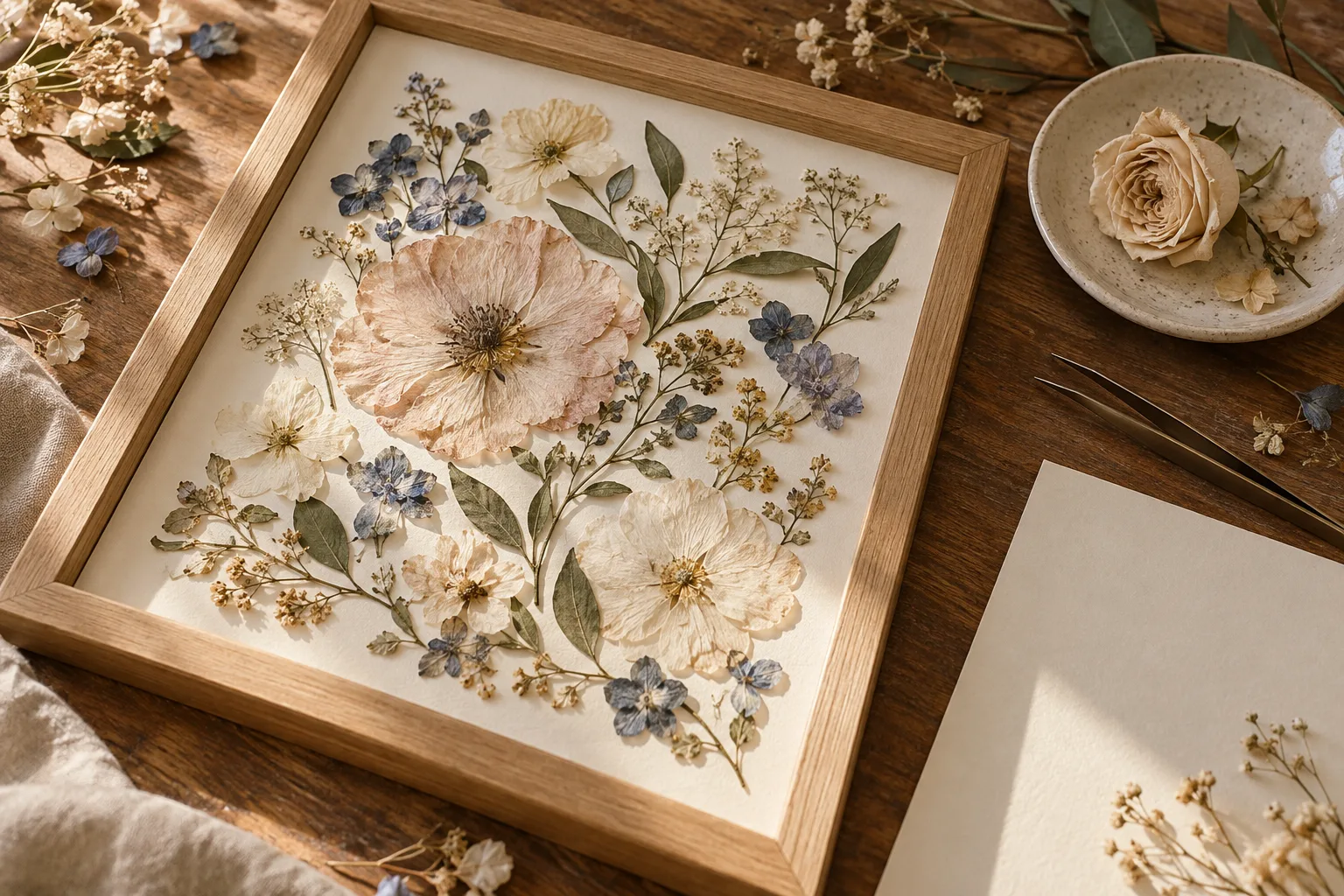
Choose a bouquet-preservation method while there is still time to discuss the flower list. A flat pressed picture, a dried arrangement and a three-dimensional display use the flowers differently. The decision also affects who takes the bouquet after the reception and what instructions that person needs.
Choose the object before the preservation technique
Decide where the finished piece will live and how much of the bouquet you want included. A framed selection of petals may serve a different purpose from a display that keeps the outline and height of several flower heads. Measure the intended shelf or wall before selecting a frame or container.
Ask whether the maker will preserve the entire bouquet, selected blooms or petals taken apart and rearranged. Confirm what happens to unused stems, ribbon, pins, charms and any family keepsake attached to the handle. If an object must be returned, identify it in the order and photograph it before handoff.
For a framed piece, request the outer dimensions and the visible artwork dimensions. Ask whether the design will be symmetrical, scattered or shaped like the original bouquet, and whether you can approve a layout before it is fixed in place.
If you prefer a resin object, ask the maker how the flowers are dried before inclusion, what color changes to expect and what the care and warranty terms cover. The drying methods below explain the plant material; they do not establish a particular resin product's lifespan.
Pressing suits a flat composition
University of Missouri Extension says flowers that are already flat, such as pansies, press best. It advises using material in good condition and avoiding wilted flowers and fleshy stems or leaves. Pressing holds flowers between clean absorbent layers while they dry. [1] This is a different goal from keeping a rose's original three-dimensional shape.
The Royal Horticultural Society identifies pansies, primroses and small leaves as suitable choices for pressing. [2] Show the maker your bouquet recipe and ask which components will be pressed whole, separated or represented by individual petals.
New York Botanical Garden gives a general pressing period of one to three weeks. [3] Treat that as a drying range, not a promise that a framed commission will be delivered within three weeks. Design, approval, mounting, framing and the maker's workload need their own timetable.
If you want to try pressing at home, practice on spare flowers of the same kind before using irreplaceable blooms. Decide what portion you are willing to experiment with. Keep the maker's flowers separate from the practice material if you have booked professional preservation.
Air drying and desiccants produce different results
RHS lists statice, grasses, yarrow, poppy seedheads and sunflowers as options for air drying. It describes hanging stems upside down in low light with good ventilation, usually for two or three weeks, with variation according to moisture content. [2] Ask whether the flowers in your bouquet suit that method instead of assuming every tied bouquet will dry evenly.
For blooms that need support while losing moisture, a desiccant surrounds the flower. Missouri explains that this can help maintain form compared with air drying. RHS identifies roses, peonies and hellebores as flowers that can be preserved using silica gel. [1] [2]
New York Botanical Garden notes that air drying can shrivel larger fragile blooms and gives a general desiccant-drying range of two to seven days. [3] Flower thickness, condition, method and environment affect the work. Ask the maker what they propose for your exact flowers and why.
Freeze-drying is another option. Missouri describes it as a process using freezing and a vacuum to remove moisture by sublimation, requiring specialized equipment and professional handling. [1] If this is the service advertised, confirm that the order actually includes freeze-drying rather than a different drying method described loosely.
Discuss color change with examples of the same flowers
Missouri notes that colors often darken as flowers dry: very dark reds, purples and blues may look nearly black, while whites often become cream or tan. It also warns that existing damage becomes more obvious after drying. [1] Ask for examples showing the fresh flower and the finished preserved version.
Compare the same flower type and a similar starting color. A preserved blush rose does not demonstrate how a dark burgundy dahlia or white orchid will look. Ask whether the maker uses color correction, paint or other additions, whether those are optional and how they will be recorded in the order.
Decide whether your priority is using the original flowers, preserving a particular color impression or keeping a recognizable bouquet shape. If the maker cannot deliver all three as you imagine them, resolve that before handing over the flowers.
Keep an unfiltered photograph of the bouquet for reference. Include a close view of any especially meaningful bloom and the ribbon arrangement, rather than expecting the maker to identify those details from a distant portrait.
Assign delivery before leaving for the honeymoon
Give one person responsibility for collecting the bouquet at the agreed time. Put their name, contact details, the maker's address, receiving hours and booking reference into the wedding handoff notes. Tell the venue and florist that these flowers are reserved.
Get the maker's instructions for the period before delivery: whether to leave the bouquet tied, how to maintain it while fresh, what packaging to use and how to protect it in transit. Ask for the latest acceptable arrival and the response if the wedding runs late or the delivery service is delayed.
Do not add hairspray, lacquer or another treatment unless it is part of the agreed method. Do not begin pressing flowers destined for a three-dimensional service without asking. The maker needs to know what has already been done to the material.
If you are doing the drying yourself, prepare the space and supplies before the wedding. University of Florida Extension advises a cool, dry, ventilated location for air drying and warns against placing flowers in a warm oven or in front of electric heaters to speed it up. [4] A hurried first attempt the morning after the reception leaves little room to correct mistakes.
Write down the work and completion terms
Request an itemized order identifying the flowers received, method, finished size, frame or container, design approvals, return of unused material and collection or shipping charges. Ask what happens if particular flowers arrive damaged or prove unsuitable.
Confirm the expected completion period and how updates will be sent. Distinguish an estimate from a guaranteed date, and ask about the cancellation, refund and damage-in-transit terms. If extra flowers or replacement material may be added, agree on that explicitly rather than discovering it in the finished piece.
Choose a delivery address where someone can receive the completed work. If your honeymoon or move overlaps the estimated finish date, ask about storage and rescheduling before shipping is booked.
Get care instructions for the finished piece
RHS advises keeping dried displays out of direct sunlight and away from moist rooms such as bathrooms, where mold can develop. [2] Ask the maker how that applies to your frame, enclosed display or other finished object.
UF/IFAS describes gentle dust removal with a soft brush for dried materials. [4] A loose dried arrangement and a sealed object may need different care, so use the instructions for the finished format rather than spraying or wiping exposed petals experimentally.
Keep the care sheet, maker's contact and order photograph together. If a petal loosens or moisture appears inside a display, ask about repair before opening or modifying the piece yourself.
Physical Book (No Download)
Bridegenic: The Glow-Up Guide for Brides on GLP-1s
$12.95 + Free Shipping
Order NowThis article provides general education, not a diagnosis or an individual treatment plan. Medication information refers to US sources. Talk with your prescriber, pharmacist or dermatologist about decisions for your care.
Read next
PlanningWedding Bouquet Care: Delivery, Water and Storage→Honeymoon & BeyondWedding Photo Prints: Frames, Albums and Storage→Sources
- Drying Flowers and Foliage for Arrangements, G6540University of Missouri Extension↩ Back to text
- How to Dry Flowers and FoliageRoyal Horticultural Society↩ Back to text
- How Can I Dry Flowers?, April 20, 2021New York Botanical Garden, Mertz Library↩ Back to text
- Drying and Preserving Plant Materials for Decorative Uses, revised January 2024University of Florida IFAS Extension↩ Back to text