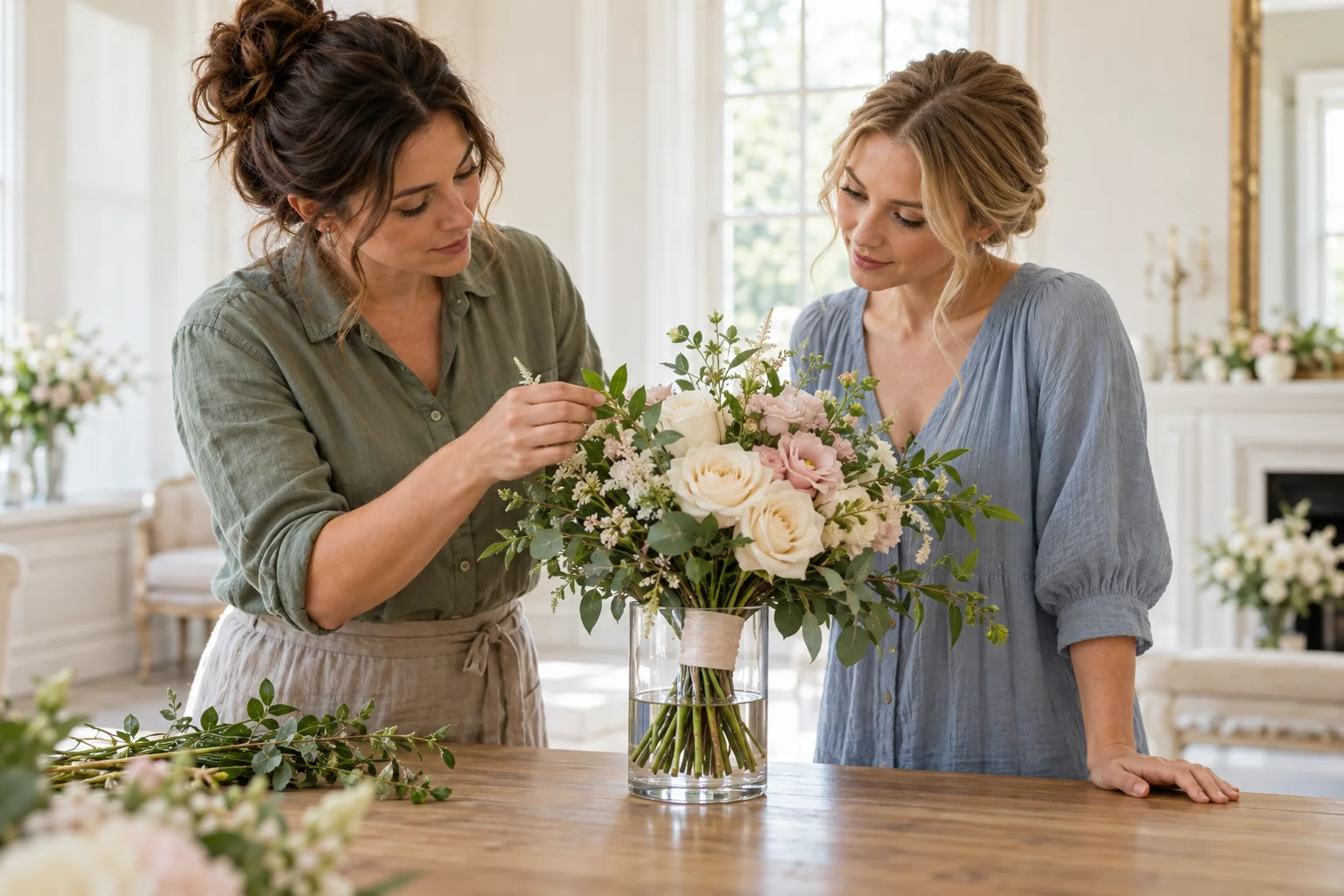
Your bouquet may arrive while makeup is underway, travel to a second location for portraits and wait through a ceremony rehearsal. Decide where it will stand between those appointments before delivery day. A vase, an agreed storage room and a named helper give the flowers a place to go whenever you put them down.
Arrange the handoff before the florist arrives
Put four details on the delivery record: arrival window, room, receiving person's name and florist's contact number. Add the first time the bouquet is needed. If portraits begin at 12:30 and the ceremony is at 4:00, give the florist both times when discussing delivery and flower selection.
Ask whether the bouquet arrives in its own vase, whether that vase must be returned and which wrapping should stay in place. Find out whether it has exposed stems, a bouquet holder or another construction. Instructions for a loose bunch cannot automatically be applied to a wired or glued design.
Have the receiving person inspect the bouquet with the delivery team. Check the intended colors and flowers against the order, then look for broken stems, crushed blooms or a leaking container. Take a photograph and raise concerns while the florist can advise. Agree in advance who can approve a substitution or repair if you are dressing.
Give exposed stems a suitable water supply
For loose cut flowers, Iowa State University Extension advises using a clean, sturdy vase, keeping submerged foliage out of the water and ensuring the stems can reach water. Replace water when it becomes cloudy or runs low. Its guidance favors commercial floral preservative; if none is available, clean water without additives is the next choice. Aspirin, pennies and household mixtures do not perform as well and some can shorten vase life. [1]
For a finished bridal bouquet, ask the florist to show the water line on the supplied container. Confirm how to keep the ribbon and decorative handle dry while the cut stem ends remain in water. Have the helper check that level after each return from photographs. These are handoff questions, not instructions to dismantle the binding or trim a finished arrangement.
If the florist supplies flower food, request the product directions and correct quantity for the vase. Keep the packet with the flower supplies so the person replacing the water can find it. Do not assume that a sachet belongs in every container regardless of volume.
Check the flowers before choosing a refrigerator
Mississippi State University's professional florist manual gives 33 to 38°F (1 to 3°C) as a storage range for most floral crops, but identifies tropical exceptions. It recommends 50 to 55°F (10 to 12°C) for flowers such as anthuriums, birds of paradise and ginger. Those figures describe professional storage guidance, not a universal thermostat instruction for your mixed bouquet. [2]
The same manual warns that beverage coolers can dry flower tissues through their fan systems and advises keeping food, including fruit, separate from cut-flower coolers. [2] A hotel minibar or catering refrigerator therefore needs more discussion than whether the bouquet fits inside.
Send the florist the proposed storage arrangement before collection. Ask whether a cool indoor room will suit the waiting period, whether professional storage is needed overnight and whether later delivery would be preferable. If the venue offers a cooler, ask who manages it and let the florist confirm its suitability. Do not change a food-storage thermostat to accommodate flowers.
Allow preparation time for flowers you arrange yourself
Conditioning means preparing cut flowers before arranging them. The Royal Horticultural Society recommends clean, sharp cutting tools, removal of foliage below the water line and a clean angled cut. It advises standing prepared stems in clean water in a cool place for at least two to three hours, ideally overnight, before bringing them into a warmer setting. [3]
Include that preparation period when ordering bulk stems or collecting garden flowers. A morning collection followed immediately by assembly and outdoor portraits leaves little time for the conditioning described in the guidance. Ask the supplier when to collect and how open the flowers should be for your wedding date.
The RHS also notes that tightly picked roses and dahlias may fail to develop fully, and discourages hammering woody stem bases because it can increase bacterial infection. [3] Ask about the species you bought instead of applying every flower-care trick to the entire order. Plan a practice arrangement with the same types of flowers if you want to learn how they handle.
Plan where the bouquet goes between photographs
Ask the coordinator and photographer to identify a holding spot at each location. That might mean the supplied vase on a stable indoor table, with the florist's instructions beside it. Put someone in charge of returning the bouquet there during breaks.
For a transfer, request packaging that supports the vase and protects the blooms. Confirm who loads, carries and unloads it, and where the container will stand on arrival. Avoid making the bride carry a bouquet, dress, phone and open vase through a parking lot at once. Have the driver and helper agree on the arrangement before departure.
Discuss the outdoor portrait sequence with the florist if heat or cold is expected. Request a plan for the flowers actually selected, including what to do if a stem droops or a bloom is damaged. Photograph the problem and call before trying a hot-water treatment, soaking the flower heads or spraying a finished design.
Chapter 13 of Bridegenic puts a person's name beside each practical task. Apply that approach here: one person receives the bouquet, knows its holding location and brings it to the next appointment. If that person is also in the photographs, assign the next handoff.
Physical Book (No Download)
Bridegenic: The Glow-Up Guide for Brides on GLP-1s
$12.95 + Free Shipping
Order NowThis article provides general education, not a diagnosis or an individual treatment plan. Medication information refers to US sources. Talk with your prescriber, pharmacist or dermatologist about decisions for your care.
Read next
PlanningSix Wedding Candle Centerpiece Checks Before You Buy→Wedding WeekYour Wedding-Week Checklist: Food, Medicine and Named Handoffs→Sources
- How to Harvest, Condition, and Care for Cut Flowers, reviewed January 2025Iowa State University Extension and Outreach↩ Back to text
- The Professional Florist’s Manual for the Care and Handling of Fresh-Cut Flowers and Foliage, pages 21–22Mississippi State University Extension↩ Back to text
- Cut Flowers: Cutting and ConditioningRoyal Horticultural Society↩ Back to text