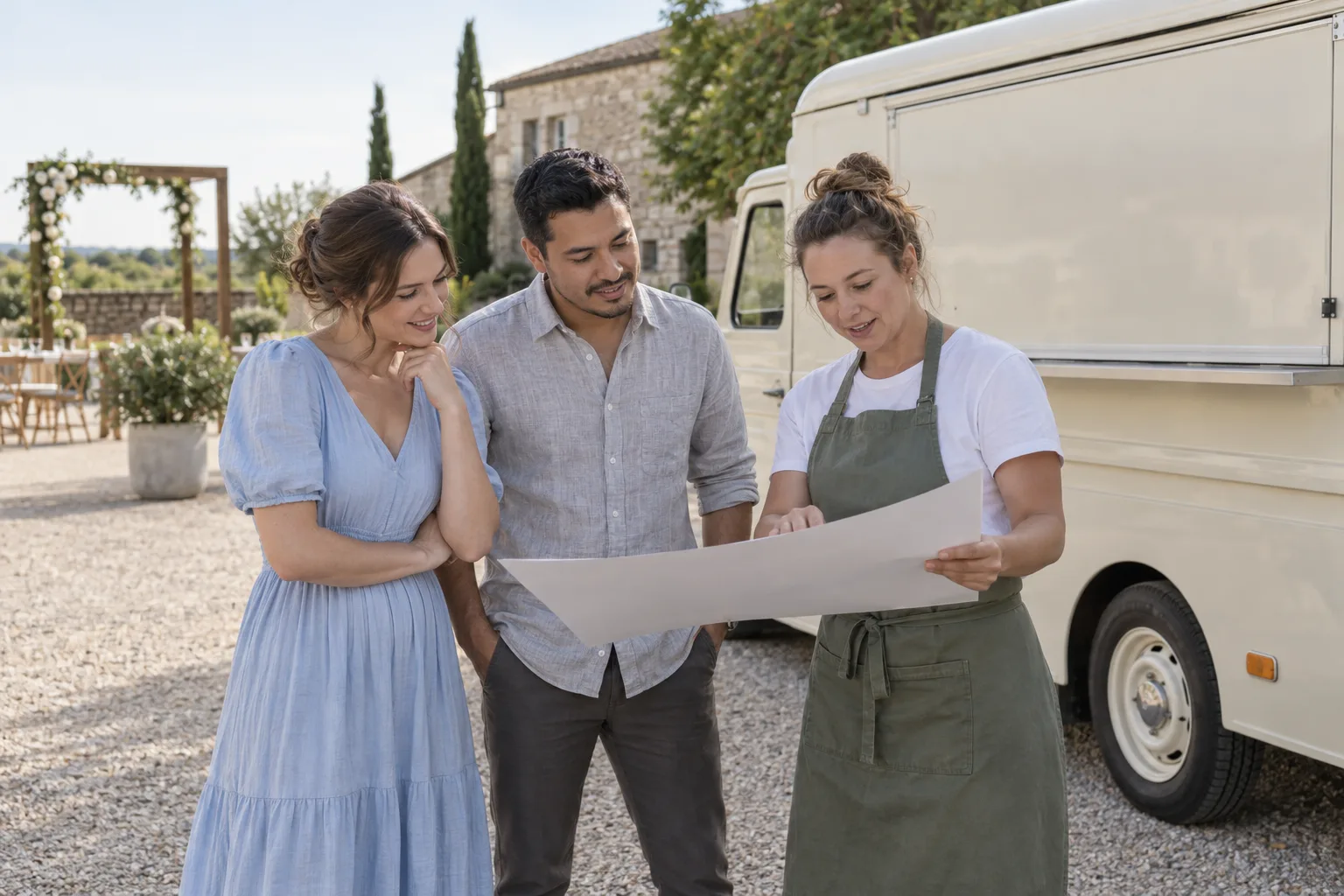
A food truck can be your wedding meal, an evening snack or a dessert service. Define that job before comparing menus. The booking needs to establish where the truck can operate, how many meals it can serve during the available time and what happens if it cannot arrive or cook.
1. Is the operator permitted for the service you are booking?
FDA identifies retail food establishments, including food trucks, as businesses regulated by state and local government. [1] Start with the health authority for the event location rather than asking whether the truck has a generic federal approval.
Request the business name, current food permit and the authority that issued it. Ask whether your location, menu and style of service require additional approval. A wedding on private property should not be assumed to remove every requirement.
King County, Washington, provides one local example: its mobile-food permit process includes plan review and a pre-operational inspection before an operating permit is issued. Its application information also identifies commissary and restroom agreements. [2]
Those are that jurisdiction's procedures, not a checklist of permits every truck everywhere must obtain. Ask the operator and relevant authority to identify what applies to your booking. Put responsibility for any application, fee and approval deadline in writing.
If the truck will serve food from a table outside the vehicle, bring a separate barbecue or use the venue kitchen, include those details in the review. Do not let the approved proposal and the event-day arrangement become different plans.
2. Have the venue and operator agreed on the exact position?
Ask the operator for the vehicle's dimensions and setup requirements, then arrange a site review with the venue. Include arrival access, gate height and width, turning space, the parking surface and the direction of the serving window.
Mark where guests will order, collect food and sit. Check the route for people using mobility aids and for anyone who cannot stand in a queue. Keep the proposed line clear of exits, vehicle movements and other vendors' working areas.
Discuss cooking fuel and fire requirements with the responsible professionals. Seattle's special-event guidance, as a local example, requires permits for propane or open-flame cooking and requires fire extinguishers for cooking operations even where a cooking permit is not required. [3]
That does not authorize the same arrangement at your venue or establish a universal separation distance. Have the operator explain the approved equipment layout, any required inspection and who checks it before service.
Agree on when the truck can enter and leave. A departure route through the dance area or a narrow lane blocked by guest cars needs attention before the reception starts.
3. What water, power and waste arrangements does the truck need?
Ask for a written list of what the truck supplies and what it expects from the venue. Include electrical requirements, any generator, potable water, handwashing facilities, wastewater handling, rubbish and staff toilet access.
Have the venue confirm the requested connections with the operator. An outlet somewhere on the property is not confirmation that it is suitable for the equipment. Do not assign a guest to improvise cables, fuel storage or plumbing.
King County's mobile-food process asks applicants for commissary and restroom agreements, illustrating that a vehicle can depend on facilities beyond its serving window. [2] Ask where preparation, washing and replenishment will happen for your event.
Clarify who monitors the food's holding conditions, who handles a power or equipment failure and when service would stop. Ask what menu changes or other arrangements would follow. These decisions belong in the provider's operating plan rather than being improvised by the wedding party.
Confirm the cleanup boundary. Who clears plates from tables, changes bins, removes rubbish and leaves the parking area in the condition the venue requires? Truck service does not answer those jobs by itself.
4. Can the menu and kitchen handle the actual food-allergy requests?
Share requirements early, with the guest's agreement, and ask who will discuss them with the cook. Review ingredients, sauces, garnishes and the preparation process. A vegetarian or gluten-free menu description is not a complete explanation of food-allergy controls.
FARE explains that allergen cross-contact can occur through shared equipment and that cooking does not eliminate the risk of a reaction from transferred allergen. Its questions for food-service staff cover preparation areas, utensils, shared grills or fryers, and identification and delivery of the meal. [4]
Ask those questions for the truck's actual setup. Find out whether staff can provide the requested meal during wedding service and how substitutions will be checked. Do not accept an ingredient being picked off a finished plate as the agreed plan.
If the operator cannot meet a guest's needs, coordinate an alternative with that guest and the venue before the day. Do not promise that any meal is safe on the provider's behalf.
Record the on-site contact and the handoff for a separately prepared meal. The wedding food-allergy guide covers that wider communication plan.
5. How many first meals can this menu produce during your service window?
Ask the operator to estimate throughput using your menu, staffing and serving arrangement. A figure from a short street-food order may not describe a wedding meal with several choices and sides.
Use simple arithmetic to test the proposal. As a hypothetical example, 150 first meals served over 90 minutes require an average of 100 meals per hour. That is a planning calculation, not evidence that a particular truck can maintain the pace or that nobody will queue.
Ask what slows service: individual payment, made-to-order items, many substitutions, one collection window or limited equipment. Discuss whether preorders, a shorter menu, staggered table release or another serving point would help. Have the operator confirm what it can deliver.
Distinguish a minimum spend from a guaranteed number of portions. Ask how the provider counts children, supplier meals, seconds and late arrivals. Confirm what happens if a popular item runs out before everyone receives a first meal.
Place the meal window beside speeches, photographs and transport. Chapter 13 of Bridegenic gives food a time and a responsible person. Arrange how the couple's meals will reach them if they are occupied elsewhere instead of assuming they will join the line.
6. What does the full price include, and what is the backup?
Request the complete quotation: food quantities, service duration, staff, travel, setup, required utilities, plates and cutlery, taxes, service charges and cleanup. Ask which figures are fixed and which depend on the final guest count.
Confirm the date for final numbers and dietary information. Put any approved menu substitutions, overtime terms and additional portions in the agreement.
Ask what happens if the vehicle breaks down, staff are unavailable, cooking equipment fails or weather prevents the approved setup. Identify who contacts you, which replacement arrangements are possible and what cancellation or refund terms you are agreeing to.
A backup meal needs a provider, timing and payment arrangement. “We will sort something out” is not enough information to coordinate with the venue. Any alternative food-service setup should have its permissions and practical requirements checked too.
Keep the final plan with the coordinator, venue and truck lead. Include arrival, opening, last orders, closing, cleanup and a reachable phone number. Update all three when the arrangement changes.

Physical Book (No Download)
Bridegenic: The Glow-Up Guide for Brides on GLP-1s
$12.95 + Free Shipping
Order NowThis article provides general education, not a diagnosis or an individual treatment plan. Medication information refers to US sources. Talk with your prescriber, pharmacist or dermatologist about decisions for your care.
Read next
PlanningSix Wedding Bar-Service Questions Before Booking→Food & EnergyFood Allergies at Your Wedding: The Caterer, Kitchen and Serving Handoff→Sources
- How to Start a Food Business: State and Local Regulation of Retail EstablishmentsU.S. Food and Drug Administration↩ Back to text
- Mobile Food Service Business PermitPublic Health, Seattle & King County↩ Back to text
- Fire Safety for Special Events: Cooking and Food VendingCity of Seattle↩ Back to text
- Avoiding Cross-ContactFood Allergy Research & Education↩ Back to text