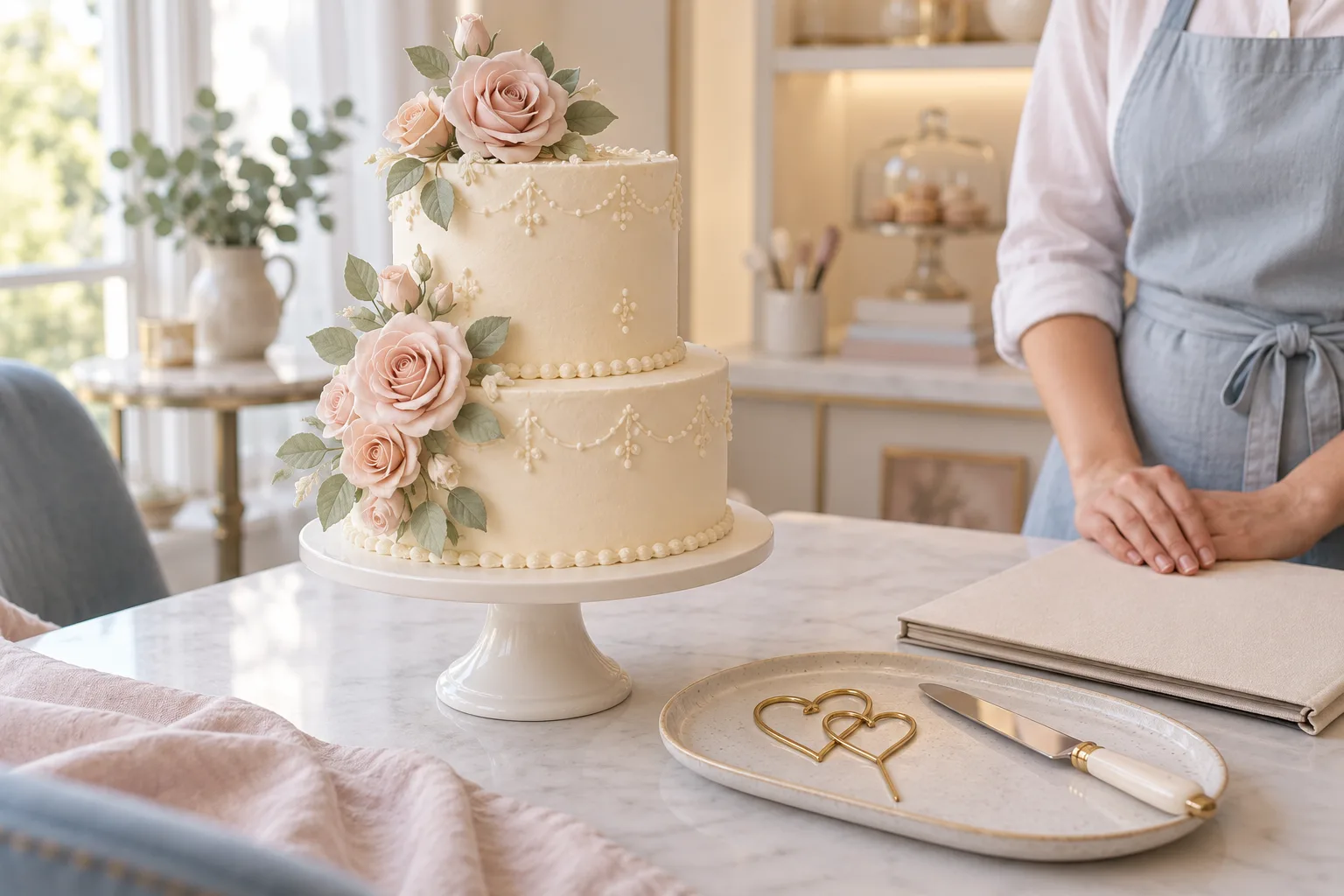
A wedding-cake photograph shows the finish, flowers and topper. It does not show the decoration labels, flower source or instructions for the people cutting the cake. Before approving the design, ask the baker to identify what guests will eat, what must be removed and how the finished cake will be handled.
1. Check the actual glitter or dust label
FDA advises against using decorative glitter or dust directly on food unless it is made to be edible. It distinguishes edible products with ingredient lists from items described only as non-toxic or for decoration. Names such as luster dust, pearl dust or shimmer powder do not settle that question. [1]
Ask the baker which exact product creates the metallic or sparkling finish. Keep its name and label with the design record, especially if you supply the product yourself. A photograph of a similar jar or a marketplace listing for the color is not the same as the package used on your cake.
A CDC report investigated six children’s illnesses after a Rhode Island birthday cake in 2018. Testing implicated copper in decorative frosting. A separate 2019 Missouri investigation identified lead in a dust used on a child’s cake decorations. [2]
Those investigations concerned particular nonedible products, not every shimmering food decoration. They explain why the intended use and ingredients matter even when a product comes from a cake-supply shop. Do not substitute craft glitter or a cosmetic pigment to match the inspiration photograph.
2. Confirm the flower identity and food source
NC State Extension advises using only edible flowers as food garnishes, with positive identification and suitable growing practices. Flowers from florists, garden centers or nurseries should be specifically labeled edible; otherwise, they may have received ornamental pesticides unsuitable for food crops. [3]
Ask who is supplying flowers for the cake and whether they were produced for consumption. The name of a familiar flower is only part of the answer. Identify the species, edible part and supplier, and have the baker approve the proposed use before the florist arrives.
Do not tell the florist to copy the bouquet onto the cake without a separate food-use discussion. If a particular flower cannot be used appropriately, ask about a sugar decoration or another design. A different flower is easier to agree on before setup than when the photographer is waiting.
The Extension guidance also notes that pollen can cause allergic reactions in some people. [3] Edibility does not establish suitability for every guest. Include flower ingredients in the allergy discussion rather than treating them as invisible because they are decorative.
3. List toppers, supports and other pieces that must come off
FDA says nonedible decorations should be removed before food is served and eaten. [1] Ask the baker which pieces are edible, which are structural and which are decorative objects. A sugar flower may still have a nonedible support, so obtain instructions for the finished assembly.
Have the baker identify dowels, boards, wires, picks, ribbons, toppers and any hidden supports used in your design. Ask how each will be located and removed during cutting. Do not assume guests or serving staff will recognize them by sight.
Placement also needs the baker’s approval. Ask how nonfood items are kept appropriately separate from edible portions; do not choose your own wrapping or coating as proof that an object is suitable for contact with cake.
Keep ornaments for photographs or as keepsakes on a separate tray after removal. If you want the topper saved, put a name beside that task so it does not return to a platter with slices or disappear during clearing.
4. Include decorations in the ingredient and allergy review
FDA explains that allergen cross-contact is the unintended introduction of an allergen into a food. It also notes that U.S. advisory statements such as “may contain” are voluntary. [4] The absence of that statement cannot, by itself, confirm that a cake or decoration is suitable for a guest’s allergy.
Tell the baker and caterer the specific allergies that need accommodation. Ask them to review the cake, filling, frosting, marzipan, chocolate, sprinkles, printed decorations and other finishing products, along with preparation and serving practices.
A decorative layer or substitute product should receive the same review as the batter. Ask how changes will be communicated and what information the server will have when a guest asks about a slice.
If a separate dessert is required, confirm who prepares it, how it is stored, how it is identified and who serves it with suitable utensils. The catering allergy handoff guide covers this wider coordination. Do not promise that removing a visible decoration makes a slice suitable.
5. Match the display plan to the complete cake
Kansas State’s frosting and filling study found that recipes with similar names can differ in acidity and water activity, affecting whether refrigeration is needed. Its discussion notes that some cream-cheese recipes require refrigeration and others do not. [5]
University of Minnesota Extension’s guidance for cottage-food producers emphasizes considering every component of layered desserts, including moisture moving between a wetter filling and a drier cake. [6] This is a reason to assess the finished product, not to apply a cottage-food rule to every commercial wedding.
Ask the baker for the storage and display instructions for the actual cake, filling and decoration combination. Confirm the venue can follow them, with suitable storage space and a named person monitoring the schedule. A frosting that holds its shape does not answer the food-safety question.
Agree on delivery, refrigeration if required, setup, cutting and handling of remaining portions. If the room or weather changes the plan, have the baker and caterer resolve the adjustment. The leftover-food guide addresses the later storage and transport handoff.
6. Give the serving team the approved design record
Chapter 13 of Bridegenic puts a person’s name beside practical tasks. For the cake, identify who accepts delivery, who confirms the design, who removes decorations and who cuts and serves it.
Send the venue a short final record: an image of the approved design, component and allergen information, removable-piece instructions, storage requirements and the baker’s contact. Ask how the team records any substitution made during finishing or delivery.
If the florist adds anything at setup, the baker’s approved plan still needs to govern what goes on the cake. Decide who can authorize a change and who tells the serving team. Avoid a sequence in which each supplier assumes the next person has checked it.
Before service, have the responsible person confirm that the removal instructions and any separately prepared desserts are understood. Keep this task off the couple’s reception schedule. The most useful design approval includes enough information for another person to serve the cake as intended.

Physical Book (No Download)
Bridegenic: The Glow-Up Guide for Brides on GLP-1s
$12.95 + Free Shipping
Order NowThis article provides general education, not a diagnosis or an individual treatment plan. Medication information refers to US sources. Talk with your prescriber, pharmacist or dermatologist about decisions for your care.
Read next
Food & EnergyWedding Reception Leftovers: Cooling, Collection and Transport→Food & EnergyFood Allergies at Your Wedding: The Caterer, Kitchen and Serving Handoff→Sources
- FDA Advises Home and Commercial Bakers to Avoid Use of Non-Edible Food Decorative ProductsU.S. Food and Drug Administration↩ Back to text
- Viveiros et al. Cake Decorating Luster Dust Associated with Toxic Metal Poisonings: Rhode Island and Missouri, 2018–2019, October 29, 2021CDC Morbidity and Mortality Weekly Report↩ Back to text
- Choosing and Using Edible Flowers, AG-790NC State Extension↩ Back to text
- Food AllergiesU.S. Food and Drug Administration↩ Back to text
- Blakeslee et al. Food Safety of Frostings and Fillings, December 2020Kansas State University Research and Extension↩ Back to text
- Frosting and Dessert Fillings, October 10, 2025University of Minnesota Extension↩ Back to text