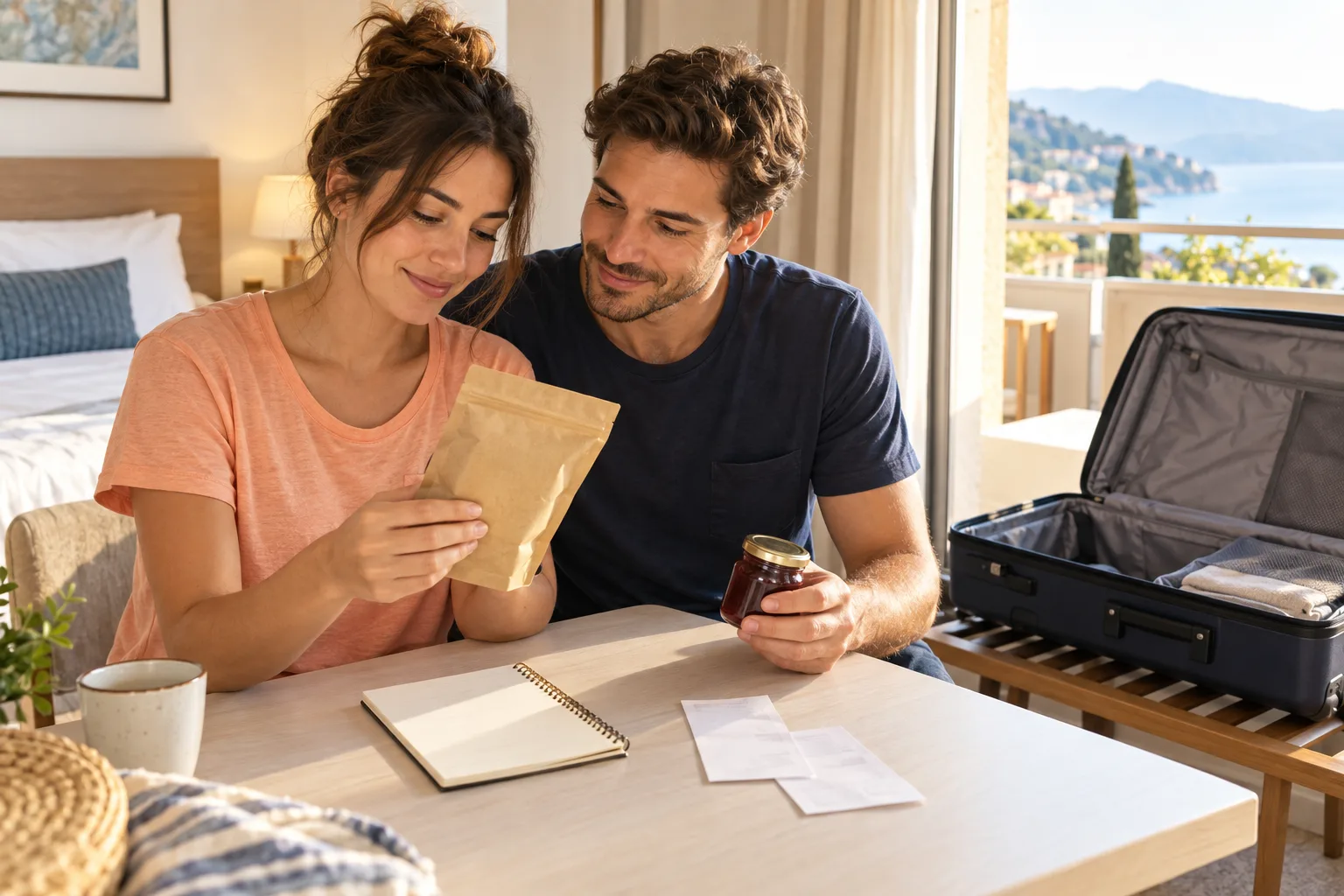
Before buying food souvenirs on your honeymoon, check the item, ingredients, origin and form against the rules for entering the United States. An unopened package or an airport shop receipt does not answer every import question. Plan the purchase before you are at the border with a gift you hoped to keep.
1. Have you listed the foods and kept their identifying information?
CBP tells travelers to declare all food, plants, agricultural and wildlife items when entering the United States. [1] Include packaged snacks and gifts in the information you provide; do not limit your declaration to items you suspect are prohibited.
APHIS says agricultural inspectors decide whether products meet entry requirements and recommends keeping receipts and original packaging as evidence of origin. [2]
Keep a short list of what you are carrying, where it came from and where it is packed. If you and your partner buy gifts separately, compare the list before arrival. Do not rely on one person remembering everything in both suitcases.
Preserve ingredient lists and any required documentation rather than transferring food into unmarked gift bags. If a shopkeeper says travelers bring the product home all the time, ask for the information needed to check it yourself.
These checks concern passenger-carried souvenirs from another country, using guidance checked on October 16, 2026. Commercial imports, shipments and movement involving U.S. territories can have different requirements. Use the official route-specific guidance for your itinerary.
2. Is the fruit or vegetable fresh, frozen, dried or commercially canned?
APHIS says almost all fresh fruits and vegetables, whole or cut, are prohibited for travelers entering the U.S. That includes produce supplied on an aircraft or cruise ship. Almost all frozen produce is also prohibited because freezing does not remove every pest or disease risk. [3]
Commercially canned fruit and vegetables may enter when declared. Home-canned products are not allowed under this traveler guidance. Most dried produce needs special requirements checked, although APHIS lists generally allowed examples including dates, figs and raisins, subject to declaration and inspection. [3]
Check the exact form before paying for a market purchase. A dried-fruit bag is not automatically equivalent to the examples listed, and a jar prepared in a home kitchen is not automatically a commercially canned product.
Review the snacks in your carry-on before arrival, including anything saved from a hotel breakfast or onboard meal. If unsure about an item you are carrying, tell the officer rather than deciding that a small quantity does not count.
3. Does the souvenir contain meat, even as an ingredient?
Read labels on sauces, filled pastries, soup mixes and savory snacks. If an ingredient is unclear, obtain a description you can use when asking APHIS. Do not infer that the entire product is admissible from its name or sealed wrapping.
APHIS links meat restrictions to animal-disease status and the product's origin and processing. It specifically lists cured hams and salami from areas within France, Germany, Italy and Spain as restricted to commercial shipments with additional certification and documentation. [4]
The same guidance describes a distinct allowance for boneless meat commercially cooked after being packed in unopened, labeled, hermetically sealed packaging so the finished product is shelf-stable. [4] Vacuum wrapping or drying a meat product is not the same description.
Ask about the actual item before purchase. Record the country of production, animal ingredients and processing information, then use APHIS's current animal-product guidance or its contact route. Avoid relying on an old list of disease-free countries.
Do not assume mailing the gift home solves a restriction. APHIS states that, for this guidance, animal products sent by mail are regulated as commercial use rather than passenger personal use. [4]
4. Which dairy product are you buying, and does it contain meat?
APHIS lists butter, butter oil and solid hard or soft cheeses among dairy items that may enter from any country, provided the cheese does not contain meat or pour like a liquid. It identifies ricotta and cottage cheese as examples outside that solid-cheese description. [5]
Do not reduce the rule to hard cheese only, or assume every soft cheese is excluded. Equally, do not treat a creamy spread or meat-filled cheese product as an ordinary solid cheese without checking.
Other milk and dairy products can be restricted according to foot-and-mouth disease status, with specified exceptions. APHIS also provides separate conditions for egg products and filled moon cakes. [5] Use those categories when the souvenir combines ingredients rather than checking only the ingredient on the front label.
Keep the complete ingredient list and origin information with the product. Ask the seller to explain unfamiliar fillings before you buy. If the label does not establish what is inside, choose a gift you can identify or obtain an official answer first.
5. Is the coffee roasted, and what is in the tea or spice blend?
APHIS permits declared roasted coffee through U.S. ports. Green, unroasted beans are treated differently: they may enter through continental U.S. ports but cannot enter or transit Hawaii or Puerto Rico. Whole coffee cherries with their pulp are prohibited at all U.S. ports. [6]
For tea, a product consisting solely of Camellia sinensis leaves differs from an herbal blend. APHIS provides ingredient-specific conditions for herbal infusions. Most dried spices may enter, but exceptions include citrus leaves and seeds and many fruit or vegetable seeds. [6]
Ask for botanical or ingredient names when a blend contains unfamiliar leaves, flowers, bark or seeds. Keep the labeled pack instead of pouring it into a decorative tin without its information.
Check the route as well as the final destination. If your connection changes, review any port-specific restriction again. A product permitted on one itinerary may not fit the same conditions on another.
6. Have you checked airport screening and the complete return route?
A food's import status does not determine its carry-on screening status. TSA lists jam and jelly as subject to its 3.4-ounce/100-milliliter carry-on limit. [7] Its liquid rules also require qualifying containers to fit in one quart-sized bag per passenger. [8]
Those are U.S. checkpoint requirements. Check the security authority for your departure airport and any transfer where you will be screened. Do not assume a jar bought after one checkpoint is exempt at every later checkpoint.
Review airline packing requirements too. Keep products identifiable and arranged so you can present them for inspection. Protect the original packaging without making the ingredients or contents impossible to examine.
Chapter 14 of Bridegenic treats airport security, airline rules and import permission as separate checks. Use that method for food souvenirs: record the official source, what it says about your item and when you checked.
Do the final review before leaving your accommodation. Check gifts, snacks and unfinished foods in both bags against the list. Ask about anything uncertain, and declare what you carry even if you expect it to be admitted.

Physical Book (No Download)
Bridegenic: The Glow-Up Guide for Brides on GLP-1s
$12.95 + Free Shipping
Order NowThis article provides general education, not a diagnosis or an individual treatment plan. Medication information refers to US sources. Talk with your prescriber, pharmacist or dermatologist about decisions for your care.
Read next
Honeymoon & BeyondBringing Your Wedding Bouquet Home: U.S. Entry Requirements→Honeymoon & BeyondYour Honeymoon on a GLP-1: How to Pack and Store Your Medicine→Sources
- When Entering the United States, What Items Must I Declare?U.S. Customs and Border Protection↩ Back to text
- Traveling From Another Country: Declaration and InspectionUSDA Animal and Plant Health Inspection Service↩ Back to text
- International Traveler: Fruits and VegetablesUSDA Animal and Plant Health Inspection Service↩ Back to text
- International Traveler: Meats, Poultry and SeafoodUSDA Animal and Plant Health Inspection Service↩ Back to text
- International Traveler: Milk, Dairy and Egg ProductsUSDA Animal and Plant Health Inspection Service↩ Back to text
- International Traveler: Coffee, Teas, Honey, Nuts and SpicesUSDA Animal and Plant Health Inspection Service↩ Back to text
- What Can I Bring? Jam and JellyTransportation Security Administration↩ Back to text
- TSA Travel Packing Checklist: Carry-On LiquidsTransportation Security Administration↩ Back to text