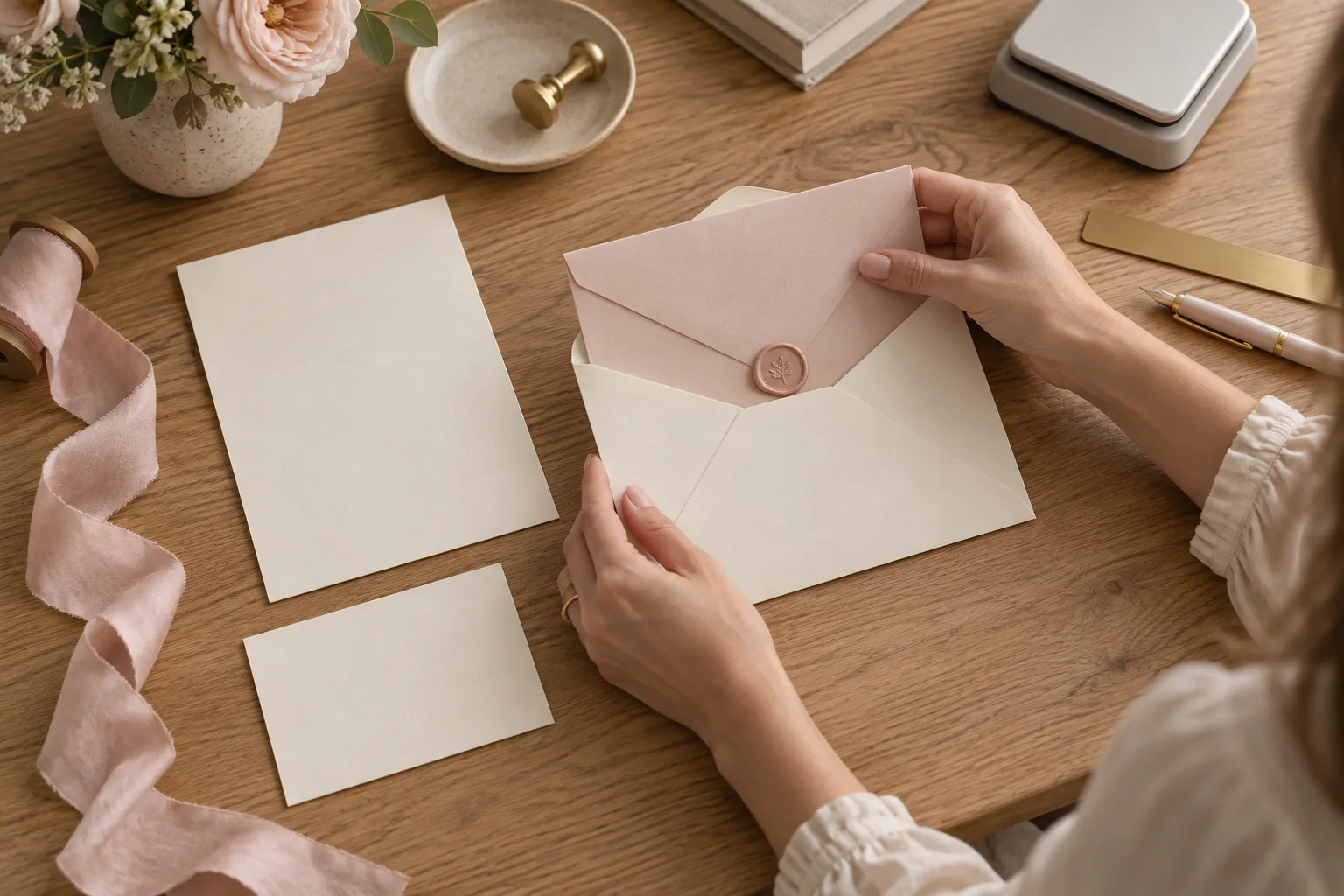
Before ordering postage for wedding invitations, assemble one complete mailing exactly as a guest will receive it. Include the liner, reply materials, enclosure cards, ribbon, seal and outer envelope. That finished piece is what needs checking, not the invitation card alone or the weight printed on the paper supplier’s listing.
1. Weigh the complete mailing before buying stamps
USPS bases First-Class Mail prices on shape and weight. Its domestic letter service has a maximum letter weight of 3.5 ounces, while larger envelopes have different limits and requirements. [1]
Take a completed sample to the Post Office before purchasing the batch’s postage. Ask which category it belongs in and what postage it needs. If you have different versions, such as an extra reception card for some guests, bring a sample of each.
Keep the checked sample with a list of its contents. A replacement envelope, heavier liner or extra insert should prompt another check. Avoid applying stamps to every envelope while someone is still deciding whether to add a details card.
Record the date of the postage check and buy the required amount for the actual mailing. A photograph of a stationer’s old stamp arrangement does not establish today’s postage for your suite.
2. Measure the envelope and check its flexibility
USPS Postal Explorer lists letter dimensions from 3½ inches high by 5 inches long to 6⅛ inches high by 11½ inches long, with thickness between 0.007 inch and ¼ inch. It notes that square, rigid or unusually shaped pieces can require a nonmachinable surcharge and can be difficult to process. [2]
Ask for the dimensions of the finished outer envelope before ordering a custom size. A small change in the design may affect the mailing category as well as the stationery cost.
Thickness is only part of the assessment. Tell the postal associate if the piece contains stiff layers, uneven contents or another feature that changes how it bends. Do not assume that being under one ounce makes an envelope a standard letter.
USPS says large envelopes that are rigid, nonrectangular or not uniformly thick can be charged package prices. [1] Paying a surcharge does not make every object eligible to travel as a letter. Have the actual piece assessed.
3. Put exposed wax seals and ribbons inside an outer envelope
USPS specifically advises placing invitations with external wax seals, strings or ribbons inside another envelope rather than sending the decorations exposed. It also says senders can bring embellished invitations to the counter, pay applicable nonmachinable postage and request hand cancellation. [3]
Show the stationer the mailing arrangement you intend to use. If the design photograph features a seal on the outside, ask how that appearance will be protected within the finished outer envelope. Include that extra envelope when checking weight and thickness.
Hand cancellation concerns the postmark. It should not be treated as a promise that the invitation will remain untouched by equipment throughout processing. Ask the postal associate about your batch and packaging, rather than relying on a handwritten “hand cancel” instruction.
USPS’s postmark guidance describes requesting a manual postmark at a retail counter for up to fifty items for free. [4] Confirm arrangements for the quantity you plan to bring; do not assume that a large batch has been arranged because a single sample was checked.
4. Proof the mailing address separately from the invitation wording
USPS recommends clear addresses, with the return address at the top left and the delivery address near the bottom center of a domestic envelope. Its addressing instructions include the recipient’s name, apartment or suite information where applicable, street address, city, state and ZIP Code. [3]
Get the current address from each household rather than copying the location used for an engagement announcement years earlier. Confirm unit numbers and whether the guest will be elsewhere during the mailing period.
Have someone proof the printed envelope against the address list. An invitation can spell every name correctly while still omitting the apartment number. Review the address placement with the stationer if decorative lettering or illustrations make it difficult to identify the delivery information.
Choose a return address where someone will collect mail and handle returned invitations. Name who corrects the list and contacts the guest. Keep that record separate from a list of guests who have declined; a returned envelope is not an RSVP.
5. Check overseas invitations as their own group
USPS First-Class Mail International is for correspondence and nonnegotiable documents, with postage affected by weight, shape and destination. Its guidance says documents-only correspondence does not need a customs form, while goods do not belong in that letter service. Delivery varies by destination. [5]
If the suite includes a keepsake, seed packet or another object, describe the complete contents to USPS before choosing the service. Do not assume an item is correspondence merely because it fits inside an invitation envelope.
USPS says international address formats vary. For a U.S.-origin international letter, put USA on the final return-address line and the destination country in English on the final delivery-address line. It also requires AIRMAIL/PAR AVION on the address side for First-Class Mail International. [6]
Ask the recipient to confirm the address in the appropriate local format. Check current service availability and country requirements close to mailing, especially if the destination or route has changed. Do not apply a domestic postage calculation to the overseas group.
6. Assess the reply card as a separate mailpiece
A small reply card is not automatically eligible for postcard postage. USPS has separate size requirements for postcards; larger or square postcards cost more. [3]
Ask USPS to check the reply card or reply envelope as well as the outgoing invitation. Include its own return address and required postage in your stationery checklist. Keep a finished reply sample so a later printing change can be compared with what was assessed.
For guests abroad, ask the postal operator in the country where the reply will be mailed which postage and format it requires. Do not label a U.S.-stamped reply envelope “postage paid” for every guest without confirming that arrangement.
You can offer a website, email or telephone response instead, with clear instructions and an option for guests who prefer another method. Check the website address from the printed card before approving the full print run. If using a QR code, include an accessible written route to reply as well.
7. Plan for replies and corrections, not just a mailing date
USPS lists a First-Class Mail delivery standard of one to five business days and states that it is not guaranteed. [7] Use that as service information, not a promise that every guest will receive an invitation within a particular wedding-planning window.
Work backward from the caterer’s attendance deadline. Allow time for delivery, the guest’s decision, any posted reply, and follow-up before you need final numbers. International mailings and guests arranging travel may need a different schedule.
A small test mailing can help you inspect how your packaging arrives, but one successful delivery cannot guarantee the whole batch. Keep spare invitations and a way to send essential details if an envelope is returned or a guest reports that it has not arrived.
Chapter 13 of Bridegenic puts names beside practical tasks. Apply that approach here: identify who maintains addresses, takes the mail to the counter, records the mailing date and follows up on responses. Keep any hotel booking deadlines beside the guest information so the mailing schedule supports the arrangements guests need to make.

Physical Book (No Download)
Bridegenic: The Glow-Up Guide for Brides on GLP-1s
$12.95 + Free Shipping
Order NowThis article provides general education, not a diagnosis or an individual treatment plan. Medication information refers to US sources. Talk with your prescriber, pharmacist or dermatologist about decisions for your care.
Read next
Wedding Week7 Checks Before Booking Your Wedding Hotel Rooms→Wedding WeekYour Wedding-Week Checklist: Food, Medicine and Named Handoffs→Sources
- First-Class Mail and PostageUnited States Postal Service↩ Back to text
- Sizes for LettersUSPS Postal Explorer↩ Back to text
- How to Send a Letter or Postcard: DomesticUnited States Postal Service↩ Back to text
- Requirements and Standards for Sending Domestic Mail: PostmarksUnited States Postal Service↩ Back to text
- First-Class Mail InternationalUnited States Postal Service↩ Back to text
- How to Send a Letter or Postcard: InternationalUnited States Postal Service↩ Back to text
- Delayed Mail and Packages: Delivery StandardsUnited States Postal Service↩ Back to text