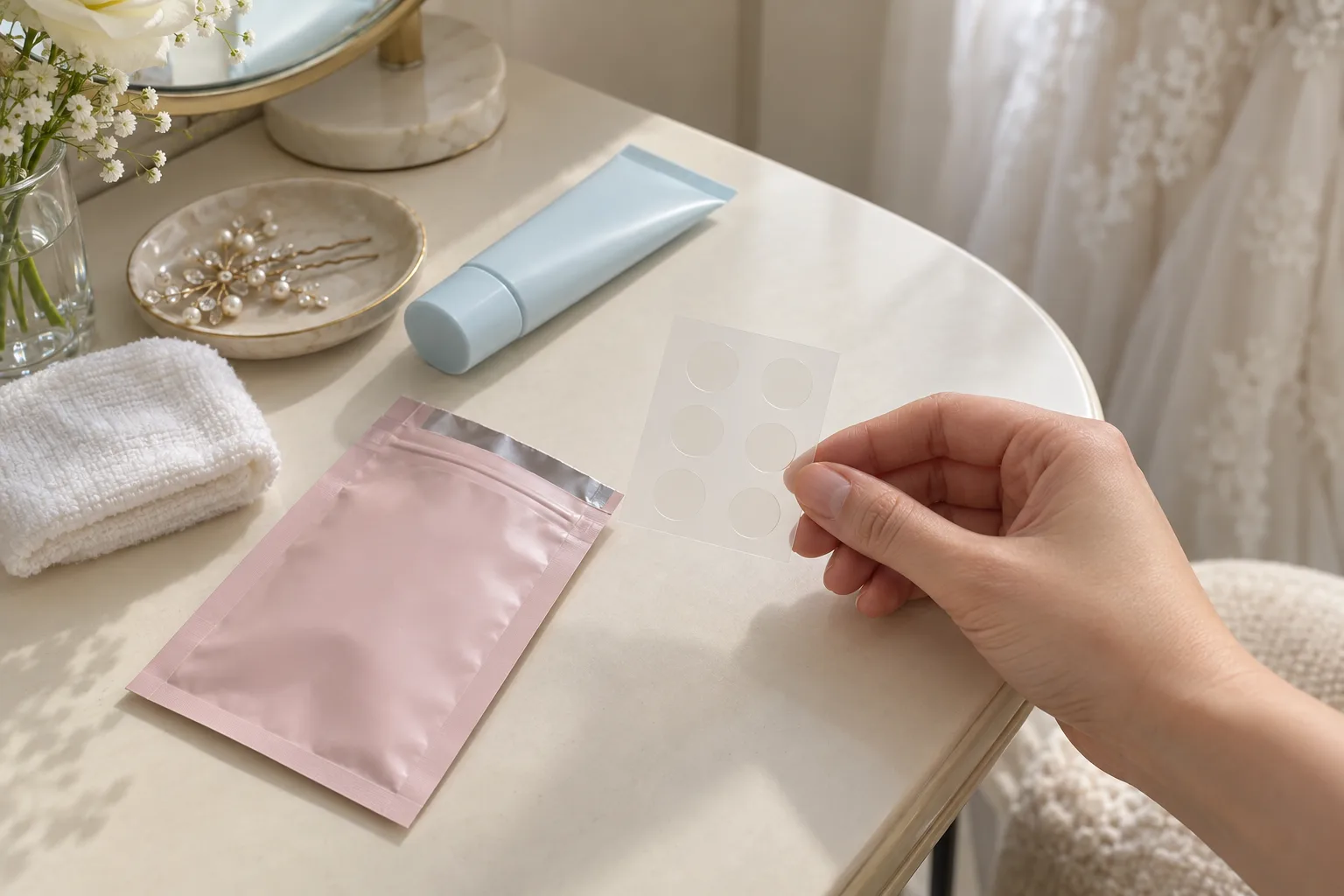
A pimple patch can cover a spot while you get on with wedding preparations. Before using one, check what it contains and what you want it to do. Absorbing fluid, protecting a blemish from fingers, delivering an acne medicine and concealing a mark are different functions. Similar-looking dots do not necessarily have the same ingredients or directions.
Read the ingredients before treating every patch alike
A plain hydrocolloid patch and a medicated patch require different decisions. For example, Hero Cosmetics lists hydrocolloid as the key ingredient in its Original patch, while its product comparison distinguishes a micropoint version containing salicylic acid. [1] That comparison describes those products, not every patch sold elsewhere.
The Peace Out Acne Day Dot label on DailyMed, updated October 18, 2024, lists salicylic acid 0.5%, with aloe extract and retinyl acetate among the other ingredients. It warns against use if allergic to the dressing or its components. [2]
Keep the full package information. Ask a pharmacist or dermatologist about any medicine, retinoid-related ingredient, botanical ingredient or adhesive that matters to your routine or reaction history. If pregnant or planning pregnancy, review the complete product rather than assuming a small sticker is ingredient-free.
Do not transfer research about an unmedicated dressing to a medicated or microneedle product. Ask what evidence applies to the actual item and what its instructions permit.
Read the short trials with their limits attached
A 2006 randomized pilot compared a 3M hydrocolloid Acne Dressing with skin tape in 20 people with mild-to-moderate acne, ten per group. Over one week, the dressing group had greater improvement on the study’s overall severity and inflammation measures. [3]
The groups began with different mean severity scores. The abstract reported no significant adverse events, but a one-week study in 20 people cannot establish long-term safety, the frequency of uncommon reactions or performance of a different brand. Its application schedule is not instructions for every patch.
A 2025 exploratory trial had 37 completers and assessed 46 pustules, with 23 patched and 23 untreated. Some participants contributed a lesion to each group. The trial was open-label, lasted ten days and used an unblinded grader. [4]
Day-two size and severity measures favored the patches. At day ten, the difference between groups was statistically significant for severity, but not for size, redness or the measured post-inflammatory pigmentation score. [4]
Good Molecules funded the trial, and both authors were employees. Quality-of-life follow-up was delayed after a protocol deviation. [4] The paper supports further investigation of that product; it does not establish permanent prevention of marks, benefit for every acne type or a guarantee for tomorrow’s photographs.
Match the expectation to the blemish
Hero’s instructions say its Original hydrocolloid patch works best on spots with visible white fluid or pus. [1] A patch that does not turn white is not a reason to squeeze or puncture the spot.
AAD warns against picking or squeezing deep acne nodules because this can increase infection, discoloration and scarring. Its advice includes hydrocolloid patches as a protective measure, while persistent or multiple deep, painful spots warrant a dermatologist’s assessment. [5]
Protecting the surface is different from establishing why recurring acne is occurring or which treatment is appropriate. Describe the pattern, pain and any scarring at the appointment instead of arriving only with a photograph of the sticker you want to buy.
The acne consultation guide discusses one prescription option for selected patients. A patch can be discussed alongside the care plan without becoming a substitute for it.
Follow the product’s preparation and wear directions
For its Original patch, Hero directs cleansing and drying the skin, placing the patch over the blemish and removing it after six to eight hours. [1] Use that as a product example, not a universal overnight schedule.
Do not assume a spot cream should go under the patch. The cited salicylic-acid patch label warns that another topical acne medicine used at the same time can increase dryness and irritation. [2] Ask how the patch fits with your existing products before combining them on the same area.
Record the patch name, how long you wore it and how the skin felt after removal. A comfortable experience with a plain patch does not confirm tolerance of a medicated version, even when the packaging looks similar.
If removal is difficult, follow the manufacturer’s instructions or obtain advice rather than repeatedly tugging or scraping the area. Do not use a new exfoliant to remove remaining adhesive just before makeup.
Respond to a rash instead of covering it again
NHS describes contact dermatitis symptoms including itching, blistering, dryness and cracking, with changes that can appear immediately or after a delay. [6]
A mark in the shape of a patch is information to report, not a diagnosis of which ingredient caused it. Stop using the suspect patch and obtain advice if symptoms persist, recur or are severe. Keep its ingredient list for the clinician.
NHS advises immediate medical advice for rapidly worsening symptoms, discharge, increasing pain, feeling unwell or chills, which can indicate infection. [6] Do not keep layering stickers over worsening skin while waiting for a beauty appointment.
Tell the makeup artist what happened and whether a clinician gave care instructions. Makeup should not be used to conceal symptoms from someone who needs to assess them.
Agree on the makeup plan while the skin is comfortable
Ask whether you intend to wear a patch during preparation, remove it before makeup or leave it visible as part of your chosen look. Test the intended combination ahead of the event if the skin is suitable. Check the edges in the lighting and photographs you expect to use.
AAD’s acne makeup guidance recommends products labeled oil-free, non-comedogenic or unlikely to clog pores, gentle application and removal without scrubbing. [7] Do not assume that a patch marketed as invisible will be undetectable beneath your own foundation.
If the skin becomes raw, painful or irritated after a trial, obtain care advice and update the artist. A successful application on intact skin does not answer how to prepare a newly irritated area.
Keep sun protection in the plan. AAD recommends broad-spectrum, water-resistant SPF 30 or higher for acne-prone skin and notes that inflammation can leave darker marks. [5] Do not treat a small sticker as your sunscreen or infer a usable SPF from a dressing study.
The makeup hygiene guide covers clean tools and product handling. Keep coverage, skin care and the longer acne-treatment plan coordinated, with a named professional for questions that remain unresolved.

Physical Book (No Download)
Bridegenic: The Glow-Up Guide for Brides on GLP-1s
$12.95 + Free Shipping
Order NowThis article provides general education, not a diagnosis or an individual treatment plan. Medication information refers to US sources. Talk with your prescriber, pharmacist or dermatologist about decisions for your care.
Read next
Face & SkinBenzoyl Peroxide Before Your Wedding: Skin and Fabric Care→Face & SkinWedding Makeup Hygiene: Brushes, Products and Touch-Ups→Sources
- Mighty Patch Original: Ingredients, Product Comparison and DirectionsHero Cosmetics↩ Back to text
- Peace Out Acne Day Dot: Salicylic Acid Patch Label, updated October 18, 2024Peace Out via DailyMed↩ Back to text
- Chao et al. A Pilot Study on Efficacy Treatment of Acne Vulgaris Using Acne Dressing, 2006Journal of Cosmetic Science via PubMed↩ Back to text
- Maldonado Lopez and da Silva Souza. A Randomized Trial Evaluating an Unmedicated Acne-Concealing Hydrogel Patch, December 2025Journal of Dermatologic Science and Cosmetic Technology↩ Back to text
- How to Treat a Deep, Painful Pimple at Home, October 18, 2023American Academy of Dermatology↩ Back to text
- Contact Dermatitis: SymptomsNHS↩ Back to text
- I Have Acne: Is It Okay to Wear Makeup?American Academy of Dermatology↩ Back to text