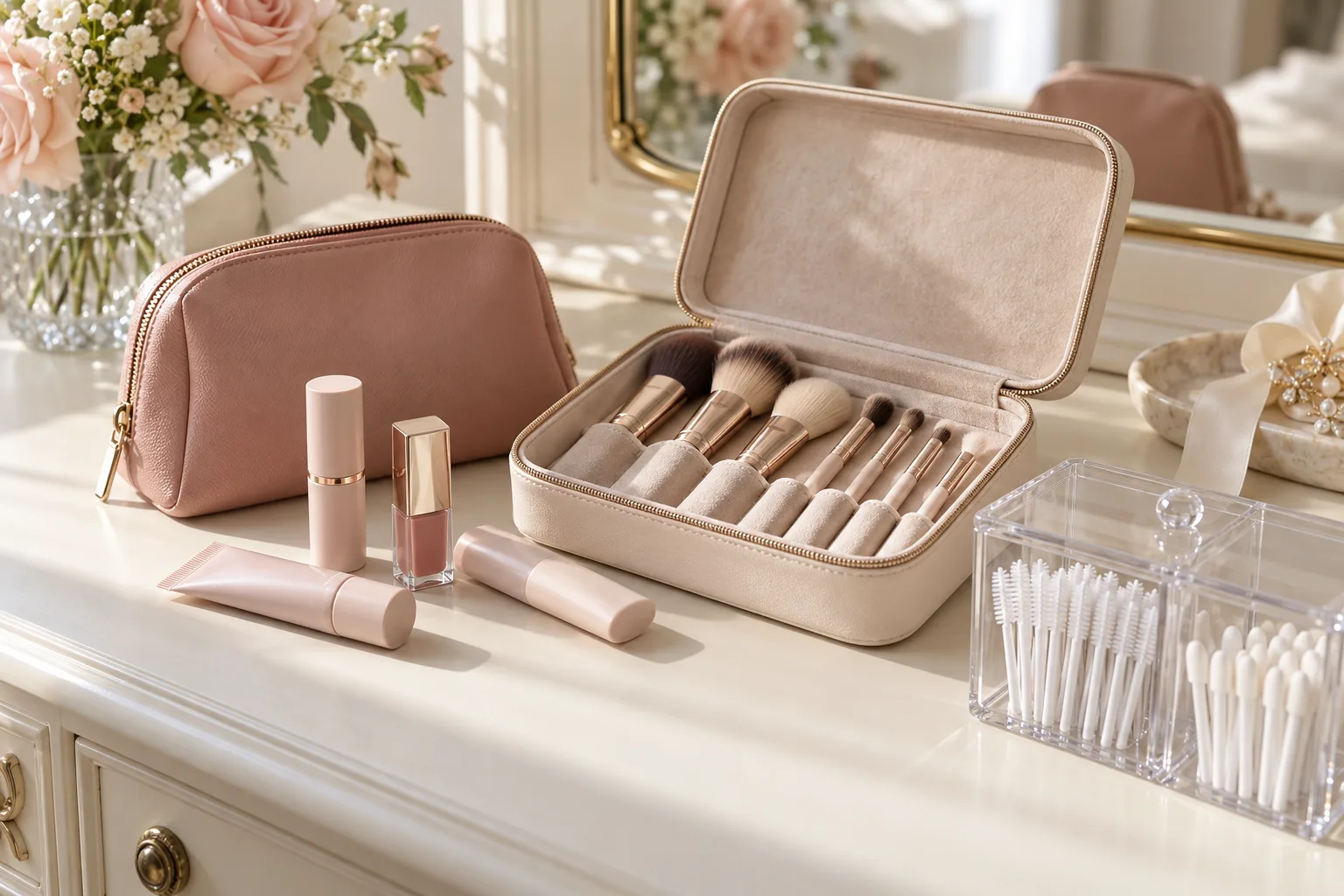
Before the makeup trial, look through the products you plan to bring and ask the artist how tools and cosmetics are handled between clients. The same conversation should cover the wedding morning, when several people may be getting ready in one room and a borrowed mascara can seem convenient.
Ask the artist to explain the working setup
Discuss hygiene when booking the trial. Ask how brushes are prepared between clients, how clean tools are stored and how used tools are kept apart from them. Request an explanation of how mascara, lipstick and cream products are dispensed and applied.
Texas's licensing department provides a concrete example: its inspection guide says makeup brushes and specified accessories must be replaced with clean items for each client, single-use items discarded, and applicators not re-dipped into products. [1]
Those are Texas provisions in the guide's service context. Ask what requirements apply where your appointment takes place; do not assume one state's wording governs every wedding.
For services covered by its special-event guidance, Texas says health and safety standards still apply at events, including weddings. [2] A hotel room or venue dressing suite should prompt questions about the setup and supplies.
Tell the artist how many people are booked and when each must be finished. Ask how the schedule accommodates changing tools and preparing the station. Add another artist or revise the order if the agreed process cannot fit the available morning.
Keep your own touch-up products separate
FDA advises against sharing eye cosmetics and warns that shared retail testers can carry contamination. If sampling is necessary, its guidance calls for a fresh single-use applicator. [3]
Do not pass one mascara wand between members of the wedding party. Ask the artist whether you should bring a personal mascara or other specified products and how those will be used during the service.
For touch-ups later, prepare an individual pouch with the products you have agreed to use. Identify who will hold it, and keep it separate from the communal getting-ready basket.
Label your personal items so a helper can return them to the correct pouch. A brush that has been used on someone else should not be handed back as though it has only touched your skin.
When shopping for a replacement shade, ask staff about the sampling method before a tester touches your face. A new applicator does not justify repeatedly returning it to the shared container after skin contact. If the process is unclear, skip the application and ask about another way to assess the shade.
Record purchase and opening dates
FDA says ordinary cosmetics are not required by U.S. law to carry a specified shelf life or expiration date. Manufacturers remain responsible for safety, and shelf life depends on the product, handling and storage. [4]
AAD explains that the open-jar symbol, when present, gives a number of months after opening. It recommends keeping track of when you open products. [5]
For the items you expect to use at the wedding, note the product name, purchase date, opening date and manufacturer instructions. Keep photographs of packaging information if you discard an outer box.
Do not assume a product is suitable because plenty remains in the tube. If you cannot establish its age or storage history, contact the manufacturer or replace it before the trial so the replacement can be assessed.
FDA's eye-cosmetics page says manufacturers usually recommend replacing mascara two to four months after purchase; AAD's consumer guide uses three months. [3] [5] Check the product's instructions rather than treating an online date chart as permission to keep it indefinitely.
If a product is also a drug, such as an SPF cosmetic, do not apply the ordinary-cosmetic labeling statement to it. Follow that product's labeling and relevant sunscreen instructions. [4]
Inspect the contents and the storage history
AAD advises discarding makeup that develops changes such as an unusual smell, altered color, clumping, separation or a different consistency. [5] An apparently normal appearance does not cancel a replacement instruction or establish an unknown product's age.
FDA explains that moisture can support microbial growth and heat can damage preservatives. It advises against leaving cosmetics in a hot car. [4]
Choose where your pouch will stay during transportation, photographs and the reception. Tell the person carrying it that it should come indoors with you rather than remain in a parked vehicle.
Follow the manufacturer's storage directions. If a container has leaked or been exposed to unsuitable conditions, ask the manufacturer about that product instead of improvising a cooling or dilution fix.
FDA says to discard dried mascara and never revive it with saliva or water. [3] Replace it before the appointment; asking an artist to rescue a dry tube wastes time and conflicts with that guidance.
Clean personal brushes with time to dry
For personal brush care, AAD recommends washing every seven to ten days. Its method rinses the tips in lukewarm water, uses gentle or clarifying shampoo, rinses until clear, removes excess moisture and dries brushes flat with the tips over the counter's edge. It cautions against soaking the whole head or drying upright because water can weaken the glue. [6]
Plan that cleaning ahead of packing, leaving time for drying. Keep the cleaned brushes protected from loose products and used tools in your bag.
AAD's makeup guide recommends cleaning a personal sponge after every use and letting it air dry after washing and rinsing. [5] Follow any additional care or replacement directions for your particular sponge.
These personal-care intervals do not authorize an artist to use the same uncleaned brushes across a morning of clients. Discuss the professional's between-client process separately.
If the artist asks you to bring your own tools, confirm which ones and how they should arrive. Bringing personal tools also does not remove the need to protect products from contamination during the service.
Plan eye makeup while seated and still
FDA warns against applying or removing eye cosmetics in a moving vehicle because an applicator can scratch the eye. It also advises using only products intended for the eye area there. [3]
Finish mascara and liner at the dressing location before departure. If the morning runs late, adjust the schedule rather than arranging an eye-makeup touch-up during the car ride.
Tell the artist about eye irritation, an infection or inflamed surrounding skin before the appointment. FDA advises avoiding eye cosmetics until the area heals and discarding those used when an eye infection occurred. [3]
If an eye cosmetic irritates you, stop using it immediately; FDA advises medical review if irritation persists. [3] Do not ask the artist to conceal worsening symptoms with another layer.
For planned lash services, use the false-lash and extension guide to organize separate adhesive and removal questions. A clean application does not establish that every ingredient suits you.

Physical Book (No Download)
Bridegenic: The Glow-Up Guide for Brides on GLP-1s
$12.95 + Free Shipping
Order NowThis article provides general education, not a diagnosis or an individual treatment plan. Medication information refers to US sources. Talk with your prescriber, pharmacist or dermatologist about decisions for your care.
Read next
Face & SkinFalse Lashes and Extensions: Plan Your Wedding Trial→Face & SkinYour Wedding Skincare Plan: From Engagement Photos to Makeup Removal→Sources
- Inspections Guide: Esthetician Services, rules 83.104(e)–(g)Texas Department of Licensing and Regulation↩ Back to text
- Special Events: Health and Safety StandardsTexas Department of Licensing and Regulation↩ Back to text
- Eye Cosmetic SafetyFDA↩ Back to text
- Shelf Life and Expiration Dating of CosmeticsFDA↩ Back to text
- When to toss your makeup and sunscreen, May 15, 2024American Academy of Dermatology↩ Back to text
- How to clean your makeup brushesAmerican Academy of Dermatology↩ Back to text