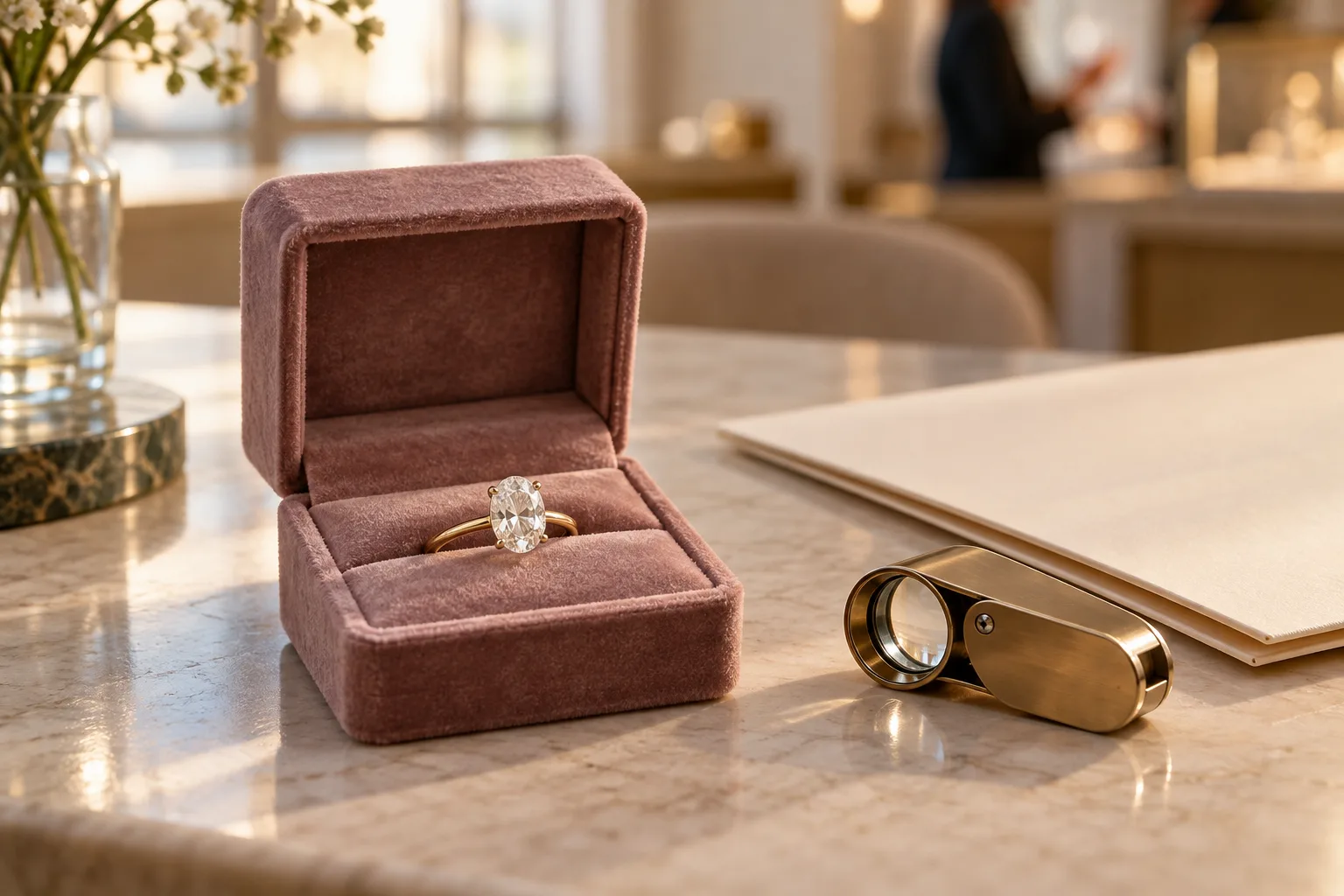
A lab-grown diamond purchase involves several separate questions: what the stone is, which laboratory assessed it, whether the report matches it and what the seller promises after purchase. Settle those questions before approving a setting, engraving or final payment. A report number alone cannot answer all of them.
Get the stone's identity in writing
The FTC distinguishes natural, laboratory-created and imitation gemstones. Laboratory-created gems have the corresponding natural gem's chemical, physical and visual properties but are manufactured. Imitations resemble another gemstone without sharing those properties. Moissanite may resemble a diamond but is a different material. [1] “Lab-grown diamond” and “diamond simulant” therefore describe different purchases.
Ask the seller to identify the center stone and the surrounding stones separately. A ring can have multiple components, so a description of the center does not settle the identity of every accent stone. Keep the description with the order rather than relying on a conversation at the counter.
If a listing uses an unfamiliar trade name, ask for the underlying material and origin. You should be able to understand the purchase without decoding a brand's vocabulary. Ask the jeweler how identity is tested and documented.
Understand which GIA service you are reading
GIA changed its assessment for colorless-to-near-colorless laboratory-grown diamonds on October 1, 2025. Its current service classifies eligible loose stones weighing at least 0.15 carats as Premium or Standard. The girdle receives a laboratory-grown inscription and assessment number. [2] [3]
Under the published criteria, Premium requires D color, clarity of Very, Very Slightly Included or higher, and Excellent polish and symmetry. For round brilliant diamonds, the cut grade must also be Excellent. Standard permits combinations of Premium criteria with the stated minimum Standard criteria, including E-to-J color and Very Slightly Included clarity. A stone below the minimum criteria does not receive this assessment. [3]
Those categories describe GIA's particular service. They are not interchangeable with a retailer's “premium collection,” and they do not automatically translate into another laboratory's individual grades. Read the document title, issuing laboratory and assessment date before comparing two offers.
GIA lists different services for laboratory-grown colored diamonds, including reports that assess growth type and post-growth treatment. [2] Do not apply the colorless service's two-category description to every colored stone. Ask which service produced the document for the stone you are considering.
Check the report, then check the stone
GIA's Report Check lets you compare report information with the laboratory's archived records. [4] Open the issuer's own site and enter the number yourself. Compare the document's origin description, shape, measurements, weight and other identifying information with what the seller has supplied.
Successful online lookup establishes that a matching record exists. It does not physically inspect the ring in front of you. Arrange for a qualified jeweler or gemologist to compare the stone and inscription with the document, and ask what further verification is appropriate if something does not match.
That distinction is supported by documented cases. In a Summer 2025 Gems & Gemology report, GIA examined four stones bearing counterfeit report inscriptions. Two were laboratory-grown diamonds and two were treated natural diamonds; none matched the natural diamonds described in the accompanying reports. [5] The case report shows why a familiar-looking number is insufficient, but it does not measure how common this problem is among retailers.
If the ring is already mounted, ask what can be checked in the setting and what would require additional work. Agree on any inspection arrangements before the return period ends. Do not remove a stone yourself to find an inscription.
Read growth and treatment wording separately
A growth method describes how a laboratory-grown diamond was produced. A post-growth treatment describes an additional process after that growth. Ask the seller to explain both entries when they appear, including whether the report states that treatment was detected, not detected or may be present.
IGI's January 2021 explanation illustrates why the wording matters. It described reports identifying untreated CVD and HPHT stones as grown with no indication of post-growth treatment, while other CVD reports could state that treatment may be included. [6] Read the exact wording and date of the document you receive; a statement of possibility is not a definite finding.
The FTC advises asking whether a gemstone has been treated. Sellers should disclose treatment that is impermanent, creates special care requirements or significantly affects value. [1] Request any care instructions in writing and pass them to anyone repairing or altering the ring later.
A laboratory-grown origin does not answer every treatment question, and a treatment entry does not by itself tell you whether you will like the finished ring. Examine the stone and ask for an explanation you understand before committing.
Compare the finished ring and full price
Ask to see the candidate ring in more than one lighting condition, with the seller's permission. Compare it with the wedding band you intend to wear, and check the setting height, how it sits on your finger and whether the bands touch as intended. The laboratory report concerns the stone; your purchase also includes the mounting and workmanship.
Request a complete quote identifying the selected stone, metal, setting, sizing, engraving, delivery and any separately charged work. If two quotes contain different stones or services, mark the differences before deciding which price suits your budget.
GIA says it does not certify or appraise materials submitted for analysis. Its reports provide technical characteristics rather than an appraisal value. [7] If the seller supplies an appraisal or discusses insurance, ask who prepared that document and what it is intended to establish. Keep it separate from the laboratory report and purchase receipt.
Settle returns and alterations before paying
The FTC recommends obtaining refund and return policies in writing and keeping the seller's descriptions, including origin, size, treatments and special care, in the sales paperwork. [1] Ask when the return period starts and whether resizing, custom fabrication, setting a loose stone or engraving changes your eligibility.
Get the delivery deadline and the response to a missed date in writing. Check whether a deposit is refundable, who pays return shipping and what condition and packaging a return requires. If you want an independent inspection, schedule it within the applicable period rather than assuming the deadline will be extended.
At collection, compare the finished order with the written specification and ask for any discrepancies to be resolved before accepting an alteration you did not authorize. Save the invoice, report, care instructions and return terms together. Your wedding date should help set the production schedule, not replace a clear purchase agreement.

Physical Book (No Download)
Bridegenic: The Glow-Up Guide for Brides on GLP-1s
$12.95 + Free Shipping
Order NowThis article provides general education, not a diagnosis or an individual treatment plan. Medication information refers to US sources. Talk with your prescriber, pharmacist or dermatologist about decisions for your care.
Read next
Dress & FittingsWedding Jewelry and Skin Reactions: Nickel, Rings and Metal Labels→Dress & FittingsWedding Ring Fit: Measurements, Resizing and the Final Check→Sources
- Buying Gemstones, Diamonds, and Pearls, November 2024Federal Trade Commission↩ Back to text
- Laboratory-Grown Diamond ServicesGemological Institute of America↩ Back to text
- GIA Launches Updated Laboratory-Grown Diamond Services October 1, August 26, 2025Gemological Institute of America↩ Back to text
- Report CheckGemological Institute of America↩ Back to text
- HPHT-Processed Natural and Laboratory-Grown Diamonds With Counterfeit Inscriptions, Summer 2025GIA Gems & Gemology↩ Back to text
- IGI Lab-Grown Reports Now Indicate Treatments, January 27, 2021International Gemological Institute↩ Back to text
- Does GIA Certify or Appraise Diamonds and Other Gemstones?Gemological Institute of America↩ Back to text