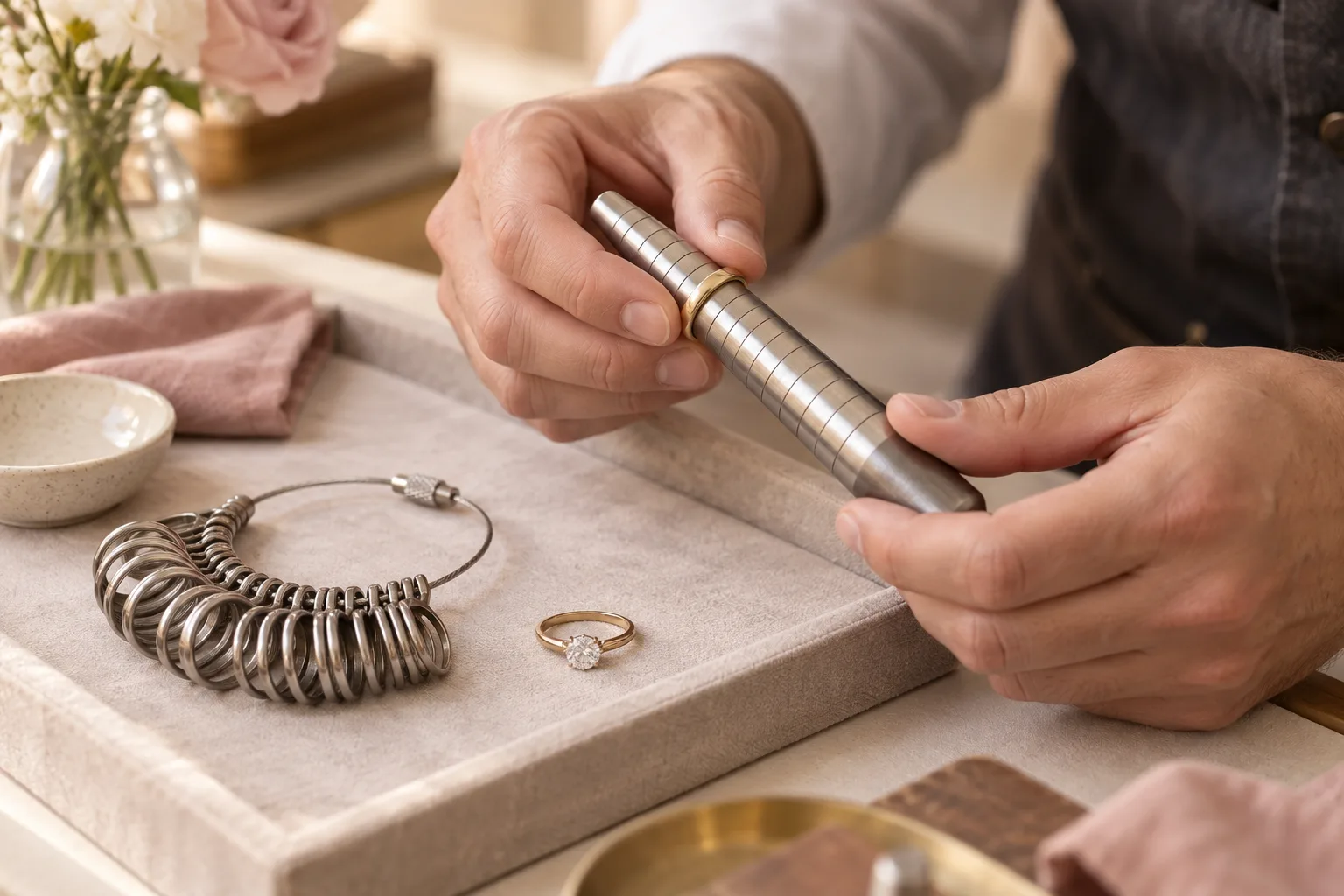
If your engagement ring has started turning on your finger or your wedding band feels tight beside it, take both pieces to a jeweler. Bring the wedding date, your usual wearing arrangement and a description of when the fit changes. A current measurement gives the appointment a useful starting point; a weight target cannot supply a finished ring size.
Measure the finger that will wear the ring
GIA recommends professional finger gauges and cautions that string stretches, paper distorts and a measurement around the finger's base misses the knuckle. Its guidance describes a fit that passes the knuckle, stays on and feels comfortable. [1]
Tell the jeweler which hand and finger you intend to use. If you bring another ring as a reference, identify where you wear it. A ring from your opposite hand or middle finger should not become an unexplained substitute measurement.
Describe the problem precisely: does the ring rotate while sitting at the base, catch at the knuckle during removal, or feel uncomfortable throughout the day? Ask the jeweler to watch you put on and remove an appropriate sizing band.
Record the size system on the work order, especially when ordering from another country. Keep the jeweler's measurement separate from an online conversion you used while browsing.
Bring the engagement ring and wedding band together
GIA's professional sizing benchmark specifies wide-finger gauges for rings wider than 4 mm. [2] Ask the jeweler to use a gauge suitable for the band you are buying.
GIA also flags bridal sets with a combined width above roughly 4 or 5 mm for special consideration. [1] Try the intended combination instead of choosing the wedding band solely from the size stamped inside your engagement ring.
Bring any additional band you plan to wear. Tell the jeweler whether the rings will usually be stacked, worn separately or moved between fingers. Ask how the width and inside shape affect the assessment.
For a custom order, request a clear explanation of what you can try before production. A narrow sample with a different inside profile may help compare appearance, but ask how the finished piece's fit will be checked.
Photograph the agreed arrangement for your own reference. Include which ring sits nearest the hand so the final fitting tests the combination you selected.
Describe changing fit without predicting a size
GIA notes that temperature, humidity, altitude and time of day can affect finger size. [1] Tell the jeweler if your ring feels different on a cold morning, during travel or later in the day.
If your body size is changing, explain that too. Ask whether another measurement before work begins would help, when that appointment should happen and what can be adjusted afterward.
Do not order a smaller ring in anticipation of a future weight or assume a particular medicine dose predicts a particular finger measurement. Ask for a plan based on the ring and the measurements available.
A useful note might read: “Turns at the base during desk work; catches at the knuckle in the evening.” That gives the jeweler more to assess than “wrong size.” Avoid repeatedly testing removal when it is uncomfortable.
If discomfort comes with a rash, bring that concern to an appropriate clinician. The jewelry and skin-reaction guide covers separate questions about metal exposure, irritation and assessment.
Have the design assessed before approving resizing
GIA identifies pavé, channel-set, twisted and full-eternity designs among rings that can be difficult to resize. [1] Difficulty needs an assessment of your piece; it should not be converted into a universal promise or prohibition.
Ask the jeweler to identify the metal, construction and stone-setting features that affect the proposed work. If the ring is inherited, disclose earlier repairs and provide any documentation you have.
Request an explanation of the method and its limits for this ring. Ask whether the work affects the pattern, engraving, finish, stone settings or the shape of the band. If a remake or exchange is proposed, have that quoted separately.
Ask who performs the work and where the ring will be kept. Before leaving it, obtain an intake record describing the piece and its condition, along with photographs if the business provides them. Keep your own purchase and service records accessible.
Do not approve an unspecified adjustment because a price sounds reasonable. The work order should distinguish resizing the band from adding an internal fitting aid or replacing part of the ring.
Discuss fitting aids and service terms
Jewelers of America's repair guidance lists sizing beads placed inside the bottom of the band as an option for small sizing discrepancies. [3] Ask whether an internal fitting aid suits your knuckle, ring construction and comfort needs.
Have the jeweler explain how the proposed aid feels, how it is maintained and whether it can be removed or altered later. A description online cannot establish how it will feel on your hand.
Check the original seller's service terms before commissioning work elsewhere. Tiffany, for example, offers complimentary resizing for its engagement-ring purchases and recommends against repeated resizing. [4] That policy does not establish the price or coverage for another seller or a wedding band.
Ask about shipping, insurance during transit, inspection, return appointments and charges if the fit needs another adjustment. Record any warranty conditions that affect using a different repairer.
If the jeweler recommends waiting, agree on a review date and a comfortable wearing option in the meantime. Do not leave with only “come back closer to the wedding” when the workshop needs a defined lead time.
Leave time for the final fitting
Book pickup early enough to try the finished work with the jeweler present. Confirm the last date on which the shop can assess a problem before you leave for the venue or destination.
At pickup, try each ring separately and then the intended combination. Describe any pressure, catching or rotation. Ask the jeweler to explain the completed work and inspect the settings, finish and engraving with you.
If the fit is uncomfortable, have it assessed before taking the ring home as wedding-ready. Do not let a paid invoice close the discussion while the jeweler is still available to examine it.
Agree with your partner on a simple ceremony alternative if the intended ring cannot be made comfortable in time, such as using a different suitable band. Tell the officiant and the person holding the rings what you have chosen.
For the handoff, name the person responsible for collecting the rings, storing them and bringing them to the ceremony. Put the receipt and service contact in your planning folder, rather than asking that person to remember the sizing discussion.

Physical Book (No Download)
Bridegenic: The Glow-Up Guide for Brides on GLP-1s
$12.95 + Free Shipping
Order NowThis article provides general education, not a diagnosis or an individual treatment plan. Medication information refers to US sources. Talk with your prescriber, pharmacist or dermatologist about decisions for your care.
Read next
Dress & FittingsWedding Jewelry and Skin Reactions: Nickel, Rings and Metal Labels→Wedding WeekYour Wedding-Week Checklist: Food, Medicine and Named Handoffs→Sources
- How to Determine Ring Size: Tips and Ring Size Chart, January 18, 2018Gemological Institute of America↩ Back to text
- Accurate Determination of Finger and Ring SizesGemological Institute of America↩ Back to text
- Jewelry RepairJewelers of America↩ Back to text
- How do I resize my engagement ring?Tiffany & Co.↩ Back to text