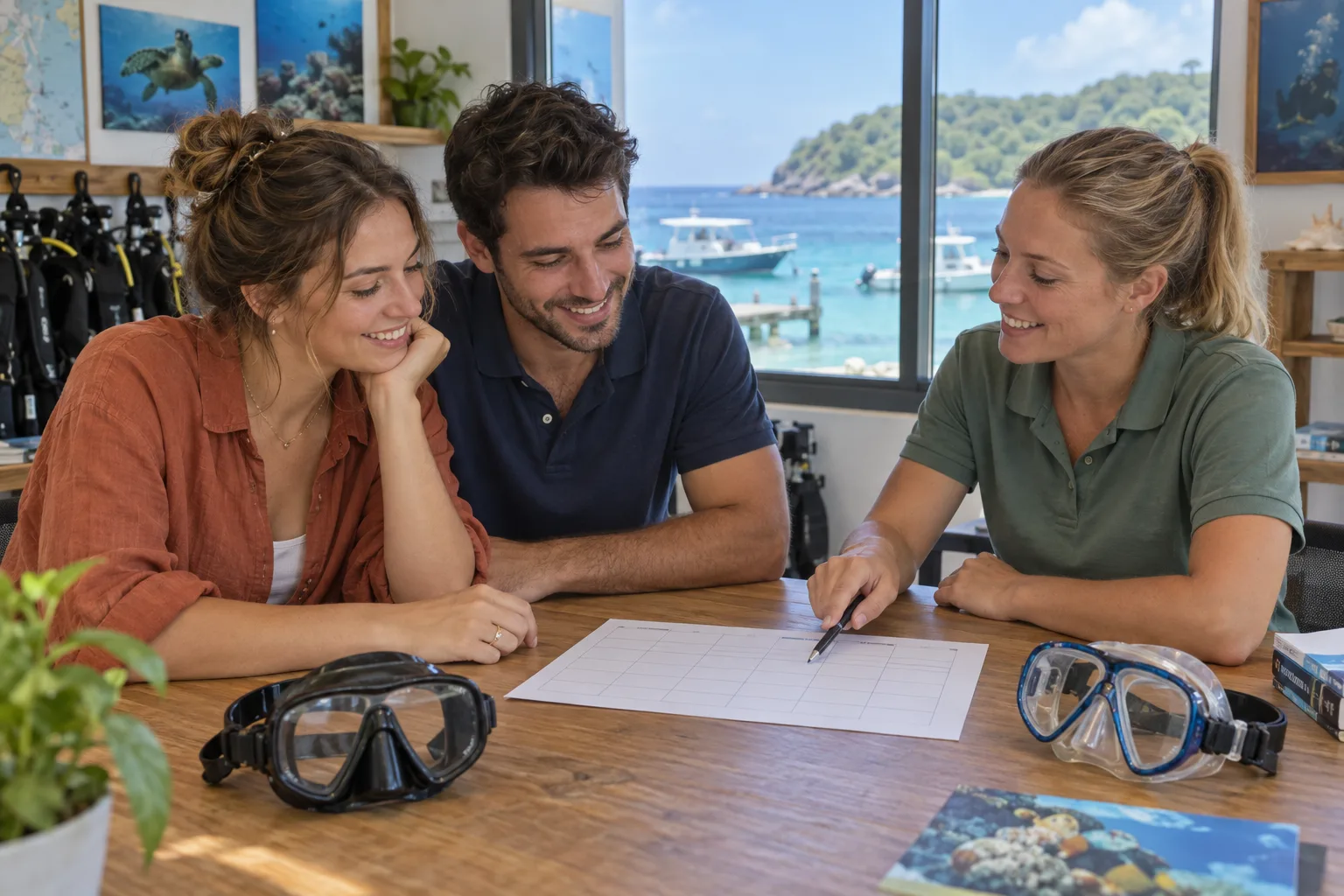
Before booking honeymoon scuba sessions, ask the operator for its medical questionnaire, training requirements and proposed dive schedule. Put the final dive beside every later flight and uphill transfer. These details are easier to review before travel than at a boat departure desk.
Request the current medical form
The Diver Medical Screen Committee's participant questionnaire, version January 1, 2026, covers recreational scuba and freediving. It directs specified answers to a medical evaluation, and says people who feel ill should avoid diving. [1]
Get the form before making a nonrefundable booking. Follow its routing instructions rather than answering only the first page or asking the operator to overlook a medical item.
The form asks about prescription medicines, with listed exceptions, and conditions including diabetes, ear problems and recent surgery. It also asks about recovery from recent dental or oral procedures. [1]
A “yes” requiring evaluation is a reason to obtain that evaluation, not a diagnosis or automatic permission to proceed. Send the complete form to the appropriate clinician and ask the operator what documentation it needs.
Discuss any concerns not captured by the questions as well. A completed checklist cannot establish that every possible health issue has been assessed.
Bring medicines, symptoms and pregnancy plans into the review
Tell the evaluating clinician which medicines you use, the reason for each and any recent symptoms. If taking a GLP-1 medicine, include the exact product and any nausea, reflux, vomiting, reduced intake or other difficulties.
Ask a clinician familiar with diving medicine how the treatment and your condition affect participation. Do not stop a prescription to change your answer to the form or assume a medicine is irrelevant because it is used for weight management.
If you have diabetes, obtain a diving-specific assessment. A wedding-day glucose plan should not be copied underwater, where monitoring, treatment and rescue present different circumstances.
The 2026 questionnaire advises people who are pregnant or attempting pregnancy not to dive. [1] Discuss a suitable alternative activity if that applies to your honeymoon plans.
Ask what to do if your health or medicines change after the evaluation. Keep the operator informed through its appropriate process instead of relying on an earlier signature after new symptoms arise.
Match the booking to your training and comfort
Explain whether you are a first-time participant, certified diver or returning after time away. Ask what training, refresher or supervised experience the operator requires for the specific activity.
Have it describe the boat, entry and exit method, conditions and physical tasks. Ask about carrying equipment, climbing the ladder and getting assistance where needed.
Discuss equipment fitting and how to signal that you want to stop. Do not assume your partner's experience transfers to you or that both of you must choose the same excursion.
Ask which activities can be rescheduled or declined and what happens if illness, weather or an unresolved medical question prevents participation. Record those terms before paying.
This article does not teach underwater procedures. Learn and practice those with the qualified instructor responsible for the activity.
Address congestion and equalization before descent
DAN's ear-injury guidance advises against diving with a cold or congestion. It says that if pressure cannot be equalized during descent, the dive should be ended safely. [2]
Tell the instructor about ear surgery, hearing or balance problems, recurring sinus symptoms and previous difficulty equalizing. Include new symptoms on the day, even if the earlier medical form was completed.
DAN's equalization guidance warns that forcing the maneuver increases injury risk and that pressure injury can occur in shallow water. [3] Learn the technique from the instructor and stop descending when there is discomfort.
Do not take a decongestant simply to push through a booking. DAN explains that a medicine wearing off at depth can contribute to blocked pressure release on ascent. [2] Ask the clinician about any product you are considering.
The seasonal-allergy guide can help organize your existing symptom and medicine history, but its everyday allergy plan does not establish fitness to dive.
For suspected ear injury, stop further diving and obtain medical assessment. DAN identifies hearing changes, ringing and vertigo as concerning symptoms; severe vertigo and nausea after diving need emergency care. [3] [2]
Reserve time after the final dive
DAN's published consensus guidance gives minimum preflight surface intervals of twelve hours after a single no-decompression dive and eighteen hours after multiple dives in a day or diving over several days. [4]
Its stated scope is symptom-free divers after air dives, followed by flights with cabin altitudes between 2,000 and 8,000 feet. The recommendations reduce risk but do not guarantee prevention of decompression sickness; longer intervals further reduce risk. [4]
Have the operator apply the appropriate rules to your actual dives, training agency and itinerary. If another applicable requirement is longer, plan for it. Do not shorten the schedule because an online summary gives a smaller number.
For dives requiring decompression stops, DAN's text advises a substantially longer interval than eighteen hours. [4] Those dives need specific planning with the qualified operator and relevant medical advice; the basic figures above should not be extended to them.
Include a domestic connection, short island flight or uphill road transfer in the conversation. Ask which elevation changes affect your plan and how they will be accommodated.
Put the final planned surfacing time and flight departure in the same time zone on the itinerary. Confirm how the operator calculates the interval if the dive finishes late or an extra dive is offered.
Seek advice for symptoms after diving
DAN lists possible decompression-illness symptoms including joint or muscle pain, numbness or tingling, unusual fatigue, weakness, dizziness, rash, breathlessness and confusion. [5]
Report concerning symptoms to the operator and obtain prompt medical assessment. Do not decide that a sore joint must be from luggage or that dizziness is simply the boat trip.
Call local emergency services for serious symptoms such as breathing difficulty, collapse or neurological changes. Tell responders about the diving and follow their instructions.
DAN advises medical evaluation even when suspected decompression-illness symptoms improve after oxygen first aid, because they can return. [5] Trained oxygen support is part of an emergency response, not a reason to abandon assessment.
DAN also advises avoiding flight and seeking medical advice when symptoms might indicate decompression sickness. [4] Do not board because the minimum interval has elapsed while symptoms remain unresolved.
Keep the dive record available, including times, depths, breathing gases and symptoms. Ask the operator to supply the information the medical team needs.
Ask how the operator obtains medical help
Before booking, ask about the emergency action plan, communications, trained first-aid staff and oxygen supply. Have the operator explain how an injured diver reaches medical care from the actual dive site.
Ask how it coordinates specialist advice and transport if recompression treatment is considered. Do not equate having a chamber somewhere on the island with having a complete emergency arrangement.
Check insurance terms for the activities, training, depth limits, rescue, treatment and evacuation you are considering. Confirm the assistance contact and authorization process with the insurer.
The honeymoon insurance guide covers benefit and payment questions. A general medical policy or booking protection package should not be assumed to include diving-related treatment.
Share the final booking, emergency contacts and post-dive travel schedule with your partner. Keep an alternative day plan available if either of you should not dive.

Physical Book (No Download)
Bridegenic: The Glow-Up Guide for Brides on GLP-1s
$12.95 + Free Shipping
Order NowThis article provides general education, not a diagnosis or an individual treatment plan. Medication information refers to US sources. Talk with your prescriber, pharmacist or dermatologist about decisions for your care.
Read next
Honeymoon & BeyondHigh-Altitude Honeymoon: Sleeping Elevations, Symptoms and Care→Honeymoon & BeyondHoneymoon Travel Insurance: Medical Care, Evacuation and Cancellation→Sources
- Diver Medical Participant Questionnaire and Medical Examiner’s Evaluation Form, January 1, 2026Diver Medical Screen Committee; UHMS↩ Back to text
- Ears & Diving: Chapter 2, InjuriesDivers Alert Network↩ Back to text
- Ear Equalization Guidelines for Scuba DiversDivers Alert Network↩ Back to text
- Flying After Diving: Consensus Recommendations and LimitationsDAN World↩ Back to text
- Decompression Illness: Symptoms and ResponseDAN World↩ Back to text