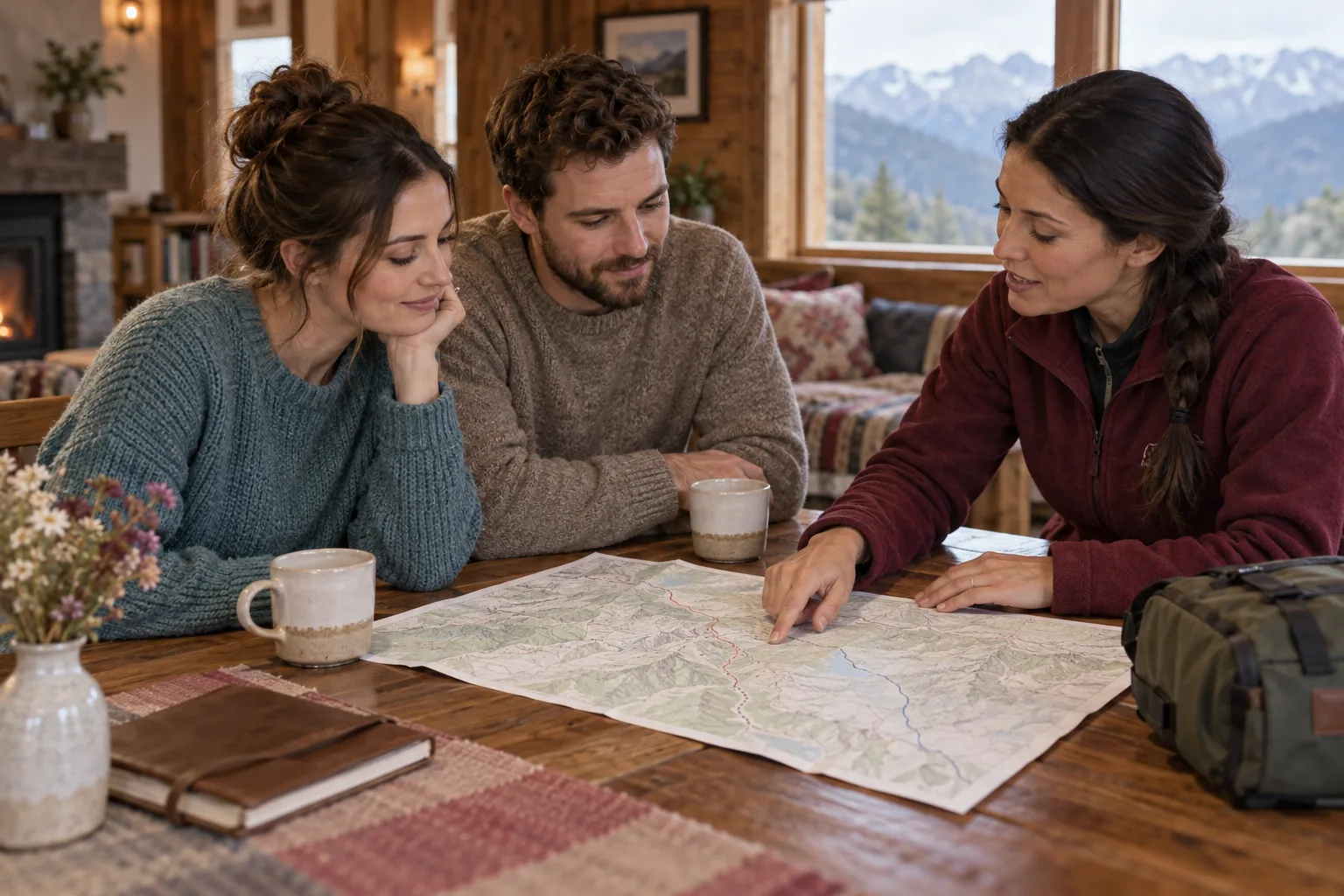
For a honeymoon in the mountains or a high-elevation city, bring more than the destination name to your travel-health appointment. List the elevation of each overnight stop, the arrival airport, higher excursions and the route to lower ground. Ask the clinician to assess the pace and your health before you commit to the schedule.
Write down the overnight elevations
CDC says an unacclimatized traveler sleeping at about 8,000 feet or higher can develop altitude illness, sometimes at lower elevations too. Physical fitness does not determine protection. [1]
Make a day-by-day itinerary showing where you arrive, the day's highest point and where you sleep. Ask the accommodation or tour operator to confirm elevations rather than using one figure for an entire region.
Include an airport transfer over a high pass, a cable-car trip or an optional hike. A booking described as a city stay can still involve rapid arrival at substantial elevation.
CDC's traveler guidance suggests considering higher day trips with a return to lower elevation for sleep. [2] Ask whether that approach suits your itinerary and health; a day excursion still needs assessment.
Bring the route to a clinician familiar with altitude travel. Ask which nights or transfers should change before making nonrefundable commitments.
Leave room for acclimatization
The Wilderness Medical Society's 2024 guideline prioritizes gradual ascent. Above 3,000 metres, it recommends increasing sleeping elevation by no more than 500 metres, about 1,650 feet, per day and including a rest day without a higher sleeping stop every three to four days. [3]
CDC's Yellow Book also describes the 500-metre sleeping-elevation limit, with an extra acclimatization night for each 1,000 metres gained. [1] Have the clinician apply an appropriate schedule to the route rather than treating either interval as a guarantee.
Ask the operator to identify the nights intended for acclimatization. A free afternoon does not automatically serve the same purpose if the itinerary moves you to a much higher bed that evening.
If a flight makes abrupt ascent unavoidable, discuss the arrival and first nights explicitly. Ask whether a lower overnight location or another route would help.
Keep the first activity bookings flexible. Agree in advance that you can cancel or move a hike without needing to argue about a deposit while feeling ill.
Review your health and earlier altitude experience
CDC recommends specialized advice for relevant heart or lung disease, sleep apnea and other underlying conditions. Pregnancy also needs assessment of maternal health, the pregnancy and access to care. [1]
Bring all medicines, including prescriptions, sleep aids and any products marketed for altitude. Tell the clinician about recent symptoms and any difficulties eating or drinking.
Describe earlier altitude trips with the sleeping elevations and ascent rate if you know them. The WMS guideline cautions that a trouble-free earlier trip does not establish low risk for a faster or higher itinerary. [3]
If you use CPAP or another medical device, ask about the device, power, permitted operating conditions and any additional care plan needed. Do not discontinue prescribed treatment because a hotel is remote.
If you have diabetes, discuss the complete management plan, supplies and device instructions with your care team. Keep that conversation specific to the trip and your treatment.
Ask which medicines belong in your plan
CDC advises discussing preventive or treatment medicines with a clinician, particularly when gradual ascent is not possible. [2] Ask whether your route warrants medication and what each prescribed product is intended to do.
Record start and stop instructions, dose, side effects, interactions and the symptoms that override the itinerary. Ask what to do if you vomit, miss a dose or become unable to eat or drink normally.
Do not borrow a companion's altitude tablets or assemble an emergency kit from several online regimens. A medicine that suits another traveler may not suit your history.
If you take a GLP-1 medicine, share that information and any current nausea or reduced intake. Ask how to distinguish symptoms needing assessment and whom to contact, rather than assuming every stomach symptom is a familiar treatment effect.
The honeymoon medicine guide covers the separate tasks of storage, import rules and labeled supplies.
Keep the arrival days flexible
CDC's traveler guidance advises avoiding alcohol and heavy exercise for at least the first forty-eight hours after arrival above 8,000 feet. [2]
Discuss that with your partner before booking a strenuous first-day activity or a celebration centered on alcohol. Schedule an arrival period that allows you to rest and observe how you feel.
Arrange accessible food and drinks that fit your usual needs and any clinical instructions. Do not rely on finishing a long excursion to reach the day's first meal.
WMS says forced hydration has not been shown to prevent altitude illness and can increase the risk of low blood sodium. Adequate hydration still matters because dehydration can resemble altitude illness. [3]
Ask for individual fluid advice where needed. Drinking extra litres should not become a substitute for changing an unsuitable ascent plan or responding to symptoms.
Tell your partner about symptoms promptly
NHS lists headache, appetite loss, nausea or vomiting, tiredness, dizziness and difficulty sleeping among altitude-sickness symptoms. It advises telling a companion and resting at the same altitude, without climbing or traveling higher, when symptoms occur. [4]
CDC notes that symptoms often begin within two to twelve hours of arrival or further ascent, including during or after the first night. [1] Feeling fine at airport pickup does not settle how the first night will go.
Agree that either traveler can report symptoms without having to defend the decision to pause. Tell the guide as well, using the symptoms and their timing rather than only saying you are tired.
Do not assume a headache is from the wedding celebrations or that nausea must be food-related. A clinician may need to consider several causes.
NHS advises going lower if symptoms worsen or have not improved after a day. [4] Follow the individualized plan and seek help sooner for serious symptoms; a day is not a waiting period for deterioration.
Recognize signs requiring immediate help
NHS identifies confusion, balance or coordination problems, breathlessness at rest, marked sleepiness, coughing up frothy or bloody material and blue or grey coloring as reasons for immediate medical help at altitude. It advises going lower straight away if possible. [4]
Know how to reach local emergency services, the guide and medical support. Tell your partner where the contact information is stored, and keep it available offline.
Ask the operator how an unwell traveler is assisted to lower elevation and where medical assessment is available. Discuss actual transport and staffing rather than accepting “we have oxygen” as the entire emergency plan.
Do not send an unwell traveler down alone. Obtain emergency assistance and follow the response instructions you have been given.
Ask the insurer about altitude limits, activities, rescue, medical transport and authorization. The travel-insurance guide can help identify the relevant policy questions.
Do not rely on an altitude product as clearance
WMS says small oxygen canisters and oxygen-bar visits do not have a role in preventing acute mountain sickness or high-altitude cerebral edema. It also finds insufficient evidence to substitute coca products for established preventive measures. [3]
Ask the clinician about any supplement, drink mix or product you are considering. A promotional claim should not replace itinerary assessment.
Keep medical oxygen arrangements, if prescribed, separate from a souvenir canister or hotel amenity. Ask the relevant care team and operator to explain equipment, supply and trained assistance.
Before departure, review the final route with your partner. Keep the decision to stop ascent and obtain care explicit, even if the trip changes.

Physical Book (No Download)
Bridegenic: The Glow-Up Guide for Brides on GLP-1s
$12.95 + Free Shipping
Order NowThis article provides general education, not a diagnosis or an individual treatment plan. Medication information refers to US sources. Talk with your prescriber, pharmacist or dermatologist about decisions for your care.
Read next
Honeymoon & BeyondHoneymoon Travel Insurance: Medical Care, Evacuation and Cancellation→Honeymoon & BeyondYour Honeymoon on a GLP-1: How to Pack and Store Your Medicine→Sources
- High-Altitude Travel and Altitude Illness, April 23, 2025; Yellow Book 2026CDC↩ Back to text
- Travel to High Altitudes, reviewed August 16, 2022CDC Travelers’ Health↩ Back to text
- Wilderness Medical Society Clinical Practice Guidelines for Acute Altitude Illness: 2024 UpdateLuks and colleagues, Wilderness & Environmental Medicine↩ Back to text
- Altitude sicknessNHS↩ Back to text