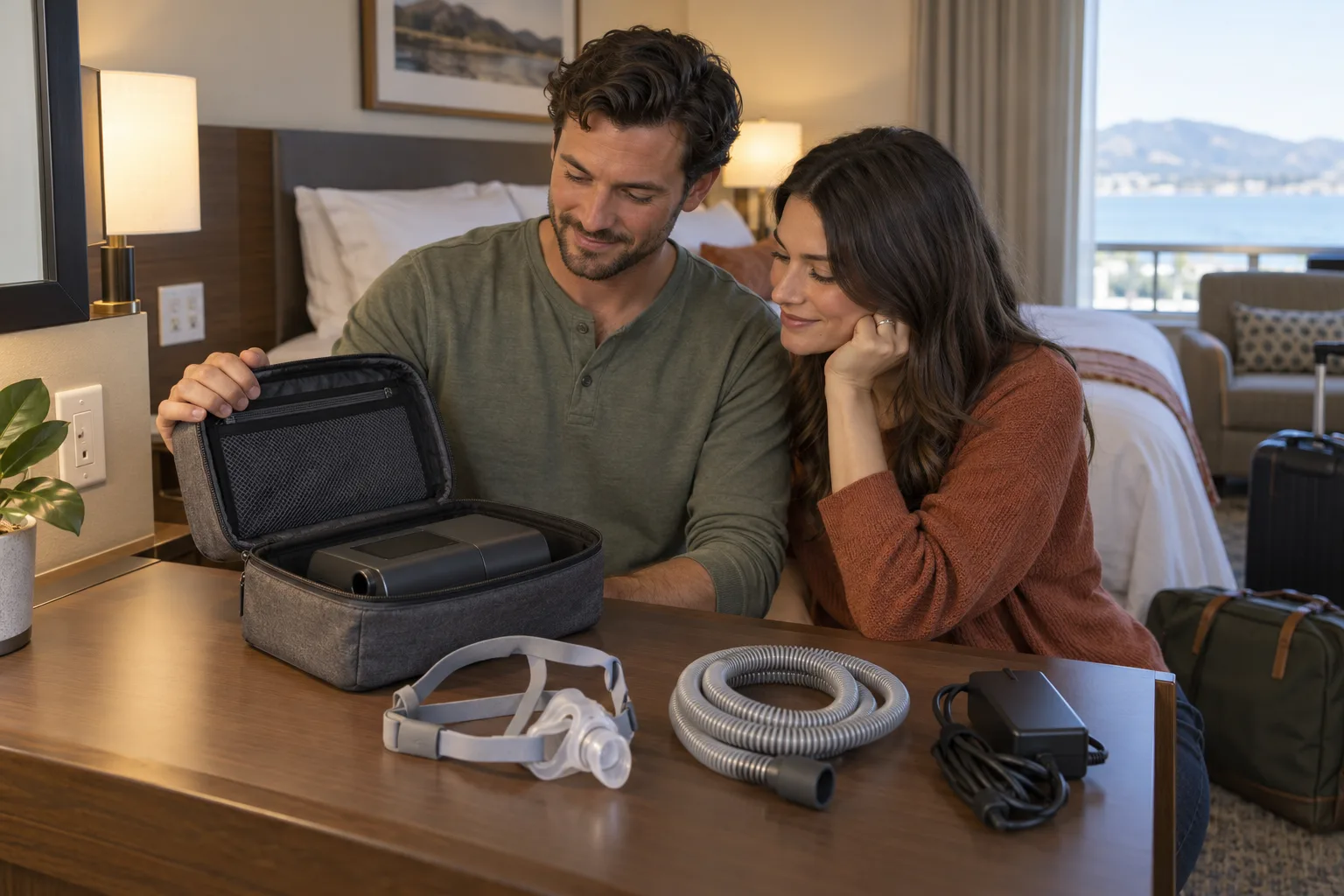
If you use CPAP for obstructive sleep apnea, plan for every night away, including the wedding hotel and overnight travel. Confirm the exact machine, power supply, mask and humidifier arrangements before departure. Put the equipment on the itinerary alongside the flights and accommodation.
Ask about treatment changes before packing
If your weight, symptoms or treatment have changed, arrange a sleep-clinic review. Bring the device information, current prescription, symptoms and any difficulties with the mask or therapy.
AASM's 2021 guidance says follow-up sleep testing may be used after clinically significant weight gain or loss. It also supports reassessment for persistent or returning symptoms despite good PAP adherence, while not recommending routine repeat testing for asymptomatic people doing well on PAP. [1]
Ask the clinician whether a review or test is appropriate for you. Do not select a new pressure from a weight-loss percentage or change settings to match a travel blog.
If taking Zepbound, its August 2026 prescribing information contains a specific limitation: the OSA trials did not establish when stopping PAP was appropriate for people previously using it consistently. [2]
One trial included PAP users who suspended treatment for seven days before the study assessment. [2] That research procedure is not an instruction to take a seven-night honeymoon break.
Ask the sleep clinician to confirm what treatment you should use until any reassessment is complete. This article concerns travel with CPAP for OSA; other forms of respiratory support need their own specialist travel arrangements.
Identify the complete setup
Write down the machine's manufacturer and model, mask name and size, tubing, power supply and any humidifier parts. Photograph the equipment labels and save the user guide offline.
Ask the supplier which spare parts are appropriate for the trip and how to obtain a replacement if a mask, connector or power supply fails. Save its support contact, including hours in the destination's time zone.
Check that the travel case contains the components for your setup. A smaller travel machine may require different accessories, so have the supplier confirm compatibility before substituting parts.
Practice packing and setting up the equipment before the wedding weekend. If using a newly prescribed travel device, allow time to learn its controls and resolve fit or comfort problems with the care team.
Keep the prescription and any manufacturer travel-compliance document with the case. Ask the airline which documentation it needs for your model and intended use.
Separate carrying the device from using it onboard
U.S. Department of Transportation guidance identifies CPAP as an assistive device and says assistive devices do not count toward the baggage limit. Cabin storage must still fit the available location and applicable safety rules. [3]
Tell each operating carrier whether you intend to use the device in flight or simply carry it to the destination. Include connections operated by another airline.
Ask about advance notice, device labels, seating, storage during takeoff and landing, battery requirements and any forms. Keep the response with your booking.
Delta provides a useful example of why the distinction matters. Its PAP policy requires an independent compliant battery supply providing 150% of the actual flight duration for onboard use, regardless of how long you intend to use the device. It says this battery-duration requirement does not apply when an accepted PAP machine is carried without being used. [4]
Delta also says its onboard outlets are not intended to support medical devices. [4] Do not build a plan around a seat map showing an outlet without checking the carrier's medical-device policy.
These are Delta's published requirements, not a universal approval for another carrier. Have your airline review the actual device and route.
Check capacity, compatibility and packing
Ask the equipment supplier to identify a compatible battery and estimate runtime for your device, settings and accessories. Then have the airline confirm that the battery and quantity meet its requirements.
FAA's lithium-battery guidance gives a standard limit of 100 watt-hours per rechargeable battery, with airline approval for up to two larger spares in the 101–160 Wh range. Airlines may apply stricter limits. [5]
Check the marked watt-hour rating before buying a battery. Capacity stated only in milliamp-hours is not enough information to compare directly with a watt-hour limit.
FAA says spare lithium batteries and power banks must remain in cabin baggage, with terminals protected against short circuits. They must be removed if a carry-on bag is gate-checked. [5]
Ask how to protect and stow your specific battery. Keep it accessible if an agent asks you to check another bag, and do not assume medical use waives battery safety restrictions.
Test the approved setup before departure with the supplier's guidance. A claimed runtime for a different machine or accessory configuration is not a verified runtime for yours.
Prepare for each airport's screening process
Check the screening authority's current instructions for the departure, transit and return airports. Airline permission to carry or use a machine does not answer every screening question.
For U.S. departures, consult TSA's CPAP screening page before travel and ask TSA for clarification if needed. Follow the officer's instructions at the checkpoint.
Pack the machine so it can be accessed without unpacking the entire suitcase. Ask the supplier how to keep the components protected if inspection is required.
Tell the screening authority beforehand if you need assistance or have questions about water or other supplies. Do not copy a relative's experience at a different airport as your only instruction.
After screening, check that the case contains your machine and all components before leaving the area.
Use the exact device's water and flight instructions
ResMed's Air Solutions support page recommends distilled water for its humidifier tub and says the tub should be emptied before transport. Its flight guidance says to turn humidification off and enable airplane mode, with specific instructions for supported devices. [6]
Ask your supplier to explain the current user-guide instructions for your model. Confirm whether the tub remains inserted, a different cover is needed or the device uses a different humidification system.
Do not transfer instructions between a conventional humidifier and a travel device that uses waterless humidification. Ask which accessories you need and how to maintain them.
For the destination, arrange the type of water specified for your device. If it will be unavailable, obtain product-specific advice before arriving rather than substituting an unverified liquid.
Keep the cleaning and drying routine from the manufacturer's instructions. Ask how to follow it during hotel changes, boat transfers or an itinerary without a suitable place for equipment care.
Confirm power at every overnight stop
Send the hotel a specific request about a suitable power outlet near the bed and a stable place for the machine. Include the wedding-night room if it differs from the room used for preparation.
Ask the supplier about the electrical requirements on your power supply, plug adapters and any additional approved equipment needed abroad. A plug fitting the wall does not by itself confirm the whole setup is suitable.
For a cruise, campsite or remote lodge, ask about power availability, restrictions and interruptions before booking. Obtain a plan from the supplier for the actual conditions.
ResMed notes that altitude compensation differs between devices and advises checking with an equipment professional. [7] Include the sleeping elevation if the honeymoon visits mountains.
The altitude guide covers the itinerary discussion, while the cruise-care guide covers advance requests to the named ship.
Set up before the end of the evening
On arrival, check the equipment, outlet, accessories and water arrangements while the supplier or hotel staff can still be reached. Do this before dinner rather than discovering a missing cable at bedtime.
Ask the sleep clinician what to do if treatment cannot be used as prescribed. Keep that contingency advice with the device record and use the support contact if equipment fails.
Tell your partner how to help locate supplies and contacts. They should not have to guess at pressure settings or assemble unfamiliar parts.
For the wedding hotel, give the person moving luggage a clear instruction that the CPAP case goes to the room where you will sleep. Confirm its arrival before leaving for the reception.

Physical Book (No Download)
Bridegenic: The Glow-Up Guide for Brides on GLP-1s
$12.95 + Free Shipping
Order NowThis article provides general education, not a diagnosis or an individual treatment plan. Medication information refers to US sources. Talk with your prescriber, pharmacist or dermatologist about decisions for your care.
Read next
Honeymoon & BeyondHigh-Altitude Honeymoon: Sleeping Elevations, Symptoms and Care→Honeymoon & BeyondHoneymoon Cruise: Medical Care, Medicines and Help Ashore→Sources
- Use of PSG and Home Sleep Apnea Tests for Longitudinal Management of OSA in Adults, June 2021, DOI 10.5664/jcsm.9240American Academy of Sleep Medicine; PubMed↩ Back to text
- Zepbound U.S. Prescribing Information, revised August 2026, OSA clinical studiesEli Lilly and Company↩ Back to text
- Assistive Device: Stowage, Damage, and DelayU.S. Department of Transportation↩ Back to text
- Medical Devices and Medication: PAP Devices and PowerDelta Air Lines↩ Back to text
- PackSafe: Lithium Batteries, updated August 11, 2026Federal Aviation Administration↩ Back to text
- Air Solutions Support: Humidification and Travel FAQsResMed↩ Back to text
- Traveling with CPAP Equipment: Altitude and Power QuestionsResMed↩ Back to text