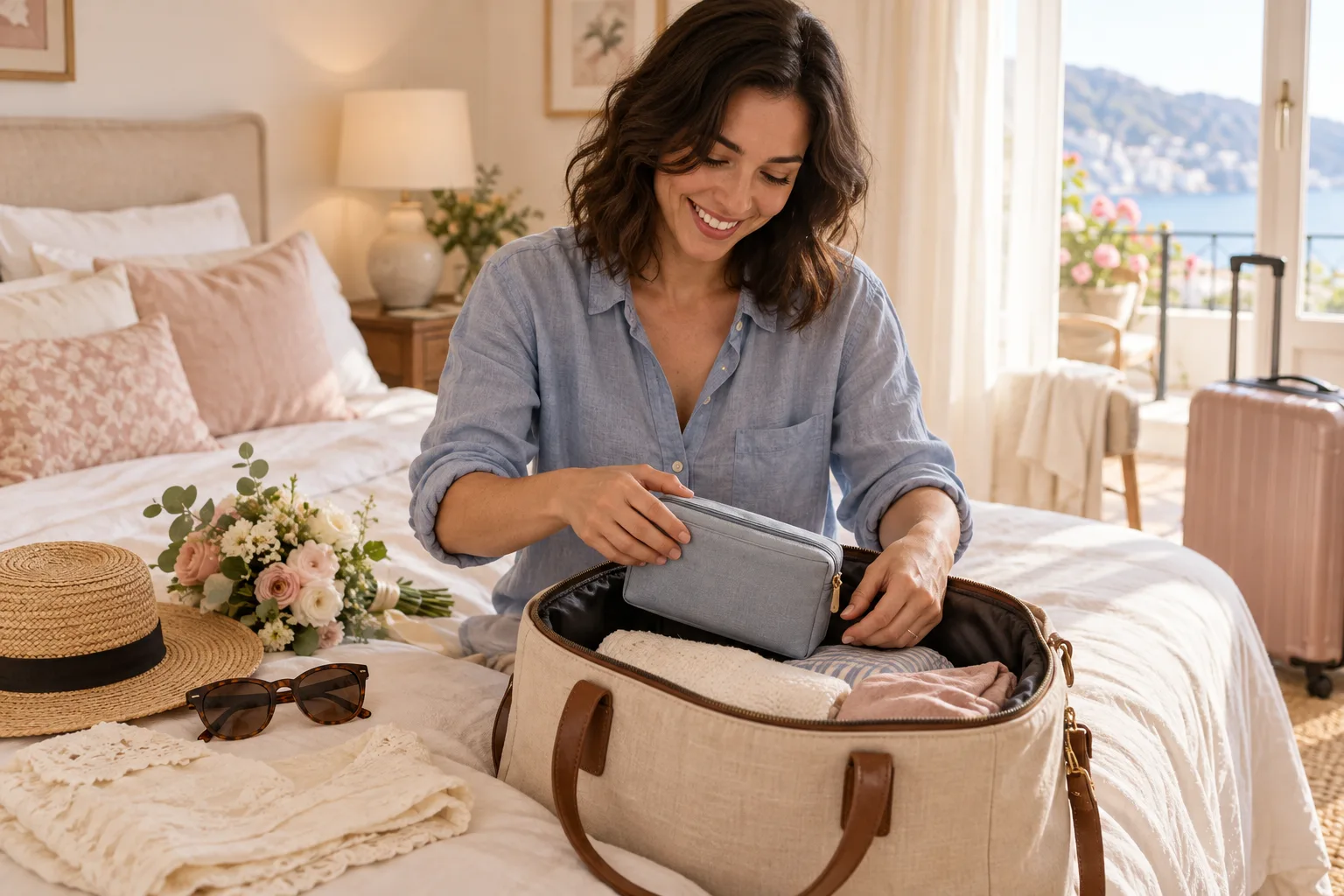
Your honeymoon packing list needs one entry more specific than “medicine”: the exact product, the container it comes in, and its storage instructions. A ten-day trip can still include a hot airport transfer, a delayed suitcase and a hotel fridge you have never used. Sort out those conditions before departure so the medicine pouch has a place in the plan.
Start with the carton, not the ingredient name
Photograph the pharmacy label and the product carton. Write down the brand, ingredient, strength, device and expiration date, plus whether the container has been opened. “Semaglutide” alone does not identify the storage rule for your package.
The current Zepbound label distinguishes single-dose pens and vials from multi-dose vials and KwikPens. Those presentations have different discard limits. [1] If your pharmacy changes the device before departure, have the pharmacist check the travel plan again.
Two single-dose storage rules worth writing down
US Wegovy single-dose pen: refrigerate at 36°F to 46°F (2°C to 8°C). Before cap removal, the pen can be kept at 46°F to 86°F (8°C to 30°C) in its original carton for up to 28 days. The patient instructions say to discard it if frozen, exposed to light or temperatures above 86°F, or out of the refrigerator for 28 days or longer. [2]
US Zepbound single-dose pen or vial: refrigerate at 36°F to 46°F (2°C to 8°C). The current prescribing information allows up to a total of 21 days unrefrigerated at no more than 86°F (30°C). Discard after that total. Protect it from heat and light, keep the carton, and do not use it if frozen. [1]
Ask the pharmacist to mark the applicable discard date. A trip shorter than either limit still needs a temperature plan: the allowance does not authorize exposure above the stated maximum. These examples do not establish storage rules for compounded medicine or another device.
Check the hotel fridge before you depend on it
Send the hotel a temperature question instead of asking only whether the room has a minibar: “Can you provide a refrigerator that maintains 36°F to 46°F for prescribed medicine, without freezing it? Is it available when we arrive, including late check-in?” Ask whether there is a fee and whether the unit switches off when you remove the room key.
These are planning questions, not a certification of the hotel's equipment. Discuss with your pharmacist how you will verify conditions, including whether a thermometer is appropriate. If the answer is uncertain, arrange another storage option before you book a nonrefundable stay.
Check the route between refrigerators too: the ride to the airport, connections, ground transport and time before check-in. Tell the pharmacist the longest expected stretch. Ask how to pack a cooling case without freezing the medicine. Wegovy's instructions specifically warn against storage directly beside the refrigerator cooling element. [2] Do not place the carton against a frozen pack based on a packing video.
Prepare for US airport screening
Put the medicine pouch where you can remove it without unpacking your entire tote. TSA permits medically necessary liquids over 3.4 ounces in carry-on bags; remove them for separate screening. [3] Its item list permits reasonable quantities of medically necessary gel ice packs even when melted or slushy. Notify the officer that they are medically necessary cooling supplies. [4]
Keep the relevant TSA pages available offline. Screening staff may inspect the supplies, so allow time. If you use needles or syringes, check the current rules for those items and arrange sharps disposal at the destination. Ask the airline about your carry-on arrangement, and keep the pouch with you if a larger cabin bag must be checked at the gate.
TSA guidance applies to US screening. Your return airport and any airport where you pass through security again may use another country's rules.
Check the destination and the layover
CDC advises checking with the destination's embassy and embassies of layover countries about permitted medicines. Carry original labeled containers, prescription copies with generic names, and ask your prescriber for a note for injectable medicine. Pack in carry-on luggage and plan enough supply for delays within the destination's rules. [5]
For each country, record the official answer, date checked, quantity limit and required documents. Include syringes or needles in the question if you use them. A successful TSA screening does not answer an import question.
If you are taking your partner's surname, check which name appears on your travel identification, ticket and pharmacy label. Ask the appropriate authority what supporting documentation is needed if they differ. Leave document preparation off the wedding-morning task list.
Put the dosing plan in writing before the flight
Ask your prescriber or pharmacist how to handle time-zone changes and a missed dose. CDC advises discussing timing changes with your healthcare provider. [5] Write the planned date and time with a time-zone label, keep a record of the last dose, and save the plan offline. Test whether your phone reminder shifts when you change zones.
Do not add a dose because your phone displays a new date, or postpone one to make an excursion easier without advice. If medicine is lost or exposed to uncertain temperatures, contact your pharmacist, prescriber or manufacturer with the product details and what happened. Cooling it again does not tell you whether it remains suitable.
Before departure, choose one way to reach your care team from abroad and one local care option covered by your insurance. Share the location of the pouch and documents with your partner so they can help if your phone or bag is out of reach.
Once those details are settled, pack the hat, choose the restaurant and leave an afternoon unbooked. Your medicine plan should be something you can consult in a minute when you need it.

Physical Book (No Download)
Bridegenic: The Glow-Up Guide for Brides on GLP-1s
$12.95 + Free Shipping
Order NowThis article provides general education, not a diagnosis or an individual treatment plan. Medication information refers to US sources. Talk with your prescriber, pharmacist or dermatologist about decisions for your care.
Read next
Dress & FittingsDress Fittings on a GLP-1: A Calm Plan for a Dress That Fits on the Day→Food & EnergyEating at Your Wedding on a GLP-1: A Food Plan for Your Happiest Day→Sources
- Zepbound US prescribing information, section 16.2, revised August 2026Eli Lilly and Company↩ Back to text
- Wegovy prescribing information and patient instructions: storageNovo Nordisk↩ Back to text
- TSA Travel Tips: MedicationTransportation Security Administration↩ Back to text
- What Can I Bring? Complete item list: Gel Ice PacksTransportation Security Administration↩ Back to text
- Traveling Abroad with MedicineCenters for Disease Control and Prevention↩ Back to text