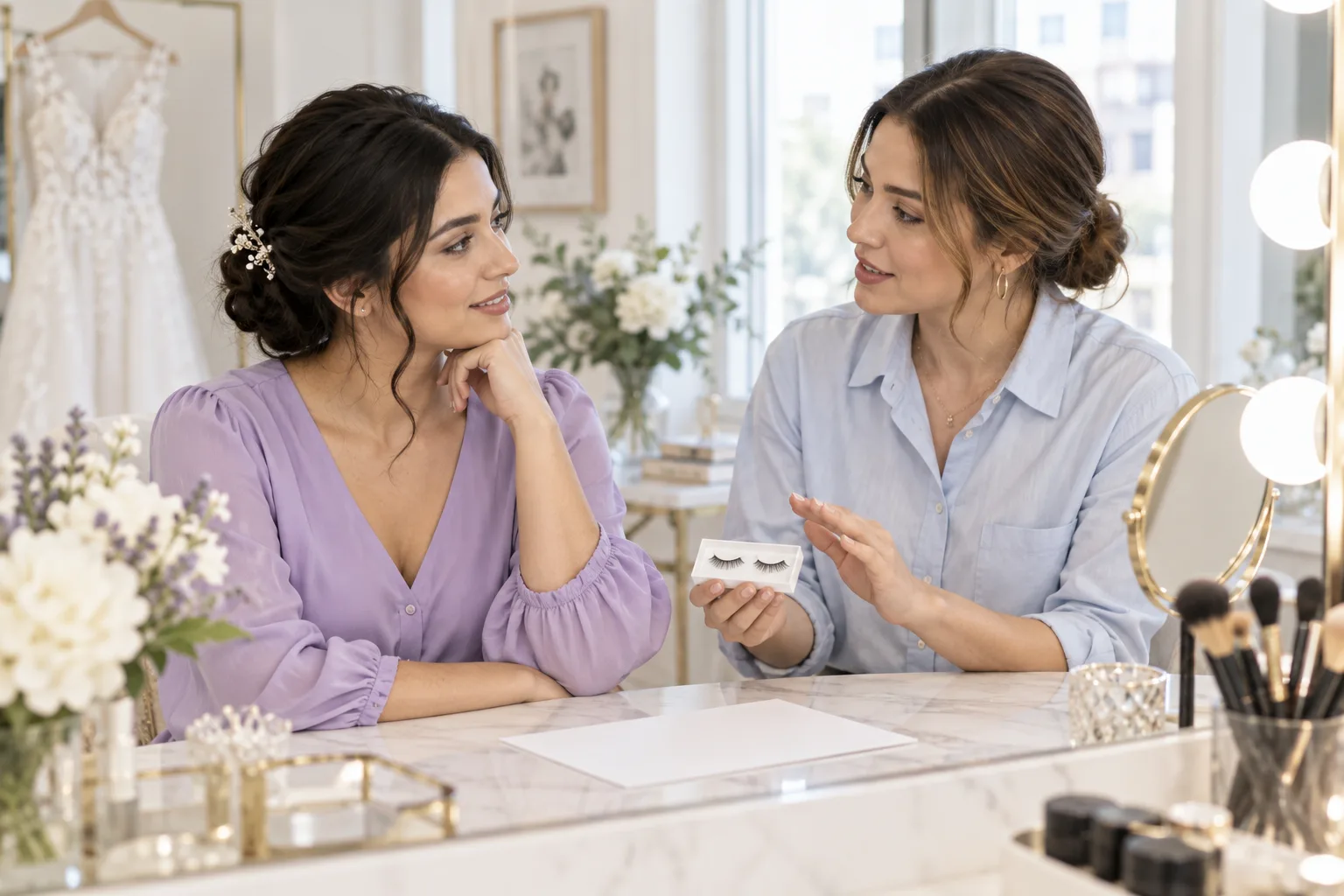
At a wedding makeup trial, photograph the lash choice and write down the adhesive. A picture records the shape; the product name helps answer a different question if your eyelids itch later. Before paying for extensions or buying several packs of false lashes, plan application, comfort, removal and a version of the look you can wear without them.
Name the service before comparing prices
Ask whether the appointment is for removable false lashes, a multiday system or individual extensions. Confirm how the product attaches, how long it is intended to remain in place and who removes it. Product names and directions matter more than a package called “bridal lashes.”
FDA treats false lashes, extensions and their adhesives as cosmetics. It specifically warns that adhesives can cause allergic reactions, irritation or injury around delicate eyelids and advises checking ingredients. [1]
Ask what the quoted fee includes: consultation, application, maintenance, removal and help if the service needs to be changed. Get cancellation terms before scheduling around travel or other appointments.
Keep the service separate from a prescription lash-growth treatment. The Latisse consultation guide discusses a different decision with its own evidence and instructions. One option does not establish the suitability of the other.
Bring the history that changes the decision
Tell the professional about previous eyelid swelling, adhesive reactions, contact-lens use, ongoing eye symptoms and treatment around the eyes. If a clinician has identified an allergy, bring the name and avoidance instructions. Do not shorten it to “sensitive skin” if you have more precise information.
Ask an eye clinician about the proposed service if you have an eye condition or use prescribed eye medicines. Keep taking treatment as directed unless the prescriber changes it. A salon appointment should not become a reason to stop an eye drop.
FDA advises avoiding eye cosmetics during an eye infection or when surrounding skin is inflamed, and discarding products used during an infection. [1] A scheduled trial can be moved. Ask about the booking policy while you are still well.
Do not use a new adhesive as an informal way to investigate a previous reaction. Bring the earlier product information to an appropriate clinician and ask what assessment is needed.
Get the adhesive information in writing
Record the brand, full product name and ingredients for the adhesive, plus primers, sealants, cleansers and removers that will touch the area. A service may involve more than one product. Ask how substitutions will be discussed before the wedding appointment.
FDA notes that natural rubber latex can occur in eyelash adhesives. Cosmetics do not have to carry a separate latex-allergy warning, and formulas can change. Professional-only products may lack a retail ingredient list, so the salon may need to contact the manufacturer. [2]
If you have or suspect latex allergy, tell the salon and your healthcare professional. FDA advises discussing those concerns and contacting manufacturers when needed. [2] The absence of a warning on the front of a bottle should not settle the question.
A claim about one ingredient does not describe every ingredient or every possible reaction. Ask what a claim applies to and let your clinician interpret it against your allergy history. Save a photograph of the identified packaging with your trial notes.
What a 2026 study found
A study published online in Cornea in January 2026 compared 208 extension wearers with 208 nonwearers, all female university students aged 18 to 29. Wearers reported watery eyes more often, 38.5% versus 21.6%, and lash loss more often, 17.3% versus 9.6%. [3]
Eye examinations also found reduced tear-film stability more often among wearers: tear break-up time below ten seconds occurred in 79.8% versus 15.4%. This measures how quickly the tear film becomes unstable, rather than a wedding-day comfort score. [3]
The study was cross-sectional, comparing groups at one point rather than randomly assigning people to extensions. Its associations cannot establish that the service caused every finding or predict your individual risk. The student population also limits how widely the results should be applied. [3]
These findings support taking symptoms seriously and discussing existing eye concerns. They do not supply a safe number of extensions, a universally suitable glue or a countdown for how many days before the wedding to book.
Separate a style trial from medical patch testing
Ask what the professional means by a “patch test”: which products, what procedure and what the result can establish. Do not treat an uneventful salon check as medical clearance or permission to retry a product that previously caused symptoms.
AAD describes medical patch testing as a dermatologist-directed investigation for delayed skin allergy. Patches are commonly worn for 48 hours, with readings at follow-up visits, including another visit four to seven days after application. It differs from a skin-prick test for immediate reactions. [4]
If a dermatologist recommends testing, follow that office's instructions and bring the requested product information. Do not spread lash adhesive on your skin using a home recipe or apply it near an irritated eye to see what happens.
The makeup trial still has useful work to do. Check whether you like the length and shape, whether blinking feels comfortable and whether the look works with glasses. Record those observations separately from any medical assessment.
Make the trial useful to the wedding-day team
Bring glasses and the details of any contact lenses you plan to wear. Ask your eye-care provider and the service professional how to coordinate lens use during the appointment. Do not improvise from a social-media instruction that assumes a different lash system.
Ask the artist to document the selected lash style, adhesive and any changes. Take a few photographs at ordinary conversation distance and with eyes open and closed. You do not need repeated magnified inspections.
Write down discomfort, tearing or redness and when it began. Contact a healthcare provider for a suspected adverse reaction. FDA says to stop using an irritating eye cosmetic immediately and see a doctor if irritation persists. [1]
Agree on an alternative using familiar, tolerated products if appropriate. Put that choice in the wedding notes so a time-pressed assistant does not introduce an unfamiliar adhesive after you have decided against it.
Plan removal before the evening ends
Obtain instructions for the exact system, including whether professional removal is needed, which cleanser or remover is intended and whom to call outside normal hours. Ask how ordinary face washing and eye hygiene should be maintained.
AAO advises that someone experiencing an allergic reaction to extensions should not try to remove them themselves because of potential eye damage. [5] Contact an appropriate clinician and arrange removal under suitable guidance. Do not pull at attached lashes or improvise with household solvents.
For a removable product, follow its directions rather than transferring a method from another system. If removal hurts or the product will not release as expected, stop and seek advice.
Pack instructions where you will spend the wedding night. If you are leaving for the honeymoon immediately, confirm who can help at the destination before choosing a service that needs follow-up.
Give eye symptoms priority over the schedule
The National Eye Institute advises going to an eye doctor or emergency room for intense eye pain, changes in vision, blurry vision, very red watery eyes or an object stuck in the eye. [6] Do not wait until after portraits for those symptoms.
For contact-lens wearers, NEI advises removing lenses with pain, redness, light sensitivity, sudden blur, unusual watering or discharge, and calling the eye doctor if symptoms persist or worsen. [7] Serious symptoms still need urgent assessment.
Keep the product names and the appointment time available for the clinician. Do not cover a painful or inflamed eye with more cosmetics to complete the look. Ask the planner or a trusted person to adjust the schedule while you obtain care.

Physical Book (No Download)
Bridegenic: The Glow-Up Guide for Brides on GLP-1s
$12.95 + Free Shipping
Order NowThis article provides general education, not a diagnosis or an individual treatment plan. Medication information refers to US sources. Talk with your prescriber, pharmacist or dermatologist about decisions for your care.
Read next
Face & SkinColored Contact Lenses for Wedding Photos: Fitting, Makeup and Backup Plans→Face & SkinLatisse Before Your Wedding: The Lash Trial, Timeline and Eye Questions→Sources
- Eye Cosmetic SafetyFDA↩ Back to text
- Latex in CosmeticsFDA↩ Back to text
- Eyelash Extension Wear Potentiates Clinical Signs of Ocular Surface Diseases Among Young Women, January 20, 2026Kyei and colleagues, Cornea↩ Back to text
- Patch testing can find what’s causing your rashAmerican Academy of Dermatology↩ Back to text
- Eyelash Extension Facts and SafetyAmerican Academy of Ophthalmology↩ Back to text
- Corneal Conditions, updated August 6, 2025National Eye Institute↩ Back to text
- Contact Lenses, updated December 5, 2024National Eye Institute↩ Back to text