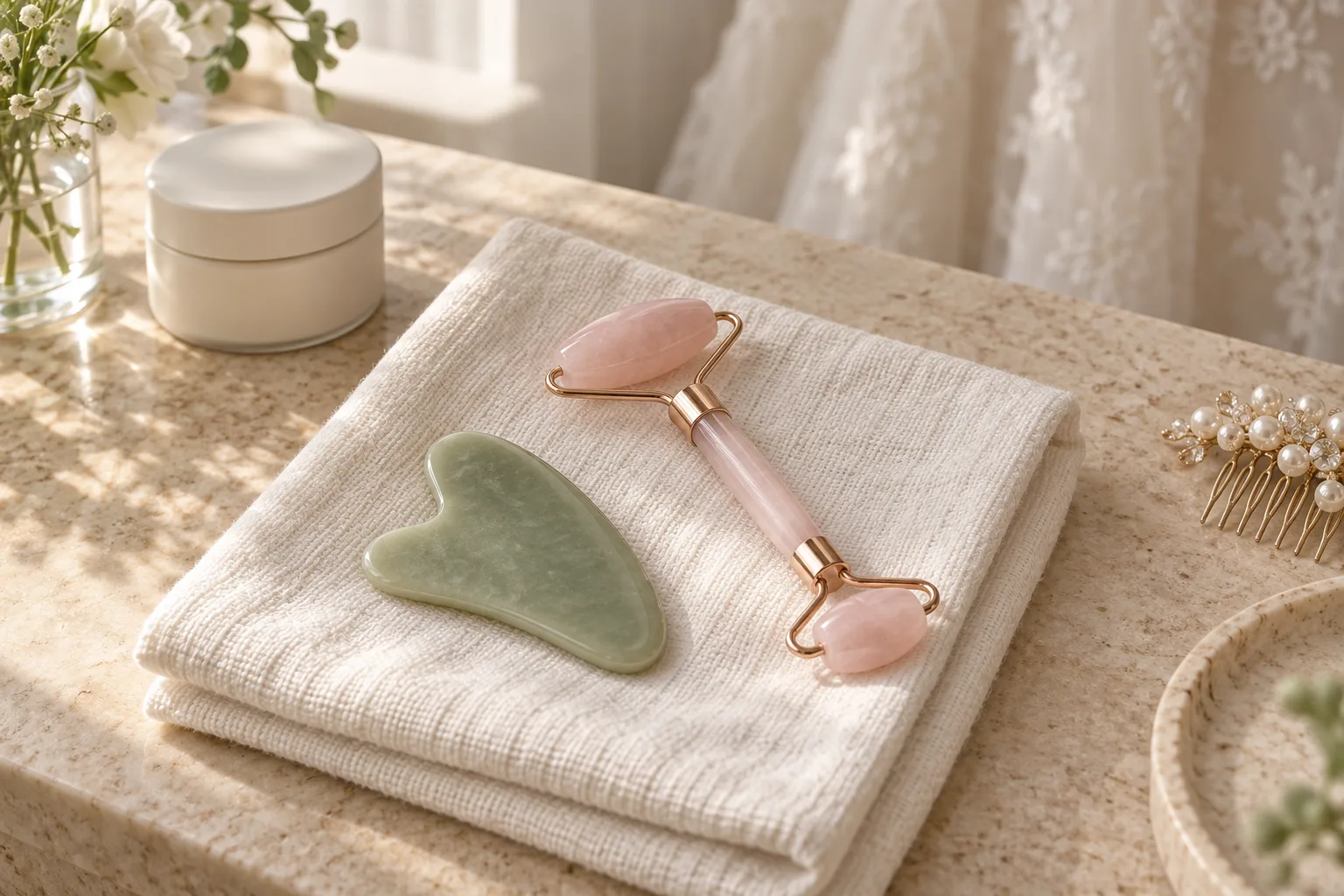
Before adding a roller or gua sha appointment to your wedding preparations, ask what you expect to change. A pleasant massage, a change in puffiness and a lasting change in facial contour are separate outcomes. Research on one does not establish the others. The available studies deserve a closer reading than a photograph beside a product link.
What the roller blood-flow study measured
In a 2018 study, five minutes of rolling the right cheek increased skin blood flow there for at least ten minutes in 12 participants. A separate five-week experiment in 14 participants found an increased blood-vessel response to local heat after daily roller use. One author worked in research and development at MTG, a company that sells facial massage devices. [1]
Those measurements describe circulation. They do not demonstrate replacement of facial volume lost during weight change, permanent lifting or how foundation will look in your ceremony lighting. The study’s duration also does not establish an appointment time that guarantees an effect when your photographer arrives.
If a provider cites this paper, ask which outcome their proposed treatment is meant to reproduce. A reference to improved circulation cannot, by itself, substantiate every contour claim on the service menu.
What the eight-week comparison adds
A 2025 randomized study enrolled 34 women and reported 33 completers. Participants used either the roller side or the gua sha edge of the same dual-function device for ten minutes, five times weekly, for eight weeks. Assessors were blinded to the assigned technique. There was no untreated or sham-massage group. [2]
Both groups had shorter measured facial surface distances, approximately 2.2 to 3.3 millimeters. The roller group improved more on skin-elasticity measurements; the gua sha group improved more on muscle-tone and stiffness measurements. Contour changes did not differ significantly between groups. [2]
The study lacked standardized clinical before-and-after photographs and follow-up establishing persistence after treatment ended. It excluded several skin conditions and recent invasive facial treatments. Yonsei University funded it; the authors declared no conflicts. [2]
Without an untreated group, the study cannot isolate massage’s effect against doing nothing. Surface distances do not measure fat removal or bone reshaping. The research schedule should not be compressed to fit a wedding deadline.
Check suitability before choosing a technique
Cleveland Clinic’s guidance distinguishes very light facial pressure from techniques used elsewhere on the body. It warns that aggressive scraping can cause soreness, bruising or discoloration and advises against treatment over irritated or inflamed skin, wounds and sunburn. It also identifies blood-thinning medicines and several health conditions as reasons to discuss suitability beforehand. [3]
Do not stop a prescribed medicine to make an appointment possible. Give the practitioner your current medicine list and ask the prescribing clinician about concerns that affect treatment.
For rosacea, AAD specifically advises avoiding rubbing, scrubbing or massaging affected skin because irritation can provoke a flare. [4] Calling a service gentle does not override that advice. The rosacea preparation guide offers a separate framework for coordinating skin care and makeup.
If you have had filler, an injectable treatment, surgery or a skin procedure, ask the treating clinician whether massage is permitted and when. Request instructions for your procedure rather than accepting a spa’s general waiting period. Record the answer before booking.
Find out what the appointment includes
Ask for the treatment steps before paying: manual massage, roller, scraping edge, oil, serum, heat, exfoliation or another device. A booking called a sculpting facial may include several procedures. The name alone cannot tell you what your skin will encounter.
Keep a copy of the proposed products and identify which ones you have used comfortably. If several new products are bundled with a new technique, a later reaction may be harder to discuss precisely. Ask whether the appointment can use a simpler agreed routine or whether you should choose a different service.
Cleveland Clinic advises keeping tools clean and intact, replacing a chipped or broken tool and reporting pain during treatment. [3] Ask the provider how the chosen tool is cleaned between clients. At home, follow the tool manufacturer’s cleaning instructions; a material that tolerates one method may not tolerate another.
A trial appointment should leave you with usable notes: the technique, products, duration, comfort during treatment and any later skin changes. If you developed a reaction, do not repeat the same treatment solely because the wedding appointment is prepaid. Obtain advice and discuss the booking terms.
Keep photograph comparisons consistent
Chapter 1 of Bridegenic separates skin surface, color, contour and camera setup. Apply that distinction when considering a massage result. A brighter image taken closer to a window cannot show which part of a perceived difference came from the treatment.
If a comparison would help you decide, use the same camera distance, light, expression and makeup conditions. Note the time between the appointment and the photograph. Ask whether promotional pictures used comparable conditions and whether they show the actual service you are considering.
Bring persistent concerns about facial changes to a clinician who can examine you. A roller purchase cannot determine whether a shadow reflects lighting, skin irritation, swelling or a change in volume. The skin and makeup planning guide can help organize those separate questions.
Put optional massage into the makeup schedule explicitly
Tell the makeup artist if someone has proposed a facial massage during preparation. Confirm the products, who would perform it and when skin preparation would begin afterward. Ask the artist whether the proposed oil or serum has already been tried with your makeup.
Leave room to omit the service if the skin is uncomfortable that morning. A familiar, comfortable routine does not need another step merely because a bridal package includes it. If your goal is time to rest before makeup, you can reserve that time without attaching a contour promise to it.
The decision note should be short enough to use: the agreed service, any clinician restrictions, the products, the appointment time and whom to contact if the skin changes. Avoid a booking whose promised result depends on tolerating pain or adding an escalating sequence of treatments.

Physical Book (No Download)
Bridegenic: The Glow-Up Guide for Brides on GLP-1s
$12.95 + Free Shipping
Order NowThis article provides general education, not a diagnosis or an individual treatment plan. Medication information refers to US sources. Talk with your prescriber, pharmacist or dermatologist about decisions for your care.
Read next
Face & SkinRosacea Before the Wedding: Treatment, Comfort and Makeup→Face & SkinYour Wedding Skincare Plan: From Engagement Photos to Makeup Removal→Sources
- Miyaji et al. Short- and Long-Term Effects of Using a Facial Massage Roller on Facial Skin Blood Flow and Vascular Reactivity, 2018Complementary Therapies in Medicine via PubMed↩ Back to text
- Ahn et al. Comparative Effects of Facial Roller and Gua Sha Massage on Facial Contour, Muscle Tone, and Skin Elasticity, 2025Journal of Cosmetic Dermatology via Hong Kong Polytechnic University↩ Back to text
- Gua Sha: What It Is and How To Do It, September 18, 2025Cleveland Clinic↩ Back to text
- 7 Rosacea Skin Care Tips Dermatologists Recommend, April 3, 2024American Academy of Dermatology↩ Back to text