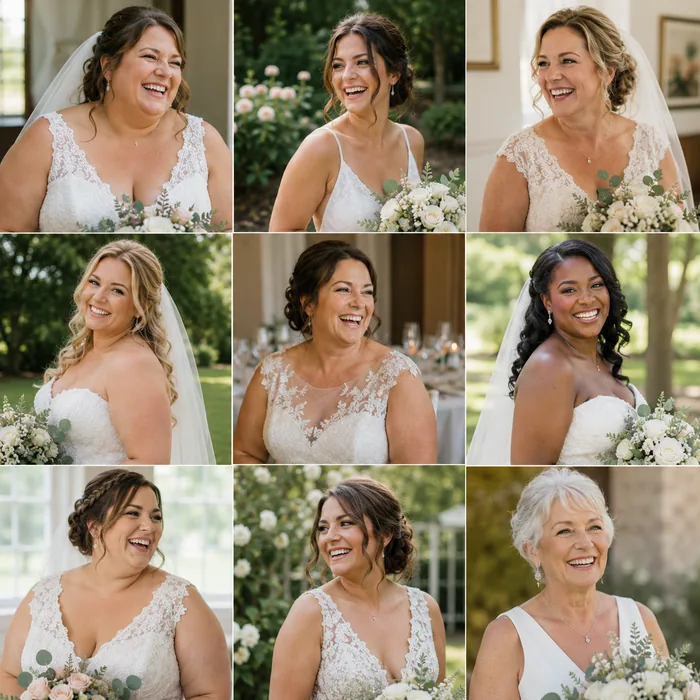


Why Do Brides Feel Like A Disaster The Second The Camera Comes Out?
Answer a few honest questions. We'll show you exactly what's happening when the camera turns to you, and what to do about it before your wedding day.
You've answered seven questions about photos, and not one was about your face.
Here's the pattern: the second a lens turns your way, your shoulders climb before you've decided anything. That's not vanity, it's a trained reflex.
Performers get the same one. They just learned to meet it with a slower breath instead of a flinch.
Fourteen questions in, and a second pattern is showing up: measuring your own gallery against someone else's before either one is even finished.
That gap is almost never about who's more photogenic. It's a production difference — budget, a second shooter, ten hours of coverage — invisible in the twelve photos someone chose to post.
There's a second layer too. A mirror shows you the same face on loop until you trust it. A camera owes you no such loyalty, which is why an honest photo can feel wrong when nothing about it actually is.
Twenty-one questions in — time for the part that explains the stiffness.
Performers who look calm aren't relying on willpower when the lens comes up. They're running a rehearsed sequence before it ever does: feet planted, shoulders dropped, hands given somewhere to rest.
A pose has a start and an end. A state doesn't — it's just the condition your body's already in, camera up or not. That's why a managed pose can still look effortful, and an unremarkable moment can look completely at ease.
Twenty-eight questions down, and here's the piece that ties the last two threads together.
A resource state isn't built in the moment a photographer counts down. It's built ahead of time, from one specific memory of feeling exactly how you want to feel on camera. Calm. Grounded. Not performing for anyone.
"Just think happy thoughts" never survives a countdown, because happy is a category, not a memory. Vague gives the body nothing to hold. A Tuesday afternoon in your parents' kitchen does.
Thirty-five questions in, and a distinction worth making: confidence and stillness aren't the same thing.
Confidence is a feeling — it comes and goes. Stillness is trained. It's your body no longer making the small defensive movements, the weight shifts, the creeping shoulders, that read as tension on film.
A still body reads as calm even when the mind underneath is somewhere else entirely. Confidence might follow eventually, but it was never the starting requirement.
Forty-two questions in — here's why a last-second "relax" never works.
Deciding to relax is a conscious choice, and conscious choices are too slow. The bracing reflex is automatic, so it fires before that decision even finishes loading. By the time your brain tells your shoulders to drop, the shutter's already caught the climb.
Saying "relax" out loud can even make it worse — it's a reminder you're being watched. The fix can't get decided in the moment. It has to already be running before the camera comes up.
Forty-nine questions in — the short version of everything so far, before the next stretch goes further.
A resource state is one specific memory, anchored on purpose and rehearsed enough times your body can drop into it without your mind supervising every second.
Stillness isn't confidence. It's the absence of the small defensive movements that make a calm body read as tense on film. None of it gets decided in the moment — it gets trained ahead of time, the same way anything holds up under pressure only because the work happened first.
Fifty-six questions in — the part about rehearsal that actually matters.
Most brides picture training a resource state as a daily meditation practice. That's not what makes it stick. What works is short, frequent reps — a minute in the car, thirty seconds in a fitting room — stacked across a few weeks until your body treats the state as familiar.
Same logic as learning to parallel park. None of it took a seminar, and none of it has to be announced out loud.
Sixty-three questions in — this one ties directly to the seconds right before a camera comes up.
Athletes call it a pre-performance routine: the same small sequence, run every time, right before the moment that matters. A resource state works the same way, triggered by a cue — a breath, a word, a way you settle your weight.
What matters isn't which cue you pick. It's that it's the same one every time, so it becomes a trigger instead of a thing you tried once.
Seventy questions in — a pattern worth naming: this reflex gets louder, not quieter, the more people are in the room.
A group photo stacks social pressure on top of the physical one already firing — an audience watching you get arranged, the sense that if your face looks off, it's the whole photo's problem.
A trained state doesn't need the room calm or private to work. It travels into a loud, crowded lineup the same way it holds in a quiet one, because it was never dependent on the room to begin with.
Seventy-seven questions in — here's why video feels harder than photos, even once stills stop being a problem.
A photo catches one frozen instant, and a bad one just doesn't get chosen. Video offers no such mercy — it catches every transitional flicker between expressions that a still would have quietly edited out.
The same trained state that steadies a photo steadies video too, because it was never a pose held for a shutter. It's a default your body is already sitting in, recording or not.
Eighty-four questions in, and a piece worth being honest about: this pattern doesn't clock out the day the wedding does.
The reflex doesn't know the wedding is over. It shows up again at the next holiday card, the next anniversary dinner, a friend's wedding where you're the guest instead of the bride.
Gritting through one day on adrenaline isn't the same as retraining a default. Adrenaline isn't a strategy. The actual goal is something still running the next time a camera turns your way, whenever that is.
Ninety-one questions in — a good spot to take stock before the next stretch shifts into new territory.
Everything so far has been the mechanism: why the reflex fires, what a resource state is, why rehearsal beats a rushed decision. Solid theory. But theory doesn't get tested until it meets an actual camera, in an actual room.
Next up: the wedding day itself, hour by hour, starting with the one moment that catches most brides off guard — the getting-ready room, before the coffee's kicked in.
Ninety-eight questions in. A wedding day isn't one photo opportunity — it's dozens, stacked back to back, each with its own lighting, its own audience, its own way of catching you off guard.
Getting-ready room. First look. The aisle. Vows shot close enough to catch every micro-expression. The first dance under low light with half the room's phones raised. Twelve hours is a long time to fake anything.
A trained default doesn't need renewing every time the setting changes. It doesn't take active management to hold — once it's running, it just keeps running.
One hundred five questions in. A wedding day was never just you and one photographer.
Family doesn't RSVP to your nervous system. There's an uncle with his own DSLR, a kid with a tablet, forty phones in forty pockets — none of them give you a countdown the way the hired photographer does.
A trained state doesn't depend on a coach or a warning to hold. It travels into a loud, unpredictable, multi-camera room the same way it holds in a quiet, scheduled one.
One hundred twelve questions in, and video changes the math in a way stills never do.
A photo catches one frozen instant, and a bad one just doesn't get chosen. A livestream offers no such mercy — no editing, no picking the good frame, just whatever your face is doing in that exact unrepeatable second. The internet doesn't do retakes.
The same trained state that steadies a photo steadies video too, because it isn't a pose held for a shutter. It's a default your body's already sitting in, recording or not.
One hundred nineteen questions in. The wedding ends, then the scroll starts.
The bracing reflex gets a second act here — not during the ceremony, but during three hundred photos landing in one evening, a tag you never approved, a comment under a picture you're still not sure about. Same reflex, different outfit.
The wedding day is a handful of hours. The gallery is forever, and a trained state hands you more usable frames to choose from in the first place.
One hundred twenty-six questions in, and the honest part: the pattern doesn't clock out once the gallery's delivered either.
The same reflex shows up at the next camera. A first-anniversary photo. A holiday card. A cousin's graduation ten years out, when no one else in the room is thinking about your wedding at all.
Gritting through one day on adrenaline isn't the same as retraining a default. The goal was never surviving one gallery — it's something still running at every camera that comes after.
One hundred thirty-three questions in — good spot to pull the whole arc together.
The bracing reflex is automatic, quieter now than a newborn's flinch but the same wiring. The comparison under every scroll was never fair — mostly a production difference, not a talent gap. Stillness isn't confidence, it's the absence of small defensive movement, and none of it gets decided in the moment. It gets trained ahead of time.
That's the theory. It's about to get tested somewhere harder: a bridal shower, a boudoir shoot, a livestream, a stranger's comment under a photo you didn't choose to post.
One hundred forty questions in. Researchers who study skill training have a word for what happens next: generalization — the gap between doing something under the exact conditions you practiced in, and doing it anywhere.
A pianist who can only play a piece on her own piano hasn't really learned it. Same logic here — a state that only shows up for one scheduled shoot hasn't generalized yet. It's a start, not a finish line.
Next test: the bridal shower, cake and games and someone's phone already up before you've had a second to prepare.
One hundred forty-seven questions in. A boudoir shoot tests something harder than a bridal shower — whether the state holds once the usual armor is gone.
Psychologists call the alternative self-objectification: watching your own body from the outside, monitoring and judging, instead of living inside it. A resource state works in the opposite direction — first-person, actually present, not narrating from a step outside.
A rehearsed memory doesn't require forgetting the camera exists. It gives your nervous system somewhere to stand while it's happening.
One hundred fifty-four questions in — the rehearsal dinner chapter, and the real question it's testing.
A boudoir shoot is intimate but controlled. A rehearsal dinner is loud, unscripted, and no one asks permission before hitting record on a toast. Does the trained state only work in a quiet room, or does it hold up in a chaotic one too?
Context-dependent calm needs the right conditions. A context-independent default doesn't need any of that — it just runs, toasts and alcohol and all.
One hundred sixty-one questions in, and here's something worth knowing ahead of time: other people's nerves are contagious, and a getting-ready room is full of them.
Researchers call it emotional contagion — one person's anxiety spreading through a room without anyone deciding to let it happen. If your calm only picks up on the room's mood, that's borrowed calm, not a trained one.
A genuinely trained state is personal, anchored to your own memory, not the room's temperature. You don't have to manage everyone else's nerves to manage your own.
One hundred sixty-eight questions in — a kind of pressure that didn't exist a generation ago: performing for people watching live but not in the room.
Researchers call it parasocial pressure — the felt sense of being watched by someone you love, with none of the normal feedback of seeing their face react. No nod, no smile to read. Just the vows, and the quiet knowledge someone's on the other end of a laptop.
A trained state doesn't need that feedback to know it's landing. It was never actually about the feedback to begin with.
One hundred seventy-five questions in — a layer of exposure that's genuinely new. A first-look video posted the same day gets watched Tuesday, then again next month by someone finding it fresh. That audience never finishes arriving.
Researchers call this an asynchronous audience. Bracing for a room full of people at one moment is one thing. Bracing for an audience arriving indefinitely, on a schedule you can't see, is a different, harder thing.
A trained state was never reacting to the size or timing of an audience. It doesn't need to know how many people are watching, or when, in order to run.
One hundred eighty-two questions in — the difference between exposure you choose and exposure someone else chooses for you.
Call it borrowed spotlight: a relative posts a candid without asking, and the angle, the moment, the caption were never yours to decide. If your calm only works when you pick the photo, that's curation wearing the costume of calm.
A genuinely trained state doesn't ask who's holding the camera before deciding whether to show up. It's already there.
One hundred eighty-nine questions in. Researchers studying factory workers in the 1920s found that productivity rose just from knowing they were observed. It's now called the observer effect.
A wedding reception runs the same way — a hired photographer, an uncle's DSLR, a dozen phones, no telling how many lenses are pointed your way at once. Most advice assumes one camera to manage. A reception blows that apart.
A trained state doesn't count lenses. It's a default your body sits in whether one person or fifty are nearby.
One hundred ninety-six questions in — the specific dread of waiting weeks for an unknown outcome with no way to check.
Disposable cameras do exactly that. No preview, no deleting a bad shot, nothing until it comes back from developing. Closer to waiting on a medical result than opening a gallery.
A resource state doesn't shorten the wait. It changes what's actually happening in your body during the moments that get caught on that film, weeks before you see a single frame.
Two hundred three questions in — the difference between a single countdown and a camera that never stops.
Researchers call it habituation: a stimulus that first triggers a strong reaction gradually stops triggering much of anything, the same way a ticking clock goes silent in a room. But a camera actively managed and performed for, hour after hour, doesn't habituate. It exhausts.
A trained state isn't vigilance. It's closer to background hum, which is exactly what lets it hold up over twelve straight hours instead of wearing thin.
Two hundred ten questions in. Every setting so far has come with official stakes. The honeymoon is the first stretch with none — no photographer, no guest list, just two people and a phone.
That makes it an informal test: does the old bracing pattern show up anyway, with nothing riding on it, or has something actually shifted?
That answer matters more than almost any other in this quiz. It's the clearest signal for whether real change happened, or the wedding day just got gritted through on adrenaline.
Two hundred seventeen questions in. A photographer posting a behind-the-scenes shot to their own story, weeks later, is its own kind of exposure — one picked frame, published to strangers who'll never meet you, open for anyone to comment on.
Those comments aren't responding to the whole day. They're reacting to a fragment, stripped of everything around it, from someone with none of your context.
A resource state was never built to control commentary. It was always about what your body does in the moment the photo gets taken, not what happens to it after.
Two hundred twenty-four questions in. One guest's candid is manageable. Fifty guests' candids, tagged over a week with no finish line, are an aggregation problem — always another one arriving after you've stopped checking.
Trying to review or brace for an open-ended pile is a losing strategy no matter how much energy goes into it. What matters isn't controlling the total. It's what's true of you in any given unscripted moment.
Once that's the case, the hashtag stops being something to manage and becomes a slightly chaotic record of a day that already went fine.
Two hundred thirty-one questions in. Leon Festinger named it social comparison theory in 1954: when there's no ruler to measure yourself against, you grab the nearest person instead.
An influencer's feed isn't a fair comparison. It's curated for a living, then amplified by an algorithm built to surface whatever performs best. That's not a fight your unfiltered Tuesday can win.
What actually helps isn't willpower to stop scrolling. It's your own state, the one lever that was always yours to fix.
Two hundred thirty-eight questions in — a stranger kind of forever. A portfolio feature isn't a wall in your own house. It's a page on someone else's site, doing their advertising for them, indefinitely.
A resource state was never about controlling what happens to a photo after it's taken. It was always about what's true the second the shutter clicks. Nothing about the frame changes — only the amount of scrutiny it draws.
The real stake isn't the algorithm or the headcount of strangers scrolling past. It's whether the woman representing that moment was the one who actually showed up for it.
Two hundred forty-five questions in — worth pulling this stretch together. The trained state held through a bridal shower, a boudoir shoot, a chaotic rehearsal dinner, a livestream audience it couldn't see, a hashtag that kept growing, and twelve straight hours of a videographer who never stopped rolling.
It even showed up on the honeymoon, with nothing official riding on it — the clearest proof something actually changed, instead of getting gritted through on adrenaline for one big day.
More ground to cover still: save-the-dates, old film cameras, drones, group chats. Every one has its own version of the same reflex.
Two hundred fifty-two questions in. In 1977, researchers showed people their own photo two ways — real, and mirror-flipped. Almost everyone picked the flipped one. Their friends picked the true one almost every time.
You've met your reversed face in the mirror every day of your life. Your friends have met the real one. That's the mere-exposure effect: familiar reads as safe, and it has nothing to do with attractiveness.
It isn't permanent, either. Look at your true, unflipped photos on purpose instead of flinching past them, and that version gets familiar too.
Two hundred fifty-nine questions in. Construal level theory says the further away something sits, the more abstractly the mind handles it. Close up, we notice flaws. From a distance, we notice shape and meaning.
A digital gallery lands close, seconds after the shutter. Film forces distance by default — weeks pass before the day even softens into shape.
That's why an old photo often lands better years later. The photo didn't change. You finally got far enough away to see it straight.
Two hundred sixty-six questions in, right after a stranger's magazine comment landed in your inbox. It's called the spotlight effect: people assume they're watched and judged roughly twice as closely as they actually are.
Someone scrolling a wedding blog spends a few seconds per photo, taking in the mood, before swiping on. No one is studying your jawline the way you are.
Most of the pressure isn't external. It's self-generated, aimed at a room paying far less attention than it feels like in the moment.
Two hundred seventy-three questions in, right after watching a ceremony from thirty feet up. Researchers who study self-distancing found that picturing yourself as a small figure watched from outside makes people judge themselves more kindly than reliving a moment from inside their own eyes.
A drone does that literally. You're not a face to critique. You're a shape inside a bigger scene, nothing left at that distance to zoom in on.
No drone required, either. The mental version, picturing the wider scene instead of just your face in it, does most of the same job.
Two hundred eighty questions in, right after a photo booth flash caught you mid-thought. In 1987, Daniel Wegner told people not to think about a white bear. Nearly everyone thought about it constantly. He called it ironic process theory — trying to suppress a thought keeps it active.
"Just relax" works the same trick, which is why a photo booth, of all places, produces some of the most relaxed shots of the day. No one says "look natural" there. Nothing for the mind to monitor against.
The fix isn't more discipline. It's pulling the instruction out of conscious awareness entirely.
Two hundred eighty-seven questions in, right after frosting on a nose and a dozen phones going up. Psychologists call it objective self-awareness: attention turning inward, onto yourself as an object being watched, instead of outward onto a task.
A posed photo is a near-perfect trigger for it — nothing to do but be looked at. A shared task, cutting a cake, gives attention somewhere else to go, and task-focus usually wins because a brain only runs one channel at a time.
Give attention a job, and self-consciousness has less room to operate.
Two hundred ninety-four questions in, right after a cousin's reply landed before you'd even finished watching your own video. Robert Cialdini called it social proof: when people are unsure how to feel, they borrow the room's reaction as a shortcut for their own.
A group text runs it at full speed. A warm reply can soften how a video lands. A slow one can plant a doubt that has nothing to do with the footage.
That's why the same clip often lands differently alone, weeks later, once no live chorus is shaping it for you.
Three hundred one questions in, right after a friend spotted you, unposed, in the corner of a stranger's photo. Psychologist Daryl Bem called it self-perception theory: people figure out how they feel by watching their own behavior, not by being told about it.
A compliment is someone else's opinion. An unposed candid, where your body is visibly relaxed and actually laughing, is proof — and proof is what self-perception trusts.
If you want to believe you were happy that day, more reassurance isn't the fastest route. More exposure to the moments your body was already doing the relaxed, happy thing is.
Three hundred eight questions in, right after finding your own face on a vendor's ad you don't remember approving. Kahneman and Tversky called it loss aversion: losing something hurts roughly twice as much as gaining the same amount helps.
Your image feels like yours the moment it exists. When it turns up somewhere you didn't choose, that registers as a small loss, which is why it stings more than a dozen compliments help.
It was never really about the photo's quality. It was a real loss of control over something that already felt like yours.
Three hundred fifteen questions in, right after watching your own ceremony projected in front of every guest at once. Researchers call it social facilitation: the presence of others changes how a moment lands.
A posed photo puts that effect on the moment of capture. A slideshow puts it on the moment of viewing — a crowd's laugh or a ripple of applause becomes part of the memory of the photo itself.
There's an upside too. A warm, real-time reaction from a full room is hard to fake, and it tends to stick harder than any private compliment does.
Three hundred twenty-two questions in, right after a camera rolled through a whole hair appointment with no countdown to brace around. Habituation is one of the oldest findings in psychology: repeated exposure to a harmless stimulus produces a shrinking response over time.
A posed photo never gives that a chance to happen — countdown, flash, done, back to square one every time. Continuous footage does. With nothing dramatic happening in response to it, the nervous system stops treating the camera as a trigger.
The formats that force one isolated moment are the hardest. The ones that run long and continuous are quietly the easiest.
Three hundred twenty-nine questions in, right after narrowing a whole wedding down to one photo for the thank-you cards. Kahneman and Fredrickson found that memory doesn't average an event — it stores the peak and the ending, and lets the rest fade. Researchers call it the peak-end rule.
That's why picking one photo doesn't feel arbitrary. You're not oversimplifying the day. You're picking which real peak gets to represent it.
It's also why the last photo of the night, the exit, the getaway car, tends to matter more than a single frame should.
Three hundred thirty-six questions in, right after noticing more of your wedding photos land right now than they did the first year. Researchers call it fading affect bias: the sting of a negative memory fades faster over time than the warmth of a positive one does.
A photo that stung on day one softens by year one, softer still by year three. You're not forgetting what was wrong. The sting is just fading faster than the warmth.
There's a catch — it needs time and no fresh reinforcement. A photo you keep re-criticizing resets the clock instead of letting it fade.
Three hundred forty-three questions in, right after scrolling through a folder of raw, unedited photos you were never meant to see. Researchers summed up negativity bias in one title: bad is stronger than good. A single flaw carries more weight than a dozen fine frames.
Scroll a hundred raw shots and five catch an awkward blink. Negativity bias guarantees those are the ones you'll remember, not because they're common, but because bad weighs more.
That's the whole reason editing exists as a profession — quietly counteracting a bias that was never about how the day actually went.
Three hundred fifty questions in. Leon Festinger named cognitive dissonance in 1957 — the discomfort of holding two conflicting beliefs, and the mind's drive to resolve it.
"I felt beautiful that day" and "I can't stand most of the photos" don't sit comfortably together. Most people resolve it by quietly editing the memory downward, because the memory is the easier belief to rewrite.
There's a better fix: change what actually gets caught in the next photo, so the mismatch never opens in the first place.
Three hundred fifty-seven questions in, right after weighing whether an app could quietly fix what years of photos haven't. It's called the uncanny valley: a face with all the right features that still reads as subtly wrong.
Your own over-smoothed face registers immediately, because you've spent decades practicing the real one. The discomfort was never about texture. It's about recognition — whether the person in the photo matches the one you know yourself to be.
Retouching edits the photo after the fact. A resource state edits what actually happened in front of the lens, so there's nothing left to smooth out.
Three hundred sixty-four questions in, right after an old prom photo surfaced somewhere it wasn't expected. Psychologists call it the reminiscence bump: memories from your teens and twenties get encoded more richly than most of adulthood.
If that old photo shows the same tense half-smile your engagement photos show, it isn't a fair fight. It's your most heavily rehearsed sense of self against something brand new.
The vividness isn't proof it's more accurate. It's proof of timing. A wedding is its own identity-forming stretch — likely why that old photo picked this exact moment to resurface.
Three hundred seventy-one questions in, right after a doorbell camera caught an unplanned ten seconds on the wedding morning. The availability heuristic says the mind judges what's representative by what's easiest to recall, not by what actually happened most.
A posed shot gets replayed constantly, so it feels like the summary of the whole day even though it was five minutes out of fourteen hours. An unmanaged clip breaks that pattern — nothing about it was engineered to be memorable, and it often feels truer anyway.
It's also why comparing your gallery to a stranger's curated feed is rigged before it starts. You're seeing all of your own messy day against her small, chosen slice of hers.
Three hundred seventy-eight questions in, right after an unplanned photo from the wedding night turned out to be the one that landed. Psychologist Allan Paivio called it dual-coding theory: images you can also describe get encoded through two memory channels at once, visual and verbal, which is why pictures stick harder than words alone.
That's part of why one candid photo can carry more weight over the years than a whole shot list of technically better ones. It doesn't need to be flattering. It needs to be real.
The case for a resource state isn't hoping a candid happens by accident. It's making the honest version show up even when the photo is planned.
Three hundred eighty-five questions in, right after a guest's close-up of the ring exchange beat the official photo to your phone. Tversky and Kahneman called it the framing effect: identical facts, judged differently depending on how they're presented.
The same ring exchange, shot by a guest versus a hired photographer, tells two different stories about the same instant. Caught reads as honest. Composed reads as effortful. Neither is wrong.
A shaking hand can read as nerves getting the better of the moment, or as proof it genuinely mattered. The shake never changes. Only the story around it does.
Three hundred ninety-two questions in, right after a group photo came back with one face reading differently than the rest. Confirmation bias means walking in already believing you don't photograph well makes the mind hunt for one tense expression and skip the thirty-nine relaxed ones.
It doesn't feel like a bias. It feels like just noticing a fact. But the noticing was never neutral — it was aimed by a belief that existed before the photo did.
Scan all forty faces with the same attention the one got, and a close look usually turns up several others mid-blink too. The one that stood out wasn't uniquely bad. It was just the one already being searched for.
Three hundred ninety-nine questions in, right after a bridal shop asked to use a fitting-room photo as their own before-and-after marketing. The contrast effect means people judge things relative to whatever they saw right before, not in isolation — the same water can feel warm to one hand and cool to the other.
Every gallery gets viewed against an implicit before too: an engagement shoot, an old prom photo, a stranger's polished feed. Nothing about the photo changes. Only the reference point does.
Choosing that reference point on purpose, this year against three years ago instead of against a stranger's best twelve frames, changes the whole experience of looking.
Four hundred six questions in, right after a magazine feature turned one wedding into a public example. Clance and Imes named the impostor phenomenon in 1978: a mismatch between external recognition and internal belief that more evidence rarely closes.
Outsiders only see the finished feature. You have access to the anxious, imperfect process too, and that gap is exactly where the impostor feeling lives.
It tends to soften not through more validation, but through naming the private process out loud to someone who can hear it without flinching.
Four hundred thirteen questions in, right after twenty unscripted minutes on a video call. Mark Snyder's self-monitoring theory says a formal photo moment, a countdown, a direction, an audience, spikes how closely people watch and adjust their own presentation.
A long, unscripted call has none of those cues, so most people's presentation gradually relaxes toward whatever's actually happening inside. Ten minutes in, you've already loosened past where you started.
A resource state works by removing those same cues on purpose, so a formal photo starts behaving like the relaxed twentieth minute instead of the tense first thirty seconds.
Four hundred twenty questions in, right after watching a bridesmaid go through the same camera moments a year after your own wedding. Festinger's social comparison theory says that without an objective ruler, the mind reaches for the nearest person instead.
Upward comparison, measuring against someone better off, breeds dissatisfaction. But there's a third option researchers call lateral comparison, relating instead of ranking, recognizing a shared experience without needing either version to win.
That's the whole difference between watching her and scrolling a stranger's feed.
Four hundred twenty-seven questions in, right after saying the camera thing out loud, in an actual room, maybe for the first time. Exposure therapy works on habituation: repeated, small-dose exposure to a fear trigger gradually shrinks the response, as long as it's graded instead of overwhelming.
A full wedding day with zero prior practice sits at the overwhelming end. A casual photo with a friend, then a slightly more formal one, is the graded version — the clinical case for practicing on purpose beforehand.
The curve isn't smooth. Anxiety can spike again mid-process. That's not failure, it's a known bump on the way to it actually working.
Four hundred thirty-four questions in, right after finding your photo buried among hundreds of strangers under the same hashtag. Researchers call it deindividuation: being one unidentified member of a large group changes how visible you actually feel.
A photo posted alone under your own name carries the full weight of individual visibility. Buried in position four hundred of a shared feed, it carries almost none of it — viewers process the crowd as a category, not you specifically.
A big anonymous audience isn't automatically the scariest exposure. Sometimes it's the safest, because size dilutes scrutiny a small, personal audience never does.
Four hundred forty-one questions in, right after texting your mom back with a final pick between three framed options. Psychologist Jack Brehm found that once a choice is made, the mind retroactively inflates the winner and deflates the alternatives. He called it choice-supportive bias.
That's why a framed photo can feel obviously correct years later, even though picking it was a coin flip against something almost as good at the time.
The discomfort of choosing tends to be worse than the discomfort of having chosen. Once it's decided, the mind starts building a case for it almost immediately.
Four hundred forty-eight questions in, right after a wedding announcement ran with a photo someone else picked. The frequency illusion, sometimes called the Baader-Meinhof phenomenon, is why that section of the paper suddenly seems to be everywhere once your own name appears in it.
The section didn't get more common. Your attention just started scanning for it. Everyone else's attention was never running at that same heightened level to begin with.
A few weeks on, once attention drifts elsewhere, it goes back to being background noise. For them, and eventually for you too.
Four hundred fifty-five questions in. Seven left, all reflective, then everything gets pulled together for your result.
Researchers Katherine Milkman, Hengchen Dai, and Jason Riis call it the fresh start effect: people pursue real change around temporal landmarks, moments that create a psychological break from a past version of themselves.
Passing along what actually helped, to someone younger, before her own first big photo day, functions as exactly that kind of landmark. It doesn't require the change to be finished. It just marks a direction — a clear enough line between before and after.