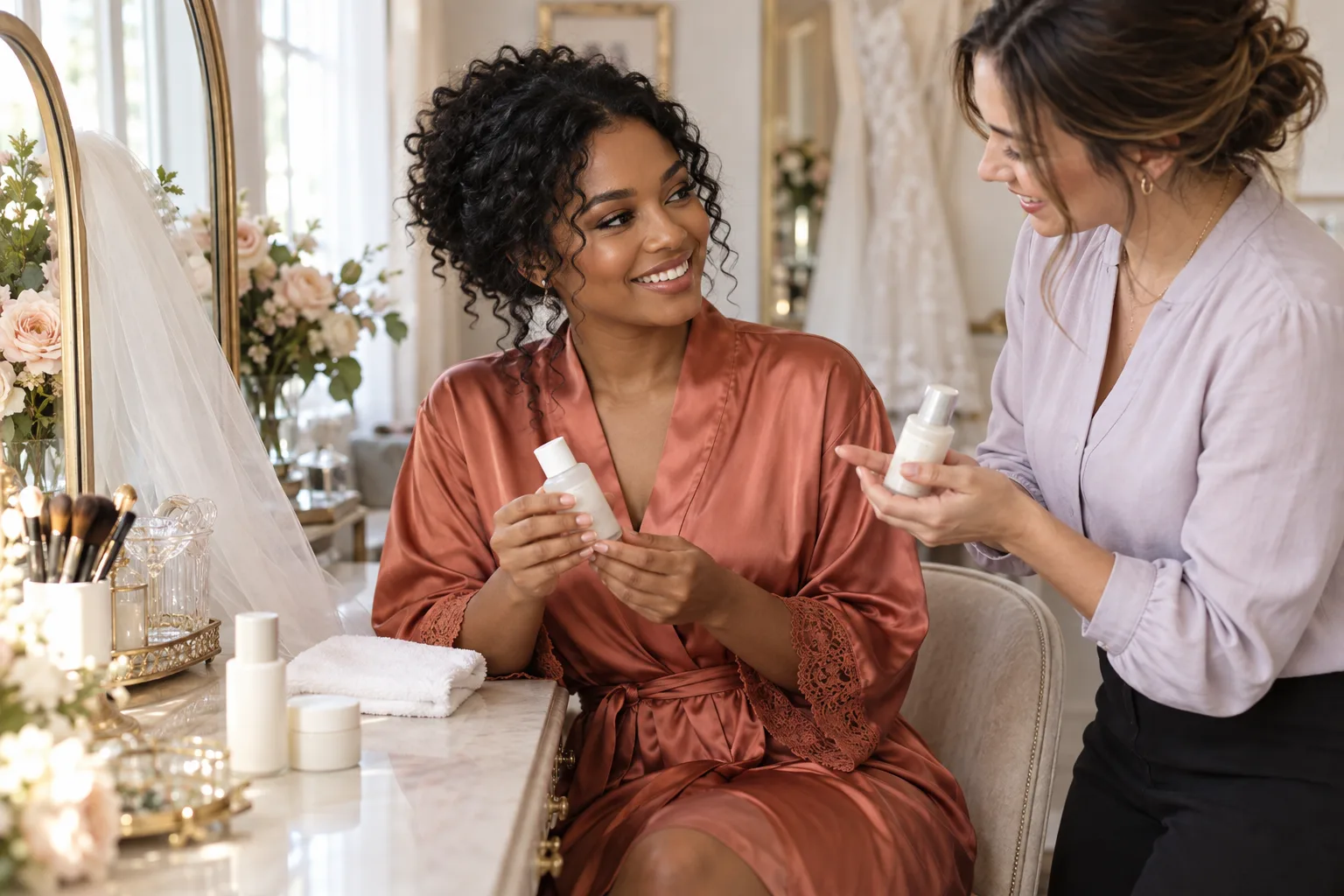
Your makeup appointment starts at nine. The first look is at noon, family portraits follow in the garden, and the ceremony begins at four. A sunscreen applied before breakfast needs a plan for the rest of that schedule. Bring the outdoor timeline to your makeup trial along with the sunscreen you intend to wear.
Read these three things on the label
The American Academy of Dermatology (AAD) recommends SPF 30 or higher, broad-spectrum protection and water resistance. Broad spectrum covers UVA and UVB. For acne-prone skin, AAD suggests labels such as “non-comedogenic” or “won't clog pores”; for dry skin, look for a moisturizing formula. A tinted sunscreen that matches your tone can reduce visible white residue. [1]
Buy a product you can apply at its instructed amount. If you dislike how it feels unless you use a tiny dab, try another formula before the trial. An expensive bottle is not useful if its texture makes you ration it.
FDA explains that water resistance is labeled for 40 or 80 minutes of swimming or sweating. That does not mean waterproof, and it does not cancel reapplication instructions. [2] Photograph the front label and directions so the person carrying your touch-up bag knows which product you mean.
Give a new product seven to ten days
AAD recommends testing a new skin-care product on a quarter-sized area, such as the underside of your arm or bend of your elbow, twice daily for seven to ten days. Use the amount and thickness you would normally use, and leave it on for its usual wear time. If redness, itching or swelling develops, wash it off and stop using it. A severe reaction may need a dermatologist. [3]
This home test can help identify a reaction before a full application. It does not promise that your face will tolerate every combination of products, and it is different from medical patch testing for an allergy. [3]
Count backward from the makeup trial, rather than from the wedding. Leave time to try an alternative if the first product irritates you. Bring a list of known reactions and the skin treatments you use. If you have an active rash or persistent irritation, ask your dermatologist for guidance before covering it with a new routine.
Rehearse the exact combination at your makeup trial
AAD's general order is cleansing, medication or treatment, moisturizer and/or sunscreen, then makeup. [4] Follow your own prescription directions and ask your clinician about any conflicts. Give the artist the sunscreen name before the appointment so they can plan the base around it.
At the trial, record the sunscreen, moisturizer, primer, foundation and powder, including shades. Photograph the products or ask the artist to write them down. A different primer supplied by an assistant on the wedding morning can change the combination you tested.
Look for small rolled pieces as products are layered, foundation collecting around the nose, visible residue along the hairline, and stinging near the eyes. Note what happens when you smile, turn your head and wear the makeup for a few hours. Tell the artist when something feels uncomfortable instead of waiting for the final mirror check.
Take an unfiltered picture in daylight and, with the photographer's help if possible, a flash picture under conditions similar to the reception. These checks are for color, texture and appearance. They cannot measure UV protection, and a good flash photograph does not justify skipping sunscreen.
Plan for your neckline, ears and hands too
AAD advises applying sunscreen about 15 minutes before going outdoors. Most adults need at least about an ounce to cover exposed skin, with body size affecting the amount. Remember the neck, ears, tops of the feet and legs; use SPF 30 or higher lip protection too. [5]
Match your application checklist to the dress: an open back, strapless neckline, side cutouts or sandals can expose skin that your usual office outfit covers. Ask a trusted helper to reach your back. Put sunscreen on exposed hands after handwashing as directed by the label.
During a practice run, check whether the dried product transfers onto a spare piece of fabric comparable to your dress lining. Ask the gown specialist about fabric care before treating any mark. Avoid testing stain removal on the gown while you are wearing it.
Your veil may leave your shoulders uncovered, and a parasol only shades you while someone holds it in position. Look at the actual coverage of each item when you decide where to stand and wait.
Put a touch-up appointment in the timeline
AAD recommends reapplying every two hours while outdoors and immediately after swimming or sweating. Follow the label's directions, including its water-resistance limit. [5] FDA also reminds consumers that sunscreen cannot block all UV radiation; shade and protective clothing belong in the plan. [6]
For example, if garden portraits start at noon and you expect to stay outside, reserve a check and reapplication break by two, with earlier action if sweating or the label requires it. Assign a person to carry the product and point out the break. The photographer needs to know that this time is already booked.
Practice reapplying with your artist. If the amount required by the directions disturbs your foundation, plan time to repair the makeup afterward. Do not assume a light mist or a dusting of powder delivers the bottle's labeled protection. This article does not endorse a makeup-preserving shortcut in place of the directions.
Ask the venue where you can wait in shade between portraits and whether a covered route is available to the ceremony. A shawl or other suitable covering can be useful while waiting, even if you take it off for the picture. A shaded waiting area also gives the people helping you somewhere to put their bags and sit.
Check the bottle and pack the kit
FDA advises discarding sunscreen three years after purchase if no expiration date is printed. [6] Check the expiration date before the trial and again when you pack. FDA recommends protecting containers from excessive heat and direct sun. [2] Keep the bottle with your touch-up supplies in a shaded place rather than leaving it on a sunny dashboard.
Pack the tested sunscreen, lip protection, the makeup items needed after reapplication, a small mirror and your written instructions. Tell your helper where the bag will be during portraits. A kit left in the getting-ready room cannot help you at a ceremony across the property.
The finished plan should tell you what to apply, who has the bottle and when you have time to use it. You can then spend the portrait session thinking about the people beside you.

Physical Book (No Download)
Bridegenic: The Glow-Up Guide for Brides on GLP-1s
$12.95 + Free Shipping
Order NowThis article provides general education, not a diagnosis or an individual treatment plan. Medication information refers to US sources. Talk with your prescriber, pharmacist or dermatologist about decisions for your care.
Read next
HairHair Shedding Before Your Wedding on a GLP-1: A Plan for Hair You Love→Honeymoon & BeyondYour Honeymoon on a GLP-1: How to Pack and Store Your Medicine→Sources
- How do I know if I am using the right sunscreen?American Academy of Dermatology↩ Back to text
- Sunscreen: How to Help Protect Your Skin from the SunUS Food and Drug Administration↩ Back to text
- How to test skin care productsAmerican Academy of Dermatology↩ Back to text
- Should I apply my skin care products in a certain order?American Academy of Dermatology↩ Back to text
- How to apply sunscreenAmerican Academy of Dermatology↩ Back to text
- Tips to Stay Safe in the Sun: From Sunscreen to SunglassesUS Food and Drug Administration↩ Back to text