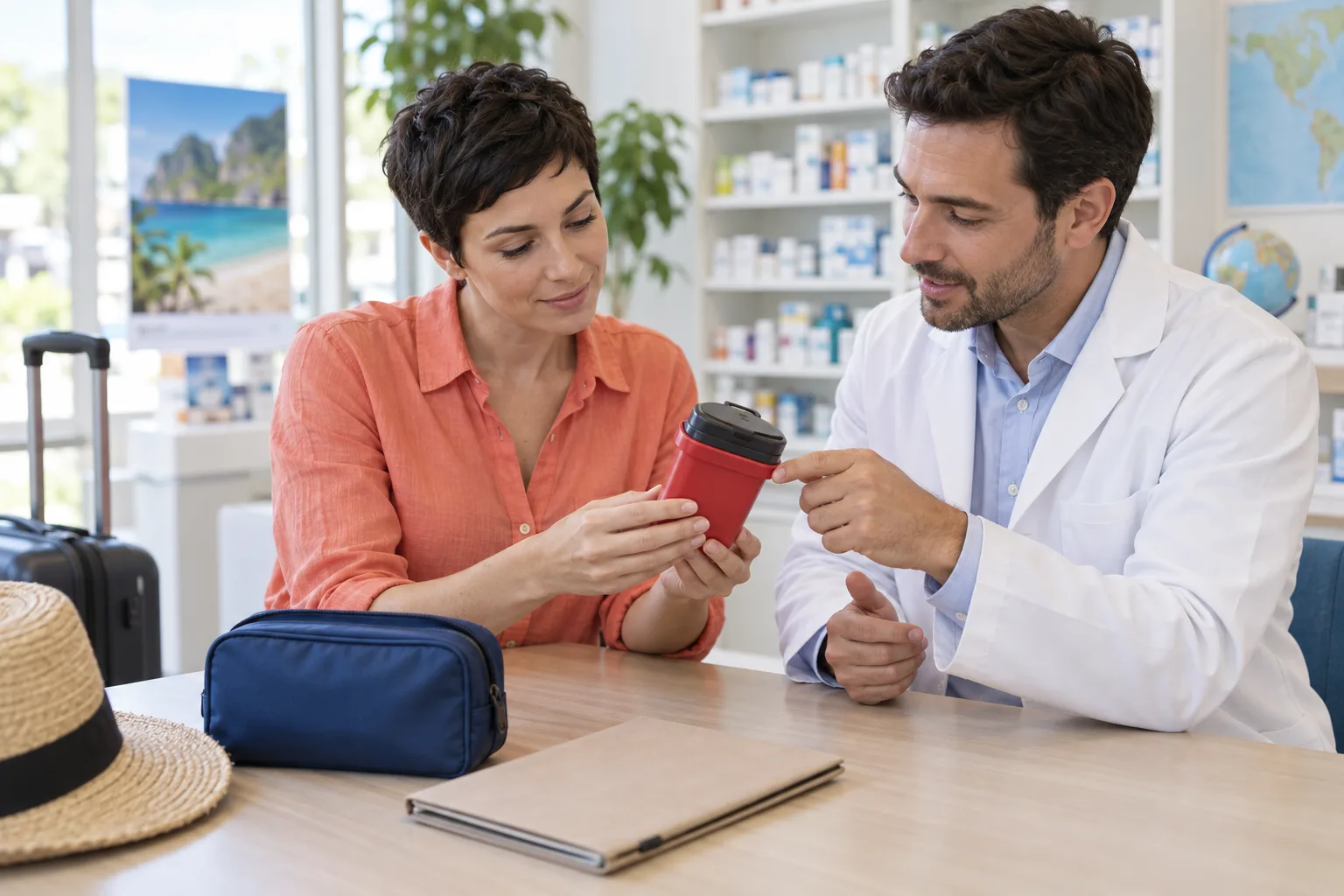
If your wedding or honeymoon medicine kit includes needles, syringes or lancets, pack a disposal plan alongside the supply. Know where the used item goes immediately, how the container travels and who will accept it when it is ready for disposal.
Review the exact device and disposable parts
FDA's examples of sharps include needles, syringes, lancets, autoinjectors and infusion sets. The issue extends beyond medicines given from a separate syringe. [1]
Take the exact product and its instructions to the pharmacist. Ask which items go into the sharps container, which parts are handled differently and how to manage them after each use. Include testing supplies as well as injection supplies.
Request a demonstration using the instructions for that presentation. If the prescription or device changes before travel, review the disposal steps again. Do not copy the method from a different pen or syringe.
Choose the container after identifying what it must hold. A compact container that accepts a small needle may not accommodate the item you actually use. Check the opening, usable capacity and closure instructions with the supplier.
Leave dose selection, administration timing and any device-specific needle handling to your prescribed instructions and training. This article addresses the disposal arrangements around that care.
Check the container's features
FDA recommends immediately placing used needles and other sharps in an FDA-cleared sharps disposal container. Smaller travel sizes are available. It describes heavy-duty plastic, a tight-fitting puncture-resistant lid, stability while upright, leak resistance and labeling that warns of hazardous contents. [2]
Ask how its temporary closure works during travel and how its final closure works before disposal. Check whether closing it permanently makes it unusable for the rest of the trip.
Pack enough capacity for the expected used supplies and reasonable delays. Base that on your existing care instructions; do not change the medicine schedule to fit the container.
If an FDA-cleared container is unavailable, FDA describes a suitable heavy-duty household container as an alternative under some community guidance. It must have the required protective features. [2] A thin drinks bottle or loose plastic bag is not equivalent to that specification.
Have the pharmacist and accepting program confirm any alternative before relying on it. A household container accepted by one program may not meet another program's collection requirements.
Keep disposal within reach
FDA recommends putting used sharps into the container immediately and carrying a travel-size container when away from home. It warns that overfilling increases needlestick risk and directs consumers to disposal arrangements when the container is about three-quarters full. [3] Follow its marked fill line and instructions.
Set the container on an appropriate stable surface before using your supplies. Keep it out of children's and pets' reach, including when relatives share the preparation room or visit the hotel suite.
Keep the clean supply and disposal container distinguishable. Do not leave a used item on a towel, bedside table, plate or makeup tray for someone to gather later.
FDA says never to put loose sharps into household or public rubbish or recycling, and never to flush them. Housekeeping and waste workers can be injured by poorly contained items. [1]
If a problem occurs with the container, stop treating it as an ordinary packing inconvenience. Ask the pharmacist, manufacturer or local health service how to contain the supplies appropriately. Do not push contents down with your hand or open a sealed container to make more room.
Ask for an actual disposal arrangement
Contact the hotel before arrival and ask whether it supplies a sharps container, accepts a sealed personal container or refers guests to another service. Confirm the answer with the person responsible for the arrangement.
Record the container types accepted, any fee, collection location and access hours. Ask whether advance notice is required. A reply that says “medical waste is handled” does not identify what a guest should do.
Include the wedding venue if you expect to use supplies there. Agree where you can set up the container and who will keep the preparation area accessible. Share only the information needed for that practical handoff.
If the hotel has no collection option, locate an appropriate program with the local health or waste authority. FDA says sharps-disposal programs and requirements vary by community. Potential options include designated collection sites, household hazardous-waste programs, mail-back services and special pickup. [3]
Confirm acceptance directly before traveling to a collection point. Ask whether it accepts visitors' household sharps and the particular container you will bring.
Keep a fallback for a closed desk, missed collection or changed itinerary. A plan that depends on one receptionist being present at checkout needs another option.
Check transport and final handoff separately
FDA advises checking current TSA rules when flying with sharps. [3] Check the security authority for each departure airport, the airline and relevant destination requirements for the actual supplies and container.
Ask separately about unused supplies and contained used items. Explain the device and container instead of asking only whether “medical things” are allowed.
Record the current official guidance and any clarification received. Security screening, airline carriage and local waste collection answer different questions; permission at one stage does not establish the next handoff.
Keep essential supplies and the portable container accessible within the applicable travel rules. Follow its closure and transport instructions. Do not plan to carry a loose used item until you find a public washroom container.
For a cruise or an organized tour, ask the operator about onboard disposal and shore transfers. Confirm whether a sealed container is collected or must remain with you for an approved later handoff.
After collection, check that you still have the capacity required for the rest of the trip. Replacing a disposed container belongs on the itinerary before the next expected use.
Keep unused medicine on its own disposal route
FDA recommends take-back options for most unused or expired medicines, including authorized collection locations and prepaid medicine mail-back envelopes. It also notes that some dosage forms have specific disposal instructions. [4]
That medicine guidance is separate from its sharps guidance. Ask the receiving program what it accepts before placing an injector, syringe or sharps container into a medicine collection box or envelope.
Check unused medicine, partly used medicine and used devices with the pharmacist as distinct items. Do not empty a device or vial to make it fit an assumed disposal category.
When travel storage is uncertain, ask the pharmacist or manufacturer about the product before deciding whether it can be used or needs disposal. Keep identifying labels available for that assessment.
FDA's take-back guidance advises removing personal information from prescription packaging before disposal. [4] Do that at the disposal stage, after preserving any information needed for care, travel identification or a product problem.
Get prompt care after a needlestick
FDA advises washing the area immediately with soap and water and seeking immediate medical attention if another person's used needle or sharp punctures you. [1]
Tell the clinician when and how the injury happened and what is known about the item. Do not postpone care until the wedding is over or the flight returns home.
Make the local care contact available offline. If a helper discovers an exposed sharp, ask them to keep others away and obtain appropriate assistance rather than manipulating the needle.
FDA specifically warns against removing, bending, breaking or recapping needles used by another person. [5] Keep untrained helpers out of device handling; they can arrange transport and manage the room while you obtain advice.

Physical Book (No Download)
Bridegenic: The Glow-Up Guide for Brides on GLP-1s
$12.95 + Free Shipping
Order NowThis article provides general education, not a diagnosis or an individual treatment plan. Medication information refers to US sources. Talk with your prescriber, pharmacist or dermatologist about decisions for your care.
Read next
Wedding WeekGLP-1 Vials Before the Wedding: Labels, Syringes and Dates→Honeymoon & BeyondYour Honeymoon on a GLP-1: How to Pack and Store Your Medicine→Sources
- Safely Using Sharps at Home, at Work and on TravelU.S. Food and Drug Administration↩ Back to text
- Sharps Disposal ContainersU.S. Food and Drug Administration↩ Back to text
- Best Way to Get Rid of Used Needles and Other SharpsU.S. Food and Drug Administration↩ Back to text
- Drug Disposal: Drug Take-Back OptionsU.S. Food and Drug Administration↩ Back to text
- DOs and DON’Ts of Proper Sharps DisposalU.S. Food and Drug Administration↩ Back to text