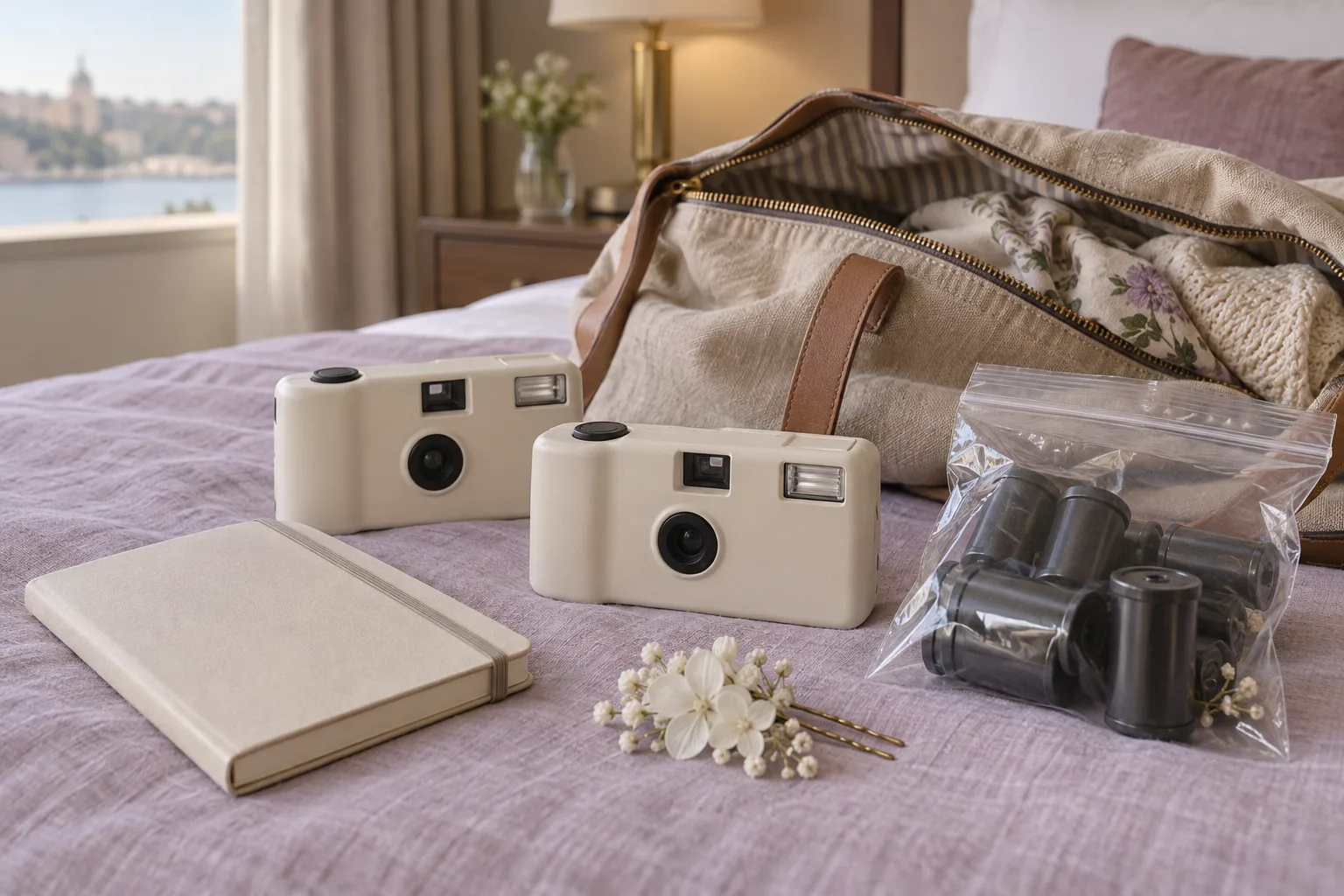
A destination wedding can send the same film through security before the ceremony, on a connecting flight and again after the honeymoon. Decide who carries the cameras and where the film will be processed before buying a box for every table. The return trip matters as much as the flight out.
Used film still needs protection
Kodak’s current CT-scanner guidance advises against scanning either unexposed film or exposed but unprocessed film. It recommends a clear resealable bag, removal from the carry-on at the checkpoint and a hand-inspection request. It also advises against checking film. [1]
A finished roll contains photographs you have taken, but it remains unprocessed until a lab develops it. Putting it in a container marked “finished” does not change its vulnerability.
Include loaded reusable cameras and single-use cameras in your count. Ask the photographer which equipment contains film; a camera bag may also contain digital equipment that needs different handling.
Kodak’s storage guidance distinguishes processed film, which is not affected by airport X-rays. [2] When arranging destination processing, confirm that the film will actually be developed before departure, rather than merely accepted at a shop awaiting shipment elsewhere.
Do not rely on an ISO cutoff for CT screening
ILFORD’s general FAQ separates newer CT equipment from older hand-luggage X-ray machines. Its initial testing warning covers all its ILFORD and KENTMERE film products regardless of ISO rating when CT scanners are used. [3]
Advice that a low-speed film is acceptable through an older scanner cannot establish that it is suitable for a CT scanner. A camera’s small size, cardboard wrapper or “wedding camera” description does not answer the question either.
Ask the airport about film-screening arrangements for your departure terminal and any transfer where you will pass through security again. Do not plan around identifying a scanner from a photograph while the line moves behind you.
For a trip with several stops, make a screening list: airport, terminal, date, whether another checkpoint is expected and the answer received about hand inspection. Update it if the route changes.
Prepare the request before the belt
TSA recommends putting undeveloped film and cameras containing it in carry-on baggage, or taking the film to the checkpoint and asking for hand inspection. [4] That recommendation concerns U.S. screening; it does not establish another country’s procedure.
Pack the film together where you can reach it before placing luggage on the belt. Keep product identification available and explain which cameras are loaded. Leave enough time for the request and any additional checks.
A hand-inspection request still involves security screening. Explain the light-sensitive contents and follow the officers’ directions. Do not open a loaded camera or pull out film to demonstrate that it is present.
Kodak says hand inspections may not be guaranteed at every airport and recommends contacting airports beforehand. If hand inspection is unavailable where CT is used, it suggests local purchase and processing as alternatives. [1]
If a carry-on is selected for gate checking, remove the film and loaded cameras before handing it over. Keep their protective pouch small enough to transfer into the cabin bag you retain.
Include instant cameras and printers
Fujifilm’s February 2020 travel notice warns that newer airport scanners can cause fogging, shadow distortion and poor results in INSTAX film after one pass. It advises carrying film and loaded cameras or smartphone printers in the cabin and requesting hand inspection. [5]
A printer can contain unexposed instant film even though the photograph it will print began on a phone. Check it along with the spare packs before packing.
Fujifilm also suggests destination purchase, or shipment through a carrier that certifies the film will not be X-rayed. [5] Ordinary tracked delivery does not by itself provide that certification.
The INSTAX mini 99 instructions warn against opening the film door before the pack is used up because light can spoil the remaining film. [6] Keep the manual for your model available and explain a loaded pack before an inspection starts.
Test the guest cameras before ordering in bulk
Airport screening is only one part of the purchase. Test the proposed model in lighting similar to the reception, then have that test camera processed. Check whether guests can understand the flash and winding instructions.
As one model-specific example, Kodak lists its Power Flash camera with 27 exposures, ISO 800 film and a flash range of 4 to 14.5 feet, or 1.2 to 4.5 metres. [7] Those figures do not describe every single-use camera.
A flash-range specification is useful when planning table photographs. Do not expect a small camera’s flash to illuminate a distant dance floor merely because it lights a nearby group.
Budget for processing and scanning as well as the cameras. Ask the lab for its price per camera, included scan size, turnaround and return of negatives. Count the total number the collector will carry after the reception, including partly used cameras.
Arrange the lab and collection handoff
Ask the lab whether it handles the exact film and format you intend to use. Confirm the delivery deadline needed for processing before your return flight, opening hours and what happens if the work is delayed.
Kodak recommends prompt processing after exposure to reduce changes in the latent image. Its guidance also warns about heat and advises letting sealed refrigerated film reach room temperature before opening, to avoid condensation. [2]
Follow the storage directions for the actual film. Do not leave the collection pouch in a hot vehicle while guests depart or place unpackaged film in a refrigerator beside wet containers.
Give one person the collection task and a count sheet. Record cameras issued, cameras returned, rolls handed to the lab and the receipt or order number. Label the outside of protective containers without opening the cameras.
Agree how finished negatives and scans will reach you. Download the scans promptly and keep another copy; the photo-backup guide covers file checks and separate copies. Confirm who retains the physical negatives before disposing of packaging.

Physical Book (No Download)
Bridegenic: The Glow-Up Guide for Brides on GLP-1s
$12.95 + Free Shipping
Order NowThis article provides general education, not a diagnosis or an individual treatment plan. Medication information refers to US sources. Talk with your prescriber, pharmacist or dermatologist about decisions for your care.
Read next
Dress & FittingsFlying With Your Wedding Dress: Bags, Flights and Arrival Care→Honeymoon & BeyondWedding Photo Backups: Downloads, Originals and File Checks→Sources
- CT Scanning X-Ray Technology and FilmKodak Alaris↩ Back to text
- Storage and Care of KODAK Photographic Materials, CIS-2017-1Kodak↩ Back to text
- General FAQs: Advice for Airport X-Ray ScannersILFORD Photo↩ Back to text
- Film: What Can I Bring?Transportation Security Administration↩ Back to text
- Traveling With Your INSTAX Film, Camera or Smartphone Printer, February 10, 2020Fujifilm↩ Back to text
- INSTAX mini 99 User Manual: Film-Pack HandlingFujifilm↩ Back to text
- KODAK Power Flash Single Use Camera: Product SpecificationsKodak Alaris↩ Back to text