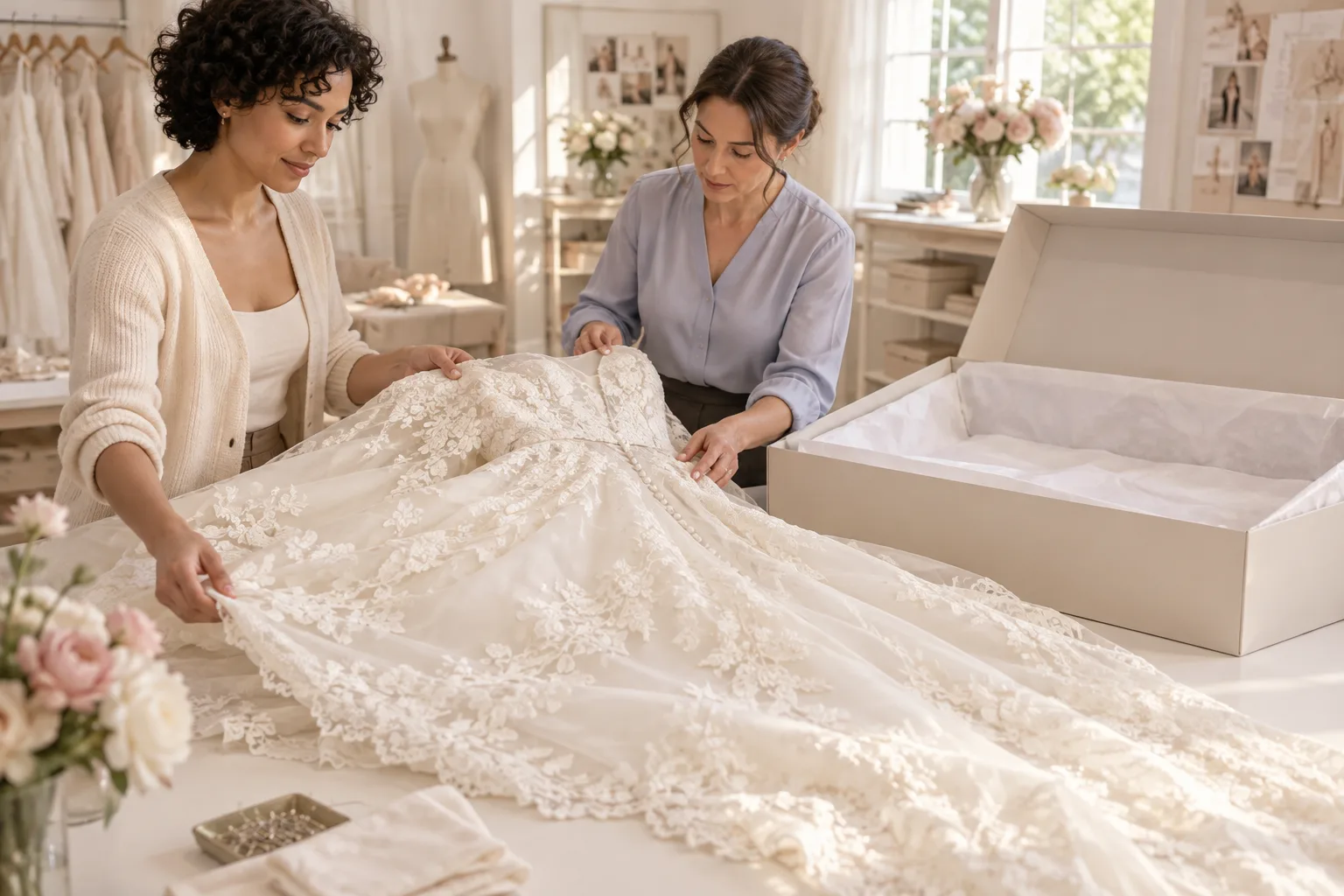
Before leaving for the honeymoon, decide who will take the dress home, which cleaner will assess it and where it will wait. Include the veil, overskirt, detachable sleeves and any repair notes. “Someone will deal with it” can leave a damp hem in a transport bag while everyone assumes another person has the instructions.
Photograph the care label before the wedding
The Federal Trade Commission's care-label guidance says instructions should address the whole garment, including non-detachable lining, trim and other details. Warnings can modify the procedure, such as excluding steam. [1]
Photograph both sides of every care label and keep the images with the designer, style name, receipt and alterations record. Ask the salon about the care needs of anything added during alterations, such as a beaded belt, decorative applique or removable component.
If you have inherited a dress, tell the cleaner what you know about its age, previous cleaning and repairs. A missing label is a reason to seek an assessment rather than assume silk, polyester and mixed fabrics should receive the same treatment.
Put each detachable piece on an inventory. Describe it in ordinary terms: “two pearl-button sleeves,” “long veil with comb” or “bow attached with two hooks.” Photograph the set together so the person collecting it can check the return.
Make an end-of-night handoff
Choose the person who can help remove and transport the dress, then confirm when they leave the reception. Ask the gown specialist how to support your particular garment during removal and transport. Keep their instructions with the garment bag.
Before the wedding, ask what to do if the hem becomes wet or the dress receives a spill. Save the cleaner's or salon's contact details for questions. Do not promise a helper that an internet stain remedy will be safe for every layer and decoration.
Write down where the dress will go that night and who will contact the cleaner. If you leave for travel early, make the appointment and authorization arrangements while you are still available. Give the helper the information needed for the handoff and keep payment details private as appropriate.
The Canadian Conservation Institute (CCI) advises that textiles be clean and dry before long-term storage. [2] If the dress is damp, seek garment-specific advice before enclosing it for an extended period. A storage box does not solve a moisture problem.
Give the cleaner a stain and condition map
Photograph the hem, underarms, neckline, train and any visible marks or damage before drop-off. In the note, distinguish what you know from what you suspect: “red wine spilled on left skirt” is different from “brown mark, cause unknown.”
Include makeup, food, drinks, outdoor dirt and anything applied afterward. If someone used a wipe, soap, powder or stain pen, provide its name and the area treated. That record is more useful than trying to make the dress look untouched before the assessment.
Point out loose beads, torn loops, pulled threads, a damaged zipper or a bustle attachment that failed. Ask which repairs belong before cleaning and which afterward. Do not cut loose threads or remove an embellishment unless the professional explains what to do.
For historic textiles, CCI emphasizes that preventing damage can matter more than removing every stain, and that commercial dry cleaning includes mechanical movement and heat. [3] An older or fragile family dress may need a textile conservator rather than an ordinary cleaning order.
That museum guidance is not a cleaning recipe for a modern gown. Use it to ask about condition and risk, especially when a sales promise suggests every mark can be removed without a tradeoff.
Ask what the preservation service includes
Request an itemized description of cleaning, stain assessment, repairs, pressing, packaging and delivery. Ask whether the work happens on site or is sent elsewhere, who examines the dress and how additional work is approved.
If the proposed method differs from the label, ask the cleaner to explain why and what risks they identify. FTC guidance says an alternative method can be risky and notes that a cleaner may ask for consent after discussing those risks. [1] Read that form with the written treatment proposal.
Ask for the total price and what could increase it. If a guarantee is offered, obtain its terms: what it covers, required storage conditions, inspection rules, exclusions and the process for making a claim. Keep those terms with the receipt rather than relying on the package's headline.
Choose support for the actual construction
CCI advises against hanging fragile, heavily beaded or decorated garments, bias-cut pieces and garments with weak shoulder seams. It also cautions against wire hangers. [2] Ask how the weight of your dress will be supported during both the short wait and long-term storage.
CCI's flat-storage guidance explains that support across the whole textile reduces stress from its own weight. It recommends a container large enough for minimal folding, a lining of prewashed cotton or unbuffered acid-free tissue, and padding at unavoidable folds. [4]
Have the specialist show you how to lift and replace the dress without pulling from the neckline. Ask whether the veil, comb or detached metal-trimmed pieces should be packed separately and how they should be identified.
Measure the storage location before buying a large box. Check shelf depth, door clearance and how you will remove the box for inspection. A container that only fits if tilted or crushed needs a different location.
Ask which box and tissue you are buying
CCI identifies acid-free cardboard and polyethylene boxes as suitable options, while advising against the plastic garment bags supplied by dry cleaners. Those bags can trap moisture, transmit light and use unsuitable plastic. [2]
The more detailed flat-storage note also identifies polypropylene and polyethylene containers and recommends removing ordinary paper wrappings, pins and staples, documenting useful information first. [4] These recommendations support asking for exact materials rather than accepting “archival” as a complete description.
Keep the invoice and care record outside direct contact with the dress, such as in a separate household file. Ask the packer how labels and inventory records are attached so you can identify the contents without pinning a paper note through the fabric.
Do not add scented sachets, colored tissue or miscellaneous keepsakes to a prepared box without checking suitability. Give the bouquet ribbon and jewelry their own storage plan if the specialist has not assessed them for contact with the dress.
Pick a storage location you can inspect
CCI explains that light damage is cumulative and irreversible, and that high humidity supports mould and can accelerate corrosion of metal components. [5] Choose a dark, dry location with stable conditions, and keep the box away from likely leaks and heat sources.
Before using a closet, look at what is above it and around it: plumbing, an exterior wall that becomes damp, a heating vent or a crowded shelf. Choose somewhere you can reach without dragging the box through stored items.
Ask for an inspection schedule and handling instructions. CCI recommends periodically repositioning folded textiles to redistribute folds. [4] Have the person who packed the gown explain how to do that for its construction and packaging.
At inspection, check the container and surrounding area as well as the dress. If you find moisture, suspected mould or insect damage, seek professional advice before returning everything to the same location. Photograph what you find and keep the treatment record available.
Keep one copy of the record with your household documents and share the practical handoff with your helper. You can then leave for the honeymoon knowing who has the dress and what happens next.

Physical Book (No Download)
Bridegenic: The Glow-Up Guide for Brides on GLP-1s
$12.95 + Free Shipping
Order NowThis article provides general education, not a diagnosis or an individual treatment plan. Medication information refers to US sources. Talk with your prescriber, pharmacist or dermatologist about decisions for your care.
Read next
Dress & FittingsWedding Shoes and Your Dress Hem: A Plan for Comfort at the Final Fitting→Wedding WeekYour Wedding-Week Checklist: Food, Medicine and Named Handoffs→Sources
- Clothes Captioning: Complying with the Care Labeling RuleFederal Trade Commission↩ Back to text
- Basic care: TextilesCanadian Conservation Institute↩ Back to text
- Commercial Dry Cleaning of Museum Textiles, CCI Notes 13/13Canadian Conservation Institute↩ Back to text
- Flat Storage for Textiles, CCI Notes 13/2Canadian Conservation Institute↩ Back to text
- Textiles and the Environment, CCI Notes 13/1Canadian Conservation Institute↩ Back to text