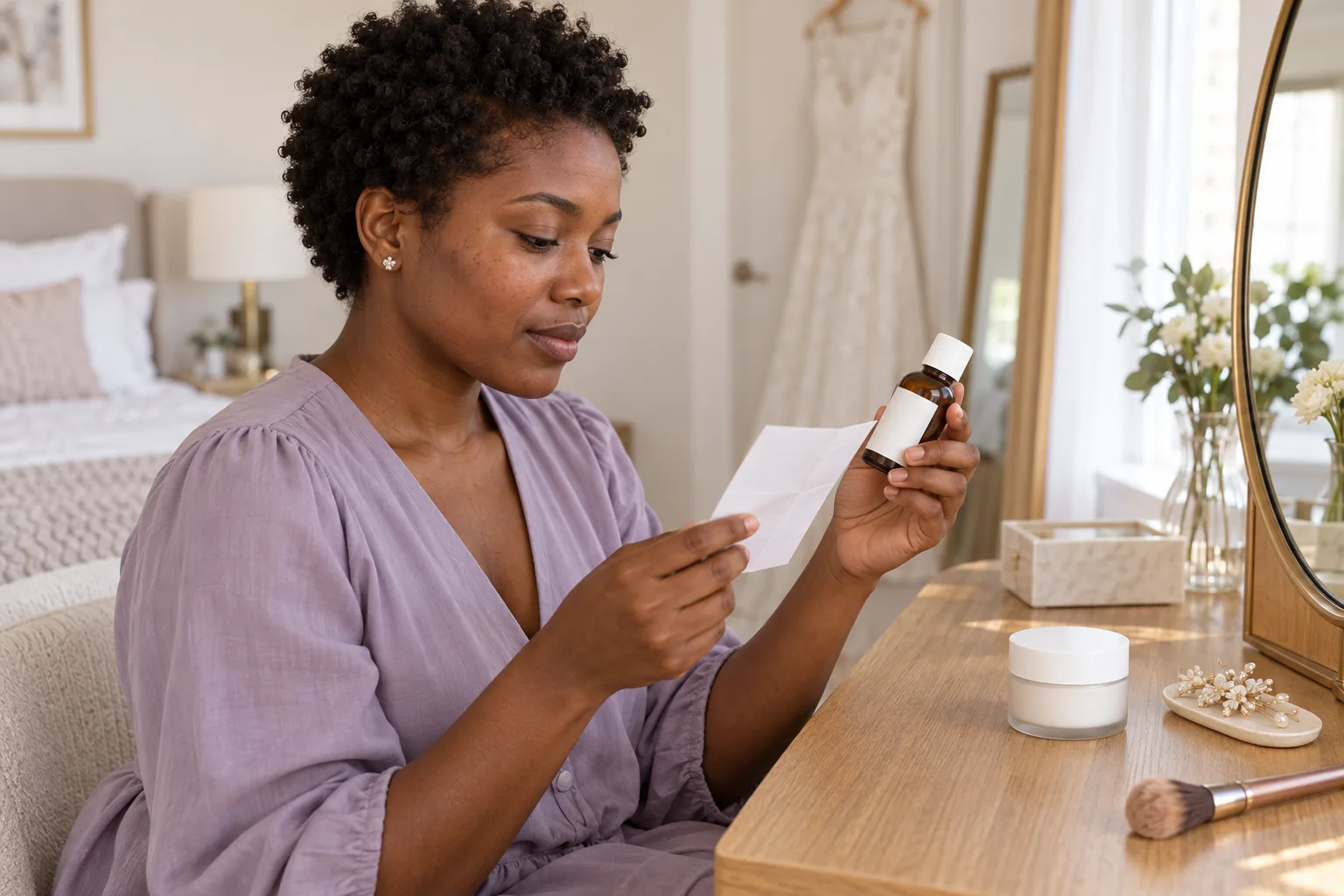
If you are considering a vitamin C serum before your wedding, name the change you want before choosing a bottle. Pigment, fine lines, skin comfort and the way makeup sits are different questions. The research offers evidence for particular formulations and measured outcomes, but a percentage on the label does not tell you how another product will perform.
Start with the formula rather than the percentage
Ask which vitamin C ingredient is present, what concentration is stated and whether the evidence concerns that finished product. Keep the ingredient list and instructions available when discussing it with a dermatologist.
A frequently cited 2001 absorption study applied L-ascorbic acid and derivatives to pig skin. In that experiment, delivery depended on formulation: acidic pH was important, and measured skin concentrations peaked with a 20% L-ascorbic acid formulation. [1]
That was an absorption experiment, not a trial establishing the best facial serum for every person. It does not prove that a 20% bottle produces the best wedding photographs, or that every derivative is ineffective in every formulation.
Do not use those laboratory conditions as a recipe for adjusting a serum’s pH or mixing powder into another cosmetic. Ask about the finished formulation and follow its directions. A product containing several active ingredients also needs review as a whole.
Understand what the older human studies tested
A 2003 double-blind randomized study compared a 5% vitamin C cream with its base on women’s photoaged low-neck and arm skin over six months. Clinical assessments and skin-surface measurements favored the vitamin C-treated side on several outcomes. [2]
This supports a finding for that cream, on those body areas, over that observation period. It does not establish that every facial serum will deliver the same change within a few days or improve every feature described as “aging.”
In a 2004 split-face melasma trial, 16 women used 5% ascorbic acid on one side and 4% hydroquinone on the other for 16 weeks, with daily sunscreen. Participants rated improvement more favorably on the hydroquinone side, while colorimetric measurements did not show a statistically significant difference between treatments. [3]
The abstract reported side effects in one of 16 participants on the ascorbic-acid side and 11 of 16 on the hydroquinone side. [3] A small comparison like this does not make vitamin C reaction-free or establish the appropriate treatment for every pigment concern.
Take an unexplained or changing mark to a clinician rather than assuming it is melasma. The melasma consultation guide explains why diagnosis and the treatment goal come before a brightening routine.
Read the 2026 retinol comparison beyond its conclusion
A trial published May 28, 2026 compared 15% L-ascorbic acid with 0.1% retinol on opposite sides of the face. Thirty adults entered; 27 were included in the final, per-protocol analysis after three withdrawals attributed to adverse effects or unwillingness to continue. Follow-up lasted four weeks. [4]
The researchers reported improvement in a dermoscopic photoaging score with both treatments and no statistically significant difference between them. However, their discussion also reports worsening pigmentation measures on the imaging system in both groups. [4]
The absence of a statistically significant difference does not by itself prove equivalent effectiveness. This small, short trial also compared vitamin C with retinol, not prescription tretinoin, and had no untreated or vehicle-only side. It cannot establish that the two ingredients are interchangeable across products, skin conditions or longer periods.
The authors’ suggestion that vitamin C suits pregnancy or inflammatory skin conditions goes beyond the enrolled population: pregnancy, pregnancy planning and inflammatory facial lesions were exclusions. [4] Do not use that conclusion as personal clearance for a formula or as an instruction to replace a prescription.
Separate a combined clinic treatment from a home serum
An August 23, 2026 melasma study randomized 71 women to yellow-light treatment plus vitamin C or yellow light plus vehicle for 12 weeks. The vitamin C group had a larger reduction in the study’s pigment-severity score, though the authors described the absolute improvement as modest. [5]
The protocol used gradually increasing concentrations before 20%, freshly mixed preparations and repeated clinic visits; 10 participants withdrew. The cosmetics supplier helped fund the study. [5] Its results do not establish what a different serum used alone will do.
The paper also needs caution on safety reporting: its abstract says no adverse events occurred, while the main text describes erythema and stinging. [5] Do not turn the abstract into a claim that the regimen has no reaction risk.
This is a reason to examine the actual comparison, not a reason to buy a light device or add a procedure. If considering treatment, let the qualified clinician explain the evidence and aftercare for that exact approach.
Give irritation a clear response plan
Ask the dermatologist how a proposed serum fits with your current acne medicines, retinoids, exfoliants and history of eczema, rosacea or product reactions. Bring the wedding and makeup-trial dates so the plan accounts for the time available.
AAD’s melasma guidance recommends gentle, fragrance-free products and warns that burning or stinging signals irritation that may darken existing marks. [6] More sensation is not a useful target for judging whether a cosmetic is working.
FDA advises stopping a cosmetic that causes an unexpected reaction and contacting a health-care professional for care advice. [7] Keep the product and ingredient information available. Do not repeatedly reapply an irritating serum to prove that you can tolerate it before the wedding.
If the current routine is comfortable and the event is close, discuss whether adding anything serves your priority. There is no requirement to introduce a serum to complete a bridal skin-care checklist.
Follow product-specific storage and opening instructions
FDA explains that cosmetic shelf life depends on the type of product, use and storage. Exposure to temperature changes, sunlight and air can affect color, texture and smell. [8]
Keep the package instructions and note when you opened the product. Ask the manufacturer about the normal starting appearance and any product-specific changes that mean it should be discarded. Do not assume that every vitamin C formula starts colorless.
FDA advises keeping cosmetic containers clean and closed, protecting them from temperature extremes and discarding products when their color or smell changes. [7] Do not try to restore an altered serum by adding water or another ingredient.
A bottle’s appearance is not a home test of its active concentration or safety. If the product changes, leaks or has uncertain storage history, seek the manufacturer’s guidance rather than using the wedding deadline to justify finishing it.
Keep sun protection and makeup testing on the calendar
A serum should not displace the sun-protection plan. For melasma, AAD recommends broad-spectrum, water-resistant SPF 30 or higher, shade and protective clothing. It also recommends an iron-oxide-containing tinted sunscreen for visible-light protection. [6]
Follow the sunscreen’s application and reapplication instructions. The sunscreen and makeup trial guide covers testing coverage, comfort and wear without relying on foundation alone for protection.
Give the makeup artist the current routine and report any new irritation. Test the combination you intend to use, including gentle removal. A clinical pigment score and a comfortable makeup application answer different questions; both deserve their own assessment.
Record which product was used and whether it pilled, stung or changed how the base wore. If you change the skin-care formula afterward, tell the artist instead of assuming the earlier trial still answers the compatibility question.

Physical Book (No Download)
Bridegenic: The Glow-Up Guide for Brides on GLP-1s
$12.95 + Free Shipping
Order NowThis article provides general education, not a diagnosis or an individual treatment plan. Medication information refers to US sources. Talk with your prescriber, pharmacist or dermatologist about decisions for your care.
Read next
Face & SkinMelasma Before the Wedding: Prescription Details, Sunscreen and Review Dates→Face & SkinSunscreen Under Wedding Makeup: What to Test Before Outdoor Photos→Sources
- Pinnell et al. Topical L-Ascorbic Acid: Percutaneous Absorption Studies, 2001Dermatologic Surgery via PubMed↩ Back to text
- Humbert et al. Topical Ascorbic Acid on Photoaged Skin: Double-Blind Study Versus Placebo, 2003Experimental Dermatology via PubMed↩ Back to text
- Espinal-Perez et al. A Double-Blind Randomized Trial of 5% Ascorbic Acid Versus 4% Hydroquinone in Melasma, 2004International Journal of Dermatology↩ Back to text
- Gunardi et al. Effectiveness and Safety of 15% L-Ascorbic Acid Serum Compared With 0.1% Retinol, May 28, 2026Dermatology Reports↩ Back to text
- Du et al. Yellow Light Alone Versus Yellow Light Combined With 20% Vitamin C for Melasma, August 23, 2026Journal of Cosmetic Dermatology↩ Back to text
- Melasma: Self-Care, updated September 12, 2023American Academy of Dermatology↩ Back to text
- Using Cosmetics SafelyU.S. Food and Drug Administration↩ Back to text
- Shelf Life and Expiration Dating of CosmeticsU.S. Food and Drug Administration↩ Back to text