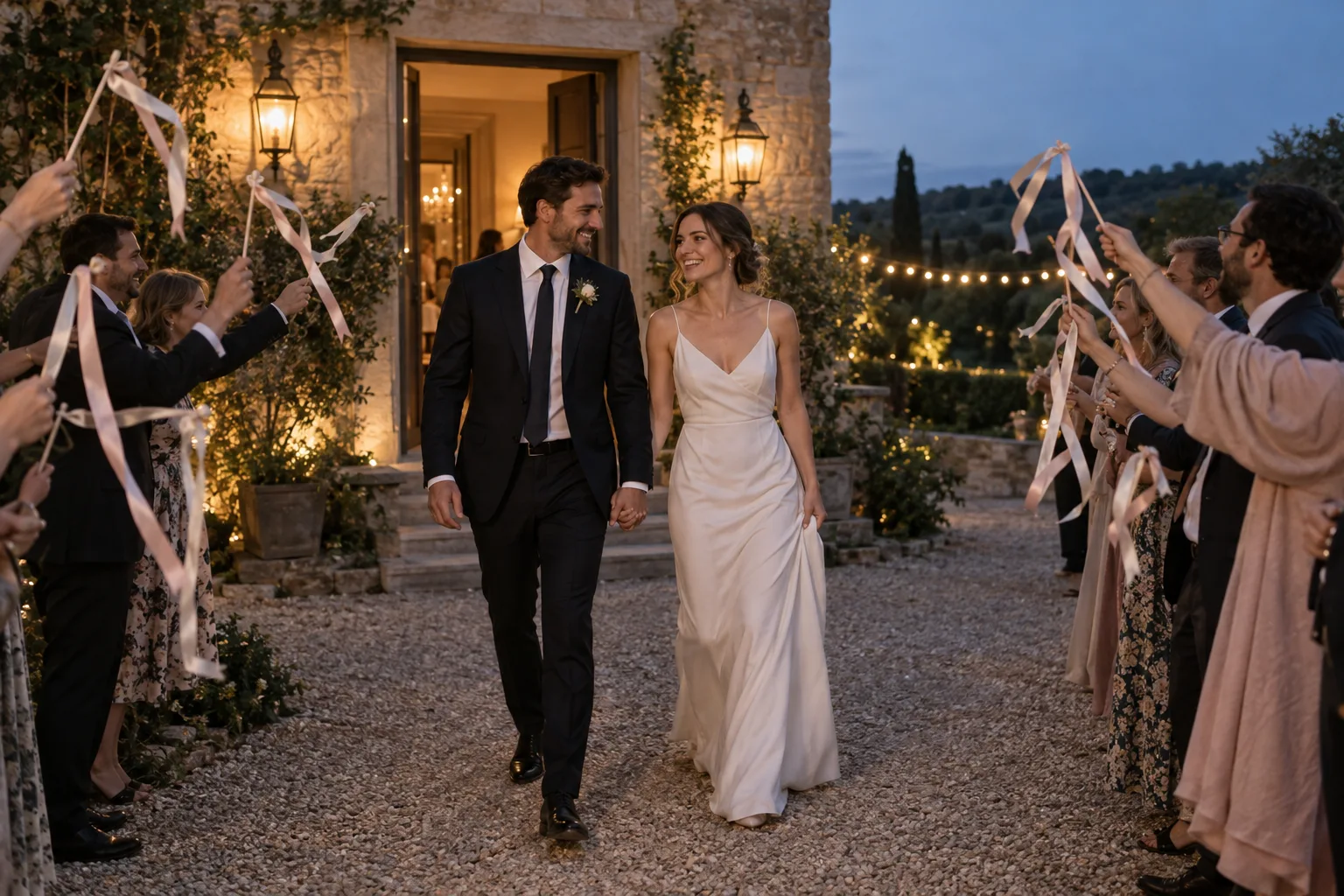
A sparkler exit, a fountain beside the first dance and a small spark device on a champagne bottle are different proposals. Before approving any of them, get the exact product and use in writing. A booking description such as indoor-safe or cold spark does not settle the venue’s rules, operator requirements or the plan for guests standing nearby.
1. What exact device and material are being proposed?
Syracuse Fire Department’s January 2026 guidance treats cold-spark machines used before a nearby audience as pyrotechnic effects requiring specified permits and operator licensing. Its review documents include the manufacturer’s specifications, venue permission and a scaled diagram of the proposed location. [1]
That is Syracuse’s guidance, not a universal classification for every jurisdiction. It shows why an effect needs a product name, model, materials and planned use rather than a reassuring marketing label.
Ask whether the proposal involves guests holding sparklers, a stationary machine operated by a supplier, an aerial display or another device. Get the instructions and specifications for the actual product, including any substitutions the supplier might make.
Do not accept a demonstration with someone putting a hand near sparks as evidence that a device is suitable beside your dress, flowers or ceiling decorations. Ask the operator how the proposed installation will be assessed. You do not need to reproduce the demonstration to evaluate the booking.
2. Who confirms local legality and venue permission?
In a January 6, 2026 advisory, Massachusetts’ State Fire Marshal said sparklers and other pyrotechnic devices, including cold-spark effects, are illegal there without professional licensing, certification and permitting. The notice to restaurants, nightclubs, bars and discotheques also warned against using them as decorations or entertainment in those venues. [2]
This is a Massachusetts example, not permission or a prohibition for every state. Ask the relevant local authority about the exact venue, device, date and indoor or outdoor setting. A product being sold online or used at another wedding does not answer those questions.
Identify who submits any required application and who supplies the operator’s credentials. Ask the venue how written permission is recorded and whether an inspection or demonstration is required before the event.
Keep those responsibilities beside the supplier’s quote. An insurance certificate or venue agreement should not be treated as a replacement for a required permit. If approval is still pending, make that status visible before paying for an effect you assume is confirmed.
3. Does the plan keep children and impaired participants away?
CPSC’s June 2026 guidance warns that sparklers can burn at about 2,000°F, tells consumers to keep children away from fireworks including sparklers, and advises against use while impaired by alcohol or drugs. It estimated 1,300 emergency-department-treated sparkler injuries in 2025. [3]
That national estimate covers more than weddings and does not give the risk for your event. It does explain why a sparkler is not an ordinary favor to put on every seat or hand to a child for a photograph.
Ask the venue how it will manage the proposed audience and participants. Do not make the reception’s final activity depend on guests following unfamiliar fire-related instructions after drinking.
Offer another way to participate, including for anyone who does not want to be near the effect. Ask the photographer to plan the picture around those choices rather than pressuring guests to hold a device for symmetry.
If the supplier cannot explain a workable arrangement, change the send-off. A ribbon wave, a well-lit walk or a final group photograph can still mark the end of the reception.
4. Who controls the layout, activation and decision to stop?
Syracuse’s cold-spark guidance requires a licensed operator on site, appropriate fire protection and clearance from combustibles. It also specifies a trip test so the machine shuts down if tipped. [1]
Those local requirements are examples of operating conditions that need professional review. Do not copy a distance from this article and treat it as approval for another model or location.
Have the operator review the finished setting, including flowers, fabric, ceiling features, nearby guests, exit routes and other suppliers’ equipment. Ask who can stop the effect and what happens if the layout changes after setup.
Agree on the activation cue with the coordinator and photographer. The operator should retain the ability to cancel the effect when conditions do not permit it, even if the couple has reached the planned entrance or dance moment.
Ask who handles the materials afterward, what fire-response equipment is appropriate to the device and how staff summon help. Do not assume an instruction for extinguishing an ordinary consumer firework also applies to machine powders. Leave that equipment-specific plan to the qualified operator and fire authority.
The tent power and heating guide covers another part of the site handoff. Review both plans together if several suppliers are working around the same reception space.
5. How will the products reach the venue lawfully?
FAA explicitly lists sparklers among fireworks and prohibits all fireworks, however small, in both carry-on and checked baggage. [4]
Do not assign a flying guest to pack wedding sparklers, pyrotechnic novelty poppers or spare fireworks as favors. Checking a bag does not solve the restriction.
Ask a qualified local supplier to address lawful sourcing and transport as part of an approved booking. If someone proposes shipping the products, have the supplier confirm the applicable transport and carrier requirements. Ordinary parcel postage is not an automatic alternative.
For a spark machine and its materials, ask the supplier about that exact equipment rather than assuming a rule for a handheld sparkler answers every transport question. Keep the responsibility with someone who can identify and document what is being moved.
If the venue cannot approve the effect or the supplier cannot arrange transport, choose another plan. Avoid leaving an unresolved box of devices for a relative to bring on the wedding morning.
6. What happens if approval, weather or the setup changes?
CPSC recommends leaving fireworks to professionals and enjoying public displays as the safest way to celebrate with fireworks. [3] For your reception, ask first whether you need a spark effect to achieve the photograph or atmosphere you want.
Discuss ordinary lighting, ribbons or another venue-approved alternative with the photographer and coordinator. Ask where people will stand, how the route stays clear and what lighting is needed for the picture.
Before signing, ask how the supplier handles refused permission, weather restrictions, an unsuitable final layout, equipment failure or cancellation by the operator. Put any agreed substitution, credit or refund terms in the contract. These are terms to negotiate, not assumed legal entitlements.
Tell the coordinator which alternative is approved so a cancellation does not trigger an improvised sparkler purchase. Keep any change within the venue’s accepted arrangements.
Chapter 13 of Bridegenic puts names beside practical tasks. Identify the supplier handling approvals and operation, the venue lead and the person communicating the backup plan. The couple should not be negotiating device placement while guests wait for a send-off.

Physical Book (No Download)
Bridegenic: The Glow-Up Guide for Brides on GLP-1s
$12.95 + Free Shipping
Order NowThis article provides general education, not a diagnosis or an individual treatment plan. Medication information refers to US sources. Talk with your prescriber, pharmacist or dermatologist about decisions for your care.
Read next
PlanningSix Wedding-Tent Power and Heating Checks Before Setup→Wedding WeekYour Wedding-Week Checklist: Food, Medicine and Named Handoffs→Sources
- Cold Spark Machines and Use of Pyrotechnics Before an Audience, January 2026Syracuse Fire Department, Fire Prevention Bureau↩ Back to text
- After Switzerland Tragedy, State Fire Marshal Reminds Bars and Clubs of Sparkler Hazard, January 6, 2026Massachusetts Department of Fire Services↩ Back to text
- CPSC Shares Fireworks Safety Tips as America Turns 250, June 24, 2026U.S. Consumer Product Safety Commission↩ Back to text
- PackSafe: FireworksFederal Aviation Administration↩ Back to text