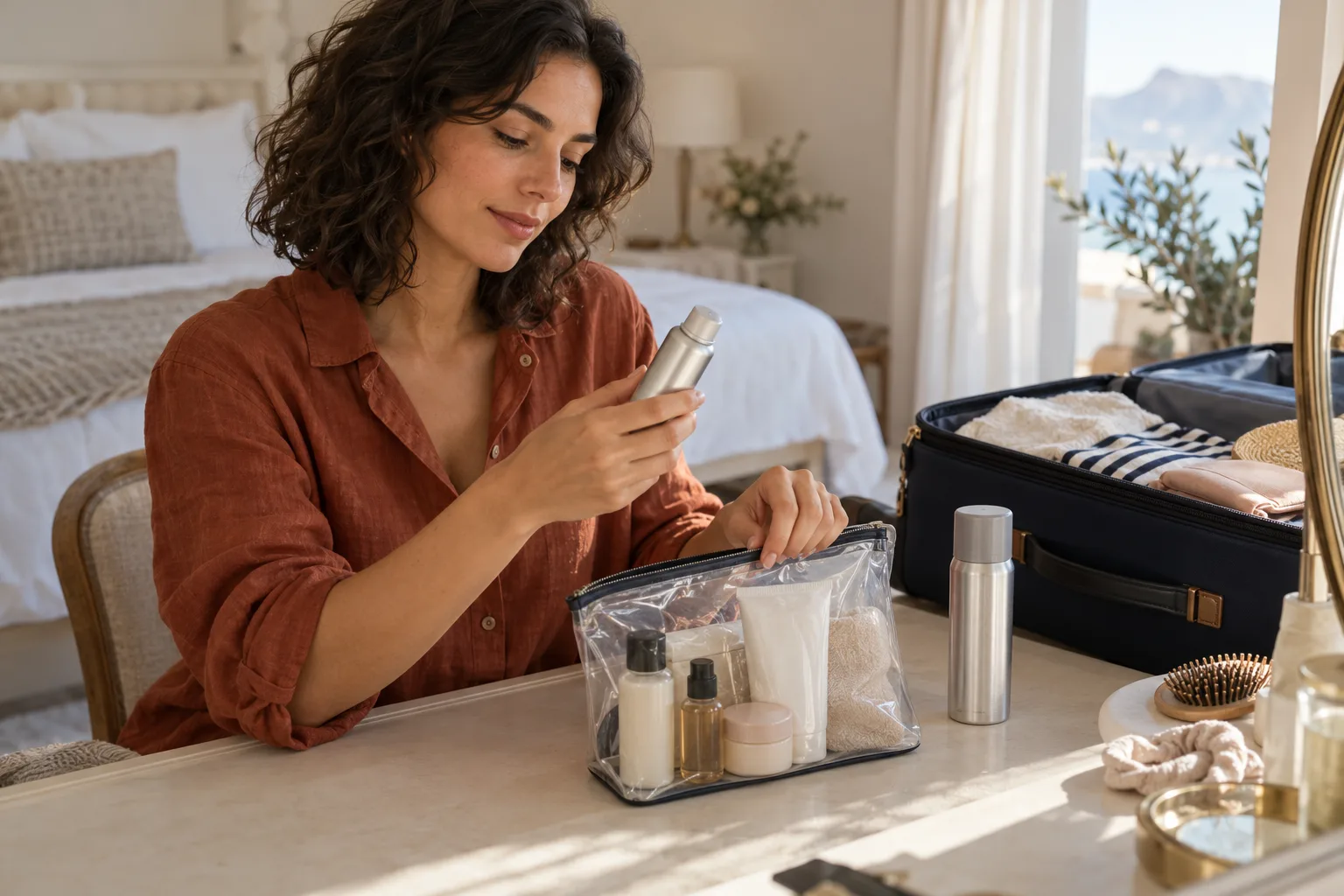
Put the actual cans on the table before packing hairspray, dry shampoo or setting spray for the honeymoon. Check their size, product type and protective caps, then check every airport and airline on the itinerary. A small can still needs to be an allowed product, and an allowed toiletry can still be too large for cabin screening.
1. Is it a toiletry aerosol, another spray or a compressed-gas can?
FAA describes an aerosol as compressed gas expelling another material, which can be liquid, powder or cream. A can of gas that is itself the product, such as canned oxygen or compressed air for cleaning, does not qualify under that aerosol exception. [3] Check the product category rather than choosing by can shape.
Hairspray, shaving cream and other personal toiletries are addressed in FAA's medicinal-and-toiletry guidance. [2] A can for a dress, household use or equipment needs its own check. FAA prohibits flammable non-toiletry aerosols, with examples including spray starch, spray paint and cooking spray, in both cabin and checked baggage. [3]
If the label leaves you uncertain, send the airline the exact product name, size and a photograph of its hazard information. Describe its intended use. A wedding emergency kit is not a category that makes every spray inside it eligible.
2. Does the container meet cabin-screening limits?
TSA's travel checklist places liquids, gels and aerosols under its 3-1-1 rule: containers of 3.4 ounces or less, all fitting in one quart-size clear plastic zip-top bag, with one such bag per passenger. [1] FAA states the checkpoint container limit as 100 mL or 3.4 ounces. [2]
Check the marked size before buying a travel set. Include other products that share the bag, such as creams, gels and toothpaste, when you test whether it closes. Do the check with the products you intend to carry, rather than assuming that a pouch advertised for travel has unlimited space.
A half-used larger can does not become a smaller container. If you want the product in the cabin, obtain an appropriately sized version and check its eligibility. Do not try to open a pressurized can or transfer its contents into another bottle.
These are ordinary toiletry screening examples. Medicines can have separate screening arrangements; use the requirements for your actual medicine rather than relabeling a beauty product as medically necessary.
3. Have you checked the per-container and combined aircraft limits?
FAA's exception limits each covered medicinal or toiletry container to 500 mL or 0.5 kg, and the total aggregate to 2 L or 2 kg per person. Covered articles include items such as perfume, nail polish and remover as well as toiletry aerosols. [6] The aggregate belongs to the person across their baggage, not to each suitcase separately.
For a volume-only example, five eligible 400 mL articles total 2,000 mL, or 2 L. Each is below 500 mL, but together they use the full volume allowance before adding other articles covered by that limit. Those 400 mL containers would also exceed the ordinary TSA cabin size limit. This calculation illustrates the two checks; it does not approve particular products.
List each relevant product and its marked quantity. Do not add grams and milliliters as if they were the same unit. If mixed labeling or product classification makes the total unclear, ask the airline to check the list.
4. Is the release device protected?
FAA requires aerosol buttons or nozzles to be protected by a cap or another suitable means against accidental release. [2] Check the actual cap before packing, especially if it has cracked or no longer stays in place. A loose can in a cosmetics pouch still needs its release device protected.
Keep enough room around the products to avoid forcing a cap off when closing the bag. If the can is leaking, damaged or missing protection, obtain a suitable replacement and follow its label and supplier's advice. Do not plan to repair a pressurized container at the airport.
Permission to carry a product also does not establish permission to use it onboard. FAA advises consulting the crew before using products that give off strong odors or vapors. [2] Plan hair touch-ups at the destination rather than assuming you can spray during the flight.
5. Have you checked the connection and return airports?
GOV.UK's current liquid guidance says rules depend on the airport. Most UK airports retain a 100 mL container limit, including for partly filled containers, while some may permit containers holding up to 2 L. It tells travelers to check the departure airport, other airports on the route and the return. [4] An airport's larger screening allowance does not cancel aircraft dangerous-goods restrictions.
Check the official instructions for the actual terminals and dates. Note where you will pass through security again. A product bought after one checkpoint may encounter another checkpoint during a connection.
For a Canadian example, CATSA's dry-shampoo page distinguishes aerosol and powder forms. Aerosol containers in the cabin must be 100 mL or smaller; certain powders and granular materials are subject to a separate 350 mL total limit and possible additional screening. [5] Switching forms therefore calls for another product check, rather than an assumption that powder has no rules.
6. Will the packing plan still work after shopping?
Include products bought on the trip when checking the return-flight plan. Keep a copy of the airline's relevant guidance with your packing list and confirm unfamiliar products before purchase. If you only need a few uses, consider whether an eligible smaller size meets the need without adding another large can.
Ask your hairstylist or makeup artist for the exact product and size if you want to maintain the wedding look on the honeymoon. Then check the transport requirements yourself. A salon recommendation concerns styling; the itinerary determines which packing checks remain.
Chapter 14 of Bridegenic starts travel preparation with the exact product and route. Apply that approach here too: identify the can, record its size, confirm its category and check the itinerary in both directions.
Physical Book (No Download)
Bridegenic: The Glow-Up Guide for Brides on GLP-1s
$12.95 + Free Shipping
Order NowThis article provides general education, not a diagnosis or an individual treatment plan. Medication information refers to US sources. Talk with your prescriber, pharmacist or dermatologist about decisions for your care.
Read next
Hair7 Checks Before Taking Hair Tools on Your Honeymoon→Honeymoon & BeyondYour Honeymoon on a GLP-1: How to Pack and Store Your Medicine→Sources
- Travel ChecklistTransportation Security Administration↩ Back to text
- PackSafe: Medicinal and Toiletry Articles, updated June 7, 2024Federal Aviation Administration↩ Back to text
- PackSafe: Aerosols, updated January 24, 2024Federal Aviation Administration↩ Back to text
- Hand Luggage Restrictions at UK Airports: LiquidsGOV.UK↩ Back to text
- Dry Shampoo, modified September 13, 2024Canadian Air Transport Security Authority↩ Back to text
- 49 CFR 175.10(a)(1): Passenger ExceptionsElectronic Code of Federal Regulations↩ Back to text