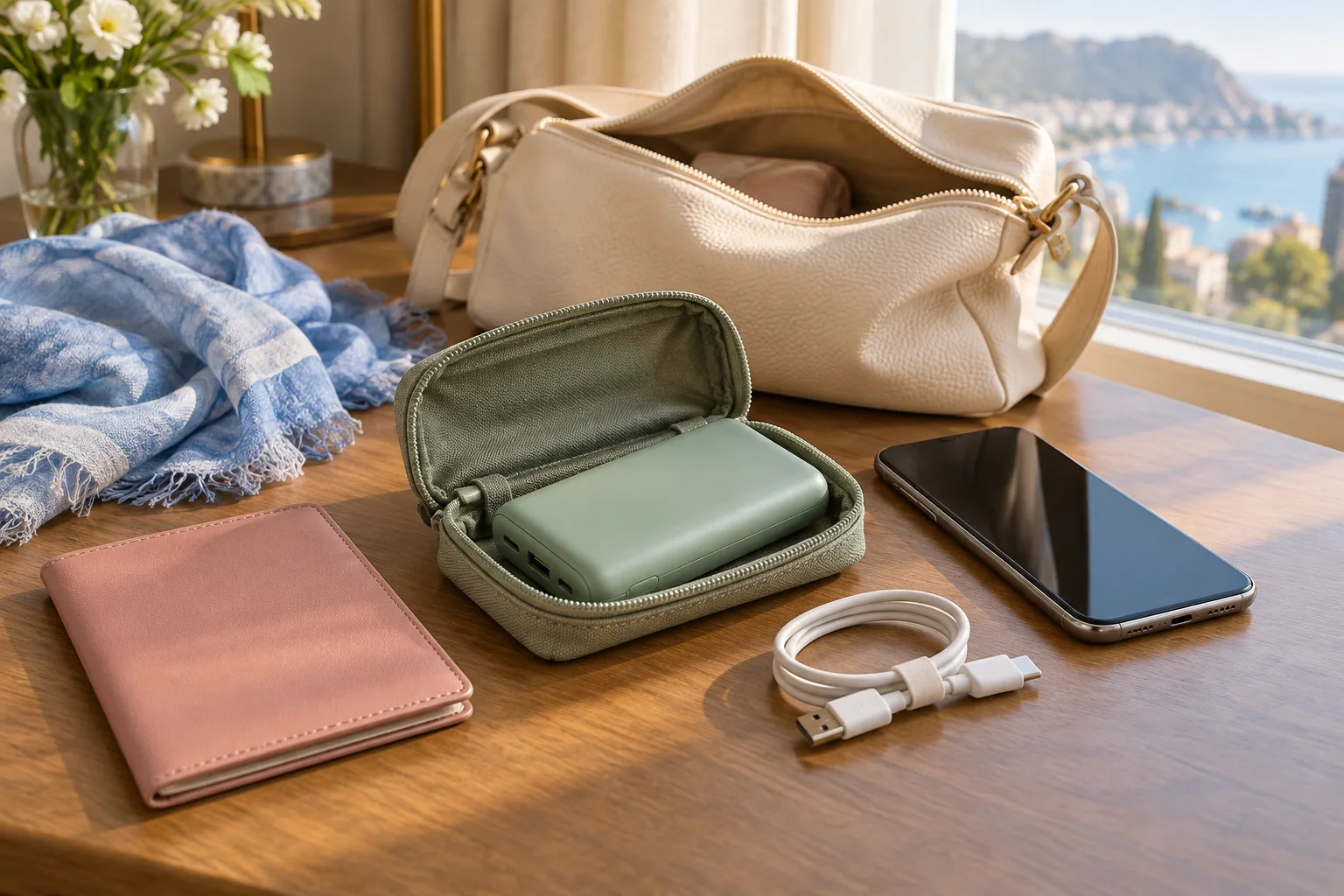
Your honeymoon phone may hold boarding passes, hotel directions and the rental-car confirmation. A power bank can help after arrival, but taking it on a flight requires more than finding room in the suitcase. Check the device, every operating airline and the rules for storing and using it before you leave home.
1. Check the operating airline for every flight
FAA warns that airlines may set stricter quantity and watt-hour limits. [1]
Check the dangerous-goods policy for every operating airline, including separately booked connections and domestic flights at your destination.
Keep a short record for each flight: permitted quantity, capacity limit, approval requirements, storage location and charging restrictions. Save the policy link and the date you checked it. Recheck before departure and again if the operating carrier changes.
Ask about anything unclear using the exact model and rating. A retailer’s travel-friendly description cannot answer which airline has accepted your device. If a rule differs between two legs, pack for both requirements rather than expecting the first airline’s acceptance to settle the second.
2. Read watt-hours rather than guessing from charging watts
FAA gives the calculation: voltage multiplied by amp-hours equals watt-hours. [1]
For an arithmetic example, 10,000 milliamp-hours equals 10 amp-hours. At a stated battery voltage of 3.7 volts, that is 37 Wh. Use the manufacturer’s information rather than assuming a voltage.
A prominent number describing charging output in watts does not state stored energy in watt-hours. Keep the actual rating visible and obtain the manufacturer’s specifications if the markings are unclear. Do not create a replacement label to make an unidentifiable device appear acceptable.
Destination rules can add another requirement. CAAC’s published notice prohibits power banks without a clear CCC marking, or from recalled models or batches, on China’s domestic flights from June 28, 2025. [2] If your honeymoon includes such a flight, check that requirement even when your international airline accepted the device.
A readable capacity rating and a certification mark answer different questions. Ask the airline or airport authority about the actual device if either is uncertain; a calculation alone cannot establish compliance with a marking requirement.
3. Count power banks separately from other spare batteries
ICAO’s March 2026 addendum information sets a maximum of two power banks per person under its Technical Instructions and separates that limit from other spare batteries. Its examples allow power banks above 100 Wh and up to 160 Wh only with operator approval. [3]
That does not require an airline to accept the larger units. Delta’s current power-bank rule allows no more than two per person, each no more than 100 Wh, without exceptions. [4] Emirates’ published rule permits one per passenger. [5]
Do not borrow a higher limit from a general spare-battery paragraph when the airline has a specific power-bank restriction. Count the units each traveler intends to carry, including one left in a handbag after the wedding.
Check any required approval before travel and retain it with the device details. If your chosen power bank is not permitted, revise the packing plan before reaching security. Splitting an unknown collection between bags does not resolve the rules.
4. Check the model, serial number and physical condition
Use the manufacturer’s recall information and, for U.S. products, CPSC’s recall listings. One September 18, 2025 Anker notice identifies five models and directs consumers to verify serial numbers and stop using affected units. [6] That is a specific recall example, not a statement about every product from the brand.
Compare the device itself with the notice. Keep its model and serial details available, and follow the recall’s instructions if it is affected. Appearance alone does not exclude a recalled battery.
FAA restricts carriage of damaged or recalled batteries likely to create sparks or dangerous heat. [1] Do not pack a suspect device while waiting to investigate it after the honeymoon.
The cited CPSC recall warns against putting affected batteries in household trash, ordinary recycling or retail battery-drop boxes, and directs owners to the recall’s return or disposal instructions. [6] Ask about appropriate handling rather than taking a recalled device to the airport for disposal.
5. Keep it with you if a cabin bag is checked
FAA requires power banks in carry-on baggage and says to remove them when a bag is checked at the gate or planeside. [1]
Pack the permitted device where you can retrieve it before handing over the suitcase. Tell your partner where theirs is stored, too. A power bank hidden beneath clothing at the bottom of a rollaboard is harder to locate when boarding staff request the bag.
Check the small items during the handoff: the charging case in a jacket, a second power bank in a tote and a removable battery associated with luggage may require separate attention under the carrier’s rules. Ask staff about unfamiliar equipment rather than treating all battery-containing items as the same category.
The hair-tool travel checklist covers a different packing decision. Permission for a corded appliance does not determine how a loose battery or power bank travels.
6. Protect it and use the airline’s permitted storage location
FAA requires protection against damage and short circuit; individual protective packaging is one option. [1] Keep connections protected according to the product instructions, away from loose metal.
Delta prohibits power-bank storage in overhead bins and calls for an accessible location such as beneath the seat ahead or in the seat pocket. [4] Emirates also prohibits overhead storage and specifies a seat pocket or bag under the seat ahead. [5]
Choose the storage arrangement the crew permits for your seat. A pouch that made packing convenient may need moving when you board. Check before placing the larger bag overhead, and keep the device identifiable rather than buried among loose accessories.
7. Separate charging the bank from charging a phone
ICAO’s addendum prohibits recharging power banks onboard and recommends against using them to recharge portable electronics. [3] These are two different actions: plugging the bank into an aircraft outlet and connecting a phone to the bank.
Delta prohibits recharging the power bank onboard and using it to recharge another device during taxi, takeoff and landing. [4] Emirates prohibits onboard power-bank use, including charging personal devices, and recharging the bank. [5] Follow your own carrier’s current policy and crew instructions.
Charge devices before boarding where permitted, and save essential travel information so a low phone battery does not leave the plan inaccessible. The phone-access guide covers backup access to bookings and accounts.
Report overheating, expansion, smoke or fire to the flight crew immediately. [1] Do not wait until landing.
Chapter 12 of Bridegenic emphasizes confirming practical decisions before the final handoff. Put this check beside the travel documents: device identified, every flight checked, permitted storage known and essentials accessible without depending on onboard charging.

Physical Book (No Download)
Bridegenic: The Glow-Up Guide for Brides on GLP-1s
$12.95 + Free Shipping
Order NowThis article provides general education, not a diagnosis or an individual treatment plan. Medication information refers to US sources. Talk with your prescriber, pharmacist or dermatologist about decisions for your care.
Read next
Hair7 Checks Before Taking Hair Tools on Your Honeymoon→Honeymoon & BeyondA Lost Phone on Your Honeymoon: Contacts and Account Access→Sources
- PackSafe: Lithium Batteries, updated August 11, 2026Federal Aviation Administration↩ Back to text
- CAAC Bans Passengers from Carrying Power Banks Without CCC Markings or from Recalled Models on Domestic Flights, July 9, 2025Civil Aviation Administration of China↩ Back to text
- Information Related to Addendum No. 1 to the 2025–2026 Technical Instructions, approved March 27, 2026International Civil Aviation Organization↩ Back to text
- Battery or Fuel-Powered Items: Lithium BatteriesDelta Air Lines↩ Back to text
- Emirates Makes Changes to Safety Rules for Customer Usage of Power Banks Onboard, August 8, 2025Emirates↩ Back to text
- Anker Power Banks Recalled Due to Fire and Burn Hazards, September 18, 2025U.S. Consumer Product Safety Commission↩ Back to text