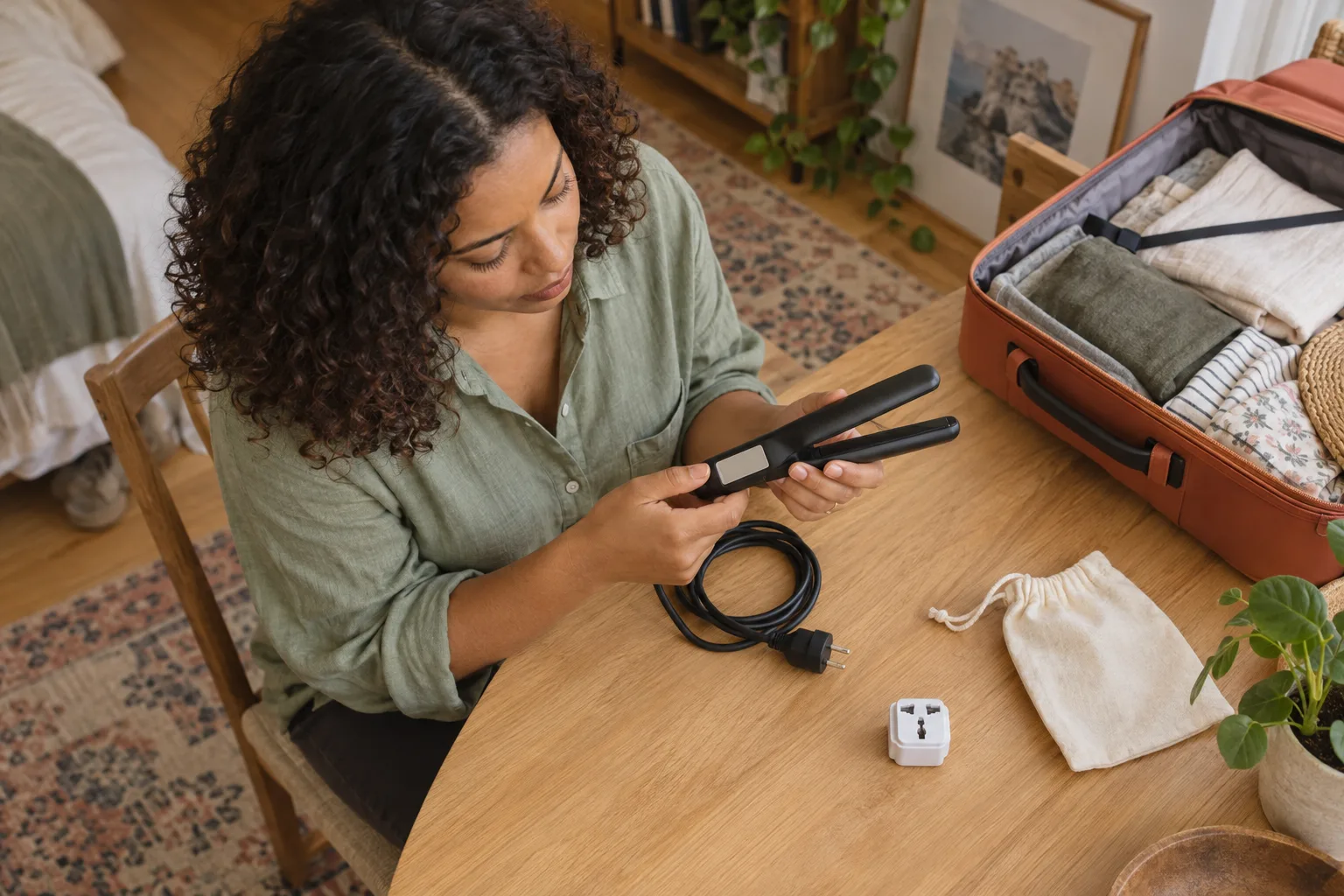
A hair tool can fit in your suitcase and still be unsuitable for the trip. Before packing a dryer, straightener or curling iron for a destination wedding or honeymoon, check its electrical label and transport instructions. A plug that fits the hotel socket answers only one of those questions.
1. Photograph the tool’s electrical label
Record the model number, country of purchase, input voltage, frequency and power rating. For a rechargeable tool, photograph the charger label too. Keep the manual available offline so a manufacturer or airline can identify the device without guessing from its color.
Electrical Safety First explains that a travel adapter changes the physical connection but does not convert voltage or frequency. Electricity supplies differ, and equipment rated for one supply may be unsafe on another. [1]
Compare the label with the supply at each destination, including a second country visited after the wedding. Ask the accommodation to confirm its supply and available socket if the room information is incomplete. Do not treat a socket that accepts several plug shapes as evidence of voltage conversion.
If the label has worn away, obtain the specifications from the manufacturer using the model number. A travel pouch or a small size does not establish that the appliance accepts multiple voltages.
2. Check the model instead of relying on the brand
Dyson’s support instructions for the Airwrap model covered by its troubleshooting page say to use it within the electricity-supply range for its purchase region. Its example says a U.S.-purchased machine will not switch on in Europe. [2]
That does not describe every Dyson dryer. The manufacturer’s Supersonic Travel page describes automatic voltage adaptation across 100–240V, although its FAQ also prints 110–240V. [3] If a destination uses the lower end of that range, resolve that inconsistency against your model’s label and manual with Dyson before relying on it.
There are distinctions within ghd’s range too. Its UK support page, updated February 2, 2026, lists most straighteners as universal voltage, with an exception for model 3.1b. It lists several UK-market dryers and styling tools, including helios, duet style and glide, as 220–240V only. [4]
A friend’s successful trip with a different model is not a compatibility check. Send support a photograph of your label and the destinations. Ask for an answer for that appliance, including any manual voltage selector and the instructions for using it.
3. Match the adapter to the appliance’s power needs
Electrical Safety First advises checking that the appliance does not exceed the adapter’s stated amp or watt rating. It also warns that some adapters do not provide an earth connection and are suitable only for double-insulated equipment. [1]
A phone charging successfully through an adapter does not establish that the same adapter suits a heated hair tool. Check the rating of the part that supplies the appliance, not only a USB charging specification printed elsewhere on the package.
Dyson’s Supersonic Travel FAQ recommends an adapter rated for 1,300W across 100–240V, or individual country-to-country adapters rather than universal adapters. [3] Read that as instructions for that dryer, not a buying specification for every tool.
If the tool’s voltage is incompatible, ask its manufacturer whether a converter is permitted. Do not buy one solely because a listing says it handles hair appliances. Arranging a compatible dryer at the destination may remove the need to carry an uncertain electrical setup.
4. Identify the battery isolation procedure before booking baggage
FAA guidance for battery-powered heat-producing devices requires airline approval and isolation of a component, such as the battery or heating element, to prevent unintended activation and heat. It sets a 100Wh limit for lithium-ion batteries in that category. [5]
Switching off and isolating the heating system are separate actions. Look for the procedure specified for your exact tool. Do not dismantle an appliance or improvise a battery modification.
Dyson’s Corrale travel instructions illustrate why the manual matters: two-pin and four-pin Flight-ready tags use different procedures. The company directs users to check for the aircraft icon, keep the tool in the specified flight-ready state throughout the flight, carry it in cabin baggage and obtain advance airline approval. [6]
Keep the airline’s response with the model instructions. If the cabin bag must be checked at the gate, tell staff about the device before handing over the bag and follow their instructions. A packed tool needs to remain accessible for that discussion.
5. Check whether a cordless iron contains gas
Cordless does not necessarily mean rechargeable. Some curling irons contain a butane cartridge, which places them under a different set of transport rules.
FAA’s cordless curling-iron entry allows one gas-fueled device per person in carry-on baggage only. It requires a securely fitted safety cover over the heating element and protection against accidental activation. Spare gas cartridges are prohibited. It also tells international passengers to check with the airline because rules can differ. [7]
Identify the fuel before packing. Do not place a refill in a toiletry bag or assume that checking the suitcase makes it acceptable. If a device’s fuel type or permitted packing cannot be confirmed, leave it out of the luggage.
The same FAA entry says ordinary corded electric curling irons and straighteners are not restricted under that hazardous-material entry. [7] That does not settle their electrical compatibility abroad or every airline’s baggage conditions.
6. Ask about every operating airline on the route
For a connecting itinerary, identify who operates each flight, including the return. Send the device’s model, power source, battery rating if applicable, isolation instructions and intended baggage location. Ask whether approval is needed and how it is recorded.
Keep the reply, the current policy and the manufacturer’s instructions together. Recheck after a flight change. A general product description such as “travel-friendly” does not confirm acceptance on your particular route.
If the wedding stylist brings professional equipment, ask who is checking its transport and local power requirements. A salon appointment at the destination may involve different equipment from the home trial. Agree on any tool-dependent changes before the wedding morning.
The hair-trial guide can help you record the agreed style, attachments and removal instructions. Use that record to explain which parts of the plan need a specific tool and which can be simplified.
7. Confirm the hotel setup and the checkout plan
Ask whether a dryer is supplied in the room, available on request or fixed to the wall. If your style needs a diffuser or another attachment, ask about that separately. “Hair dryer provided” does not identify its fittings or guarantee that your own attachments will fit.
Plan a suitable place to use and set down the appliance. CPSC advises keeping hair dryers away from water, unplugging them when not in use, keeping air openings clear and avoiding soft surfaces such as beds during operation. [8]
Follow the tool’s instructions for cooling and storage before packing it on checkout morning. Do not assume an ordinary cloth pouch is a heat-resistant case. Allow enough time to finish styling, unplug the appliance and pack it as directed.
Rehearse a simpler option with familiar accessories before departure. That gives you a usable choice if the hotel equipment differs, the airline declines a device or the exact electrical requirements remain unresolved.

Physical Book (No Download)
Bridegenic: The Glow-Up Guide for Brides on GLP-1s
$12.95 + Free Shipping
Order NowThis article provides general education, not a diagnosis or an individual treatment plan. Medication information refers to US sources. Talk with your prescriber, pharmacist or dermatologist about decisions for your care.
Read next
HairHair Smoothing Before Your Wedding: Questions for the Salon→HairA Wedding Hair Trial for Shedding or a Sensitive Scalp: Extensions, Veils and Comfort→Sources
- Travel Adaptors: Usage and SafetyElectrical Safety First↩ Back to text
- Airwrap Model Support: Using Your Machine AbroadDyson↩ Back to text
- Supersonic Travel Hair Dryer: Overview and Travel FAQDyson↩ Back to text
- Can I Use My ghd Product Outside of the UK?, updated February 2, 2026ghd↩ Back to text
- PackSafe: Battery Powered Heat Producing Devices, updated January 22, 2025Federal Aviation Administration↩ Back to text
- How to Travel With Your Dyson Corrale StraightenerDyson↩ Back to text
- PackSafe: Curling Irons (Cordless), updated February 22, 2023Federal Aviation Administration↩ Back to text
- CPSC Cautions Hair Dryer OwnersU.S. Consumer Product Safety Commission↩ Back to text