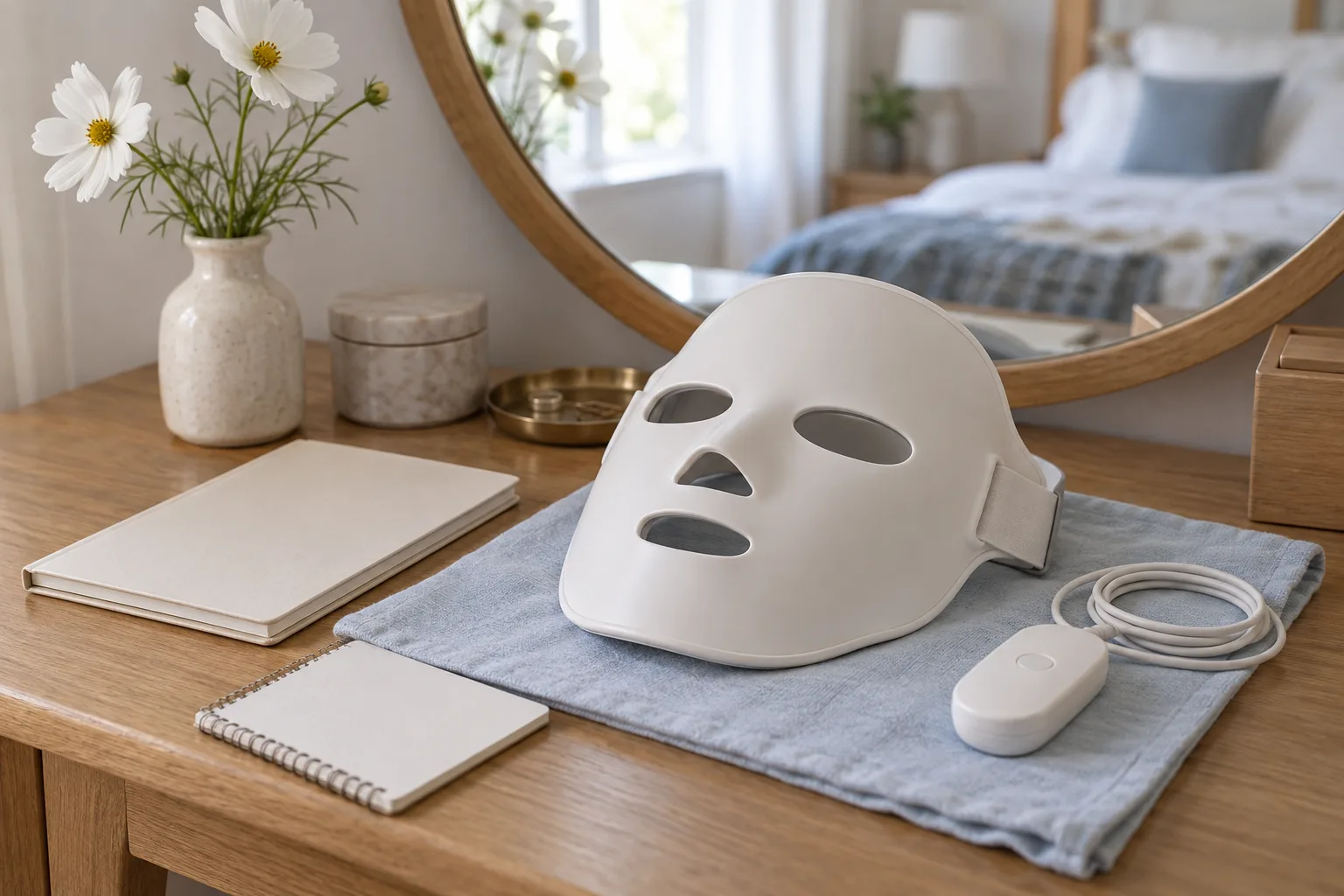
An LED mask can turn a small cosmetic purchase into weeks of appointments with your bathroom mirror. Before adding one to wedding preparation, identify the feature you want to change, the evidence for that model and the time its instructions require. A photograph of glowing LEDs tells you none of those things.
Read the crow’s-feet trial carefully
A 2025 randomized trial enrolled 60 adults of Asian ancestry, aged 30 to 65, with Fitzpatrick skin types II to V. It tested a particular 630-nm red and 850-nm near-infrared mask for crow’s feet at rest. [1]
The methods specify nine minutes, five times weekly for 12 weeks, with follow-up through week 16. The comparison mask emitted one-tenth-strength red light and no near-infrared light; it was not a zero-light comparison. This schedule describes the study, not instructions for a different device. [1]
At week 12, independent ratings improved by at least one point for 25 of 29 treated participants, or 86.2%, versus five of 30 controls, or 16.7%. That is a proportion meeting a rating threshold, not an 86.2% reduction in wrinkles. Participant-rated global improvement did not differ significantly between groups. [1]
Y&J Bio funded the study. Its size, selected population and short follow-up limit what it can establish about other users, uncommon harms or lasting effects. It did not test wedding photographs, facial-volume restoration or every mask sold as red-light therapy. [1]
Match the evidence to the model
Save the manufacturer, model number and instructions before comparing a seller’s claims with a paper. If the study used another device, ask what supports applying its findings to this one.
Record which concern the study measured. Crow’s feet at rest, acne lesions, pigmentation and facial contours are different outcomes. A paper about one cannot answer every appearance question on a product page.
Check whether the comparison involved another treatment, reduced-intensity light or no treatment. Find the number of participants and the treatment duration before accepting a percentage in an advertisement.
Before-and-after photographs need matching expression, lighting, distance and makeup. Ask what else participants used. Your own bathroom photographs can document a routine, but changes between two pictures cannot establish the device caused them.
Understand the FDA wording
FDA’s 510(k) process compares a device with a legally marketed predicate to determine substantial equivalence, including safety and effectiveness. Clearance does not promise that an individual buyer will obtain the advertised cosmetic result or that every cleared device had its own randomized trial. [2]
FDA also distinguishes registration and listing from clearance, approval or authorization. A business displaying an establishment-registration certificate has not thereby established that its mask is cleared. [3]
Ask for the exact clearance number and match the manufacturer, model and intended use in FDA’s records. The wording matters more than an FDA logo on a sales graphic.
For example, the 2025 clearance summary for LED LIGHT MASK A093 identifies red-light use for full-face wrinkles and blue or combined red-and-blue use for mild to moderate inflammatory acne in adults. Its submission relied on nonclinical testing and comparison with a predicate; it says clinical testing was unnecessary. [4]
That example is not a product recommendation. It shows why “FDA-cleared” alone cannot tell you whether a mask was studied in a trial like the one above. Ask separately about clearance, supporting clinical research and suitability for your concern.
Check your skin and medicines first
The American Academy of Dermatology advises people with darker skin tones to consult a dermatologist before home use because visible-light sensitivity can contribute to hyperpigmentation. It also cautions about photosensitive conditions such as lupus and medicines that increase light sensitivity. [5]
Bring the proposed device instructions and a current medicine list, including skin prescriptions, to that discussion. Do not stop prescribed treatment to make an optional mask fit your schedule.
If uneven pigmentation is the concern, ask for an assessment before selecting a device by color. The melasma guide explains why diagnosis and a treatment plan matter when planning makeup and photographs.
Ask how the device fits with any peel, laser procedure or other planned treatment. Obtain instructions from the professional responsible for that treatment rather than combining schedules from several advertisements.
Use the supplied instructions as the boundary
Read the model’s preparation, session length, frequency, cleaning and storage directions before the first session. Confirm whether its different modes have different instructions. A timer does not explain which setting is appropriate.
AAD says to follow device directions and use eye protection when required. [5] Check the specified protection and fit before switching on the mask. Do not assume that closing your eyes, using sunglasses or borrowing another device’s eye inserts satisfies its requirements.
If the instructions are missing or unclear, obtain them from the manufacturer before use. Ask about compatibility with products applied underneath; do not invent a serum-and-mask combination because both products appear in the same video.
Do not double sessions to catch up before an appointment or copy the research schedule onto a different model. Give a makeup artist or photographer an accurate description of what you have used if a skin change affects a planned session.
Decide how you will assess the purchase
AAD notes that some users see subtle changes and others see none; repeated treatment takes time. Mild irritation or pain can occur, and longer-term effects remain uncertain. [5] Noninvasive treatment still needs instructions and a plan for problems.
Before paying, read the return window, opened-product exclusions, warranty and replacement-part costs. Compare the required routine with your calendar. A return deadline can expire before the treatment period used in a study has finished.
Choose a review point with your dermatologist when clinical advice is involved. Write down the specific concern and what improvement would make continued use worthwhile. A seller’s request to keep purchasing accessories is not a useful outcome measure.
If you develop irritation, pain or a concerning change, stop the session and seek advice rather than increasing exposure. Eye symptoms need prompt assessment. Keep the model details and settings available for the treating professional.
For wedding week, protect time for a familiar skin and makeup routine. The skin-care planning guide helps organize those appointments without requiring a new device purchase.

Physical Book (No Download)
Bridegenic: The Glow-Up Guide for Brides on GLP-1s
$12.95 + Free Shipping
Order NowThis article provides general education, not a diagnosis or an individual treatment plan. Medication information refers to US sources. Talk with your prescriber, pharmacist or dermatologist about decisions for your care.
Read next
Face & SkinYour Wedding Skincare Plan: From Engagement Photos to Makeup Removal→Face & SkinCollagen Supplements Before the Wedding: What the Skin Studies Can Support→Sources
- Park et al. Clinical Study of a Home-Used LED and IRED Mask for Crow’s Feet, February 14, 2025Medicine↩ Back to text
- Medical Device Safety and the 510(k) Clearance ProcessU.S. Food and Drug Administration↩ Back to text
- Are There FDA-Registered or FDA-Certified Medical Devices?U.S. Food and Drug Administration↩ Back to text
- K250880: LED LIGHT MASK A093 Clearance Summary, June 20, 2025U.S. Food and Drug Administration↩ Back to text
- Is Red Light Therapy Right for Your Skin?American Academy of Dermatology↩ Back to text