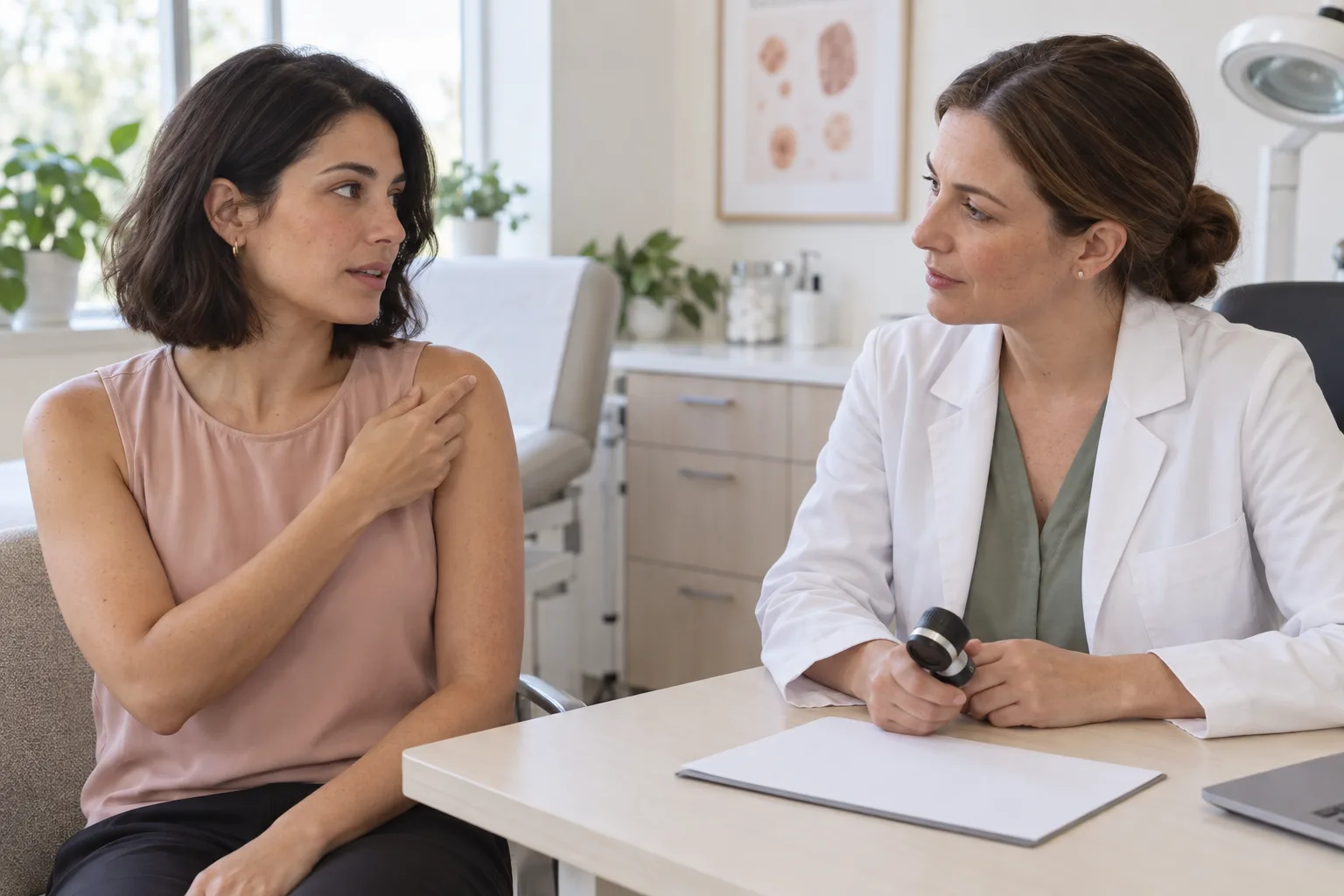
If a spot is changing, itching or bleeding, arrange a dermatology assessment before treating it as a cosmetic detail. If a confirmed benign mole or skin tag catches on your necklace or dress, ask about removal, aftercare and follow-up with the wedding and honeymoon dates in view. The examination should come before a removal deadline.
Report what changed
The American Academy of Dermatology recommends an appointment for a new spot, one that differs from others, or a spot that changes, itches or bleeds. Its ABCDE guidance highlights asymmetry, irregular borders, varying color and evolution. [1]
Tell the office when you first noticed it and what changed. A dated photograph may help explain the history, but it cannot establish the diagnosis. Include pain, bleeding, rubbing from clothing and anything you have applied to it.
Bring the product packaging if you already tried a remover. Tell the dermatologist whether the spot was previously frozen, shaved, burned or treated elsewhere, even if the surface now looks different.
AAD notes that melanoma can be smaller than six millimeters. [1] Do not wait for a spot to reach a particular diameter or show every ABCDE feature before asking for assessment.
Give the wedding and travel dates when booking, along with the symptoms. Let the clinical team decide the appropriate timing. Do not label a changing lesion as a cosmetic appointment simply because photographs made you notice it.
Find out what the growth is
AAD describes skin tags as harmless growths that often occur where skin, jewelry or clothing rubs. It also warns that a wart or skin cancer can be mistaken for a skin tag. [2]
Point to the exact spot during the examination. If several areas concern you, make a short list so the appointment does not address one while overlooking another. Ask whether each needs treatment, observation or further assessment.
AAD says most moles do not need treatment. Dermatologists may remove one because it is bothersome, the patient dislikes its appearance or it is suspicious for cancer. [3]
Keep those reasons distinct in the discussion. A stable benign growth that you prefer to leave alone can remain part of your appearance. A suspected skin cancer needs a clinical plan even if removal would affect the dress or portrait schedule.
If a necklace catches repeatedly, bring a photograph of how it sits. Ask whether adjusting the jewelry or garment is a reasonable option while the skin concern is assessed. Do not tie thread around a growth or trim it with manicure scissors.
Understand the injury evidence for removal products
In August 2022, FDA issued warning letters concerning unapproved drugs sold for mole and skin-tag removal. Its announcement distinguished these over-the-counter drug products from properly evaluated treatments. [4]
A 2023 case series examined injuries associated with unapproved, non-device topical removers. It identified thirty-eight cases: thirty from Amazon consumer reviews and eight reported to FDA. Fourteen involved facial injuries, including four near the eye. [5]
Reported problems included burns, pain and ulceration, sometimes with lasting scarring or disfigurement. The authors noted underreporting, limited clinical details and potential bias in consumer reviews. [5]
Those reports document serious injuries but cannot calculate the proportion of users harmed. They also do not establish a safe acid concentration or a reliable way to select a growth for home treatment.
Do not assume “botanical” or “homeopathic” means a remover is gentle. The case series included products listing botanical ingredients as well as caustic agents. [5] Show the exact product to the dermatologist if you are considering it or have already used it.
AAD also warns that home mole removal can cause infection, scarring and delayed cancer diagnosis. [3] Removing the visible surface does not answer what the growth was.
Keep device clearance specific
FDA's November 2024 record for Compound W Skin Tag Remover documents clearance through the 510(k) pathway. The stated indication is over-the-counter treatment of skin tags in adults aged twenty-two or older. [6]
That is a medical-device indication for skin tags. It does not authorize using that device on moles or diagnose an unidentified spot on your neck. It also does not establish that every product advertised with a similar name has the same regulatory status.
If you have a question about a skin-tag product, ask the clinician or pharmacist about the exact item, its labeling and whether your situation fits. Do not transfer a wart-remover instruction to a tag, or a skin-tag instruction to a mole.
AAD warns that wart-removal medicine can damage the softer skin of a tag. [2] A discount bundle of several removal products is not a reason to experiment before the wedding.
Ask what the procedure and result involve
AAD describes surgical excision and surgical shave as mole-removal approaches. Removed tissue may be examined under a microscope to check for cancer; the exact approach depends on the lesion. [3]
Ask what the dermatologist recommends and why. Will there be stitches? Is the procedure intended to remove the whole lesion or obtain a diagnostic sample? Will tissue go to a laboratory, and when and how will you receive the result?
For a skin tag, AAD lists clinician-performed freezing, electrodesiccation and removal with a sterile blade or scissors among options. [2] Ask which fits the location and what visible wound or dressing to expect afterward.
Discuss prior healing problems, scar concerns, adhesive reactions, medicines and relevant health conditions. Do not independently pause a prescribed medicine to reduce bruising or bleeding.
Arrange the results contact before travel. Write down whom to call if the expected message does not arrive. If further treatment is recommended, ask how urgently it is needed and which wedding or travel arrangements should change.
Plan around the wound rather than a fixed countdown
AAD's skin-biopsy guidance says many wounds heal in seven to ten days, while some sites, such as lower legs, take longer. It advises avoiding immersion in pools, hot tubs and similar water until the wound heals. [7]
Those are general biopsy observations, not a promise that any removal will be photograph-ready in a week. Ask about your procedure, site and healing circumstances. A closed wound, removed stitches and a less noticeable scar are separate milestones.
Get written instructions for cleaning, covering the site, dressing changes and any stitch-removal appointment. Ask about makeup, shaving, hair products, exercise, garment friction and sun protection for the treated area.
For a site near a neckline or shoulder strap, discuss the expected dressing with the alterations specialist after receiving the clinical instructions. Do not remove a necessary dressing to make the garment sit differently.
Tell the makeup artist where products must be avoided and how any approved dressing will be handled. The skin-care and makeup plan can hold those instructions without inviting the artist to make a medical decision.
Review honeymoon water activities using the swimming guide. A waterproof covering is not a universal substitute for the clinician's restriction on immersion.
Know what needs another call
After a biopsy, AAD advises calling the dermatologist right away for worsening pain, increased swelling, warmth, pus, yellow or golden crusting, or fever. [7] Obtain your own procedure's instructions for bleeding or other unexpected changes as well.
Keep the office's daytime and after-hours contact details with the care supplies. If symptoms occur abroad, use appropriate local care and provide the procedure date, treatment details and medicine list.
AAD says a mole that grows back after removal should prompt another appointment immediately. [3] Do not treat regrowth with a stronger remover or assume it is only a cosmetic issue.
Keep a copy of any diagnosis, pathology result and follow-up plan. If the concern is benign and removal is optional, you can discuss deferring it until after the wedding. If assessment identifies a medical need, let that guide the next step.

Physical Book (No Download)
Bridegenic: The Glow-Up Guide for Brides on GLP-1s
$12.95 + Free Shipping
Order NowThis article provides general education, not a diagnosis or an individual treatment plan. Medication information refers to US sources. Talk with your prescriber, pharmacist or dermatologist about decisions for your care.
Read next
Honeymoon & BeyondHoneymoon Swimming: Cuts, Tattoos and Water Precautions→Face & SkinYour Wedding Skincare Plan: From Engagement Photos to Makeup Removal→Sources
- What to Look For: ABCDEs of MelanomaAmerican Academy of Dermatology↩ Back to text
- Skin Tags: Why They Develop, and How to Remove Them, May 1, 2023American Academy of Dermatology↩ Back to text
- Moles: Diagnosis and TreatmentAmerican Academy of Dermatology↩ Back to text
- FDA Issues Warning Letters to Three Companies for Selling Unapproved New Drugs for Mole and Skin Tag Removal, August 9, 2022U.S. Food and Drug Administration↩ Back to text
- Serious Skin Injuries Following Exposure to Unapproved Mole and Skin Tag Removers, January 2023Konkel and colleagues, Journal of Clinical and Aesthetic Dermatology↩ Back to text
- K242803: Compound W Skin Tag Remover, November 6, 2024 clearance and summaryU.S. Food and Drug Administration↩ Back to text
- Skin Biopsy: Dermatologist-Recommended Wound Care, November 29, 2022American Academy of Dermatology↩ Back to text