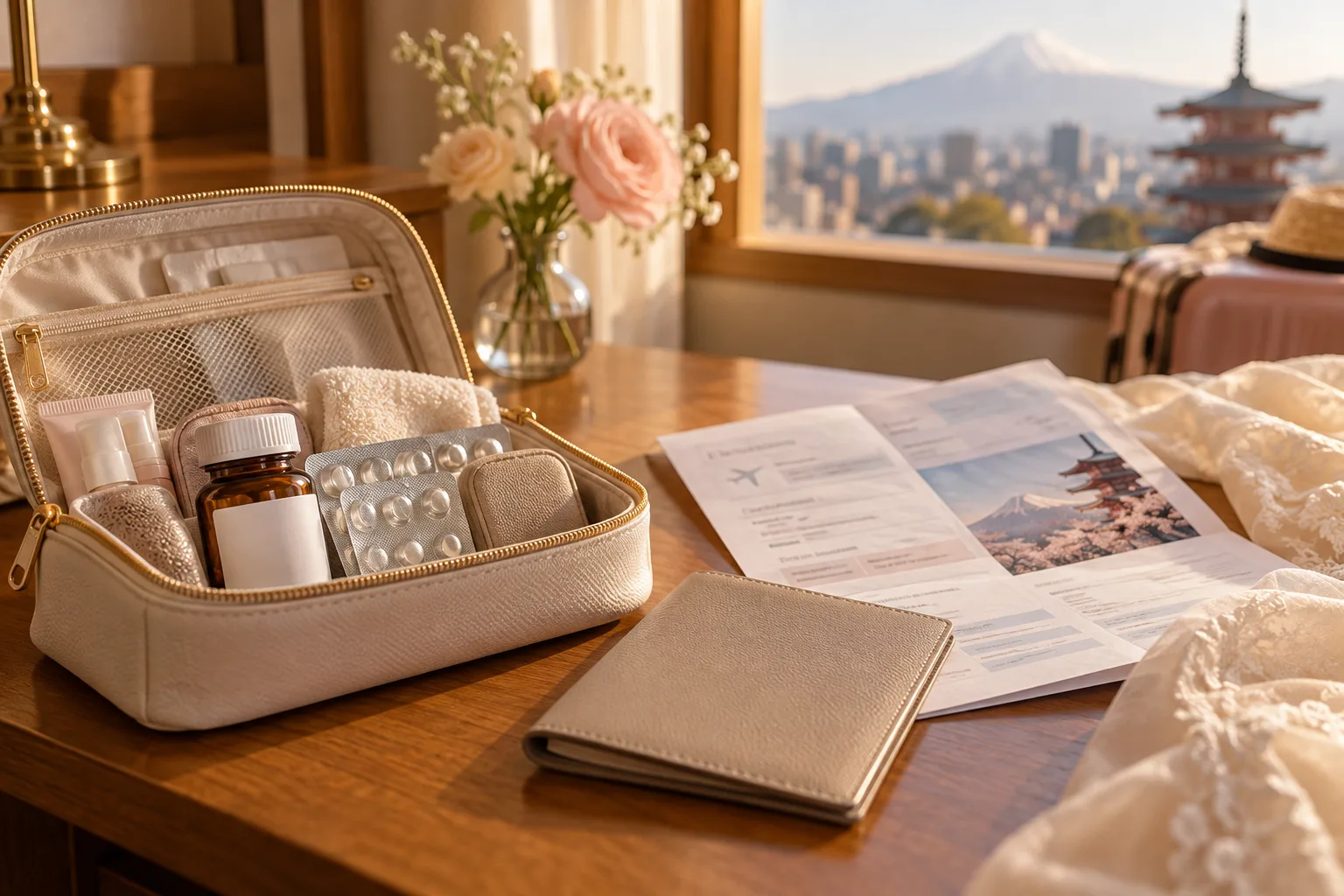
Check the medicines for a Japan honeymoon before the wedding week. The name on a prescription bottle, the amount in the bag and the airport where you enter all belong in that check. A medicine permitted in your home country may need advance permission in Japan, or may be prohibited there.
Make a product list, not just a prescription list
Include daily prescriptions, as-needed medicines, injections, sleep aids, pain treatments and cold or allergy products. Photograph the ingredient panel and pharmacy label while preparing the list. A multi-ingredient product needs each active ingredient checked.
For each item, record the generic name, brand, strength per tablet or dose, dosage form, prescribed use and number of tablets, pens, vials or other units you intend to carry. Ask your pharmacist to help identify an ingredient or formulation that is unclear.
CDC's 2026 Yellow Book notes that medicines not controlled in the United States can still be restricted elsewhere. It also recommends a clinician's letter listing generic names, dosing details and the reason for treatment. [1] Keep the medical information in a private travel file, separate from the wedding itinerary shared with guests.
Understand the ordinary quantity exemption
Japan's Ministry of Health, Labour and Welfare lists an exemption from Import Confirmation for up to one month's supply of general prescription medicine. Other drugs and quasi-drugs generally have a two-month allowance, while eligible external-use products have a separate limit of 24 per item, excluding prescription products and designated poisons. Controlled and prohibited substances need their own check. [2]
The ministry also lists up to one month's supply for injectable medicine and its syringe, limited to a prefilled syringe or self-injection kit. [2] Do not apply that wording automatically to every vial-and-syringe arrangement or to spare needles packed separately.
The current ministry Q&A says importing a syringe without its medicine requires Import Confirmation even for one piece. [3] Send the office the exact supplies you plan to bring if your arrangement does not clearly match the exemption.
Count the amount you will carry, including any contingency supply, rather than using the honeymoon's length as the answer. If your pharmacy dispenses a larger package than the trip requires, ask how the actual quantity should be documented. Do not describe an eight-week supply as a two-week supply because you expect to return after fourteen days.
Check controlled ingredients separately
The Narcotics Control Department states that Adderall's amphetamine ingredient cannot be imported even for treatment. Lisdexamfetamine, including Vyvanse, is classified differently and requires advance permission. [4] Do not treat the two medicines as interchangeable at the border or change treatment without your prescriber.
NCD's psychotropic rules have substance-specific quantity thresholds and separate provisions for injections. [4] If your medicine falls in that category, ask the office to confirm how your strength, formulation and total amount fit the current rules. A general one-month supply exemption does not answer every controlled-substance question.
Check the exact product in any over-the-counter cold or allergy pack too. The brand name on a travel checklist is insufficient if different versions have different ingredients. Ask the Japanese authority about the product you have, rather than using another traveler's experience with a similarly named box.
If the medicine cannot be brought, contact your prescriber well before departure. Discuss treatment continuity and whether the itinerary is workable. CDC says reconsidering a destination may be the wisest choice when a required medicine is prohibited and permission cannot be obtained. [1]
Apply for Import Confirmation when required
The Embassy of Japan calls the general import certificate Yunyu Kakunin-sho, previously Yakkan Shoumei. It says the certificate must be obtained before leaving for Japan and advises applying at least two weeks before travel. Applications go to the regional bureau associated with the arrival airport. [5]
Use the current application link reached through the ministry or embassy page. An older blog's saved form or obsolete certificate name is a reason to check the official route again.
The current ministry Q&A lists a valid prescription or doctor's note naming the patient, medicine and doctor for all items in the application, plus airline or cruise documentation showing the applicant's name, arrival date, arrival place and flight or cruise number. It says complete applications are normally processed in a few business days, excluding weekends and national holidays. [3]
Use the embassy's earlier application recommendation when scheduling the work. The processing estimate leaves little room for missing information, a delayed appointment or a corrected itinerary. Put a reminder before the wedding week so the application is not competing with fittings and final vendor payments.
Use the separate controlled-medicine procedure
NCD advises applying at least 14 days before travel and warns that Tokyo NCD cannot accept last-minute applications. Its process requires the relevant forms, a prescriber's medical certificate and medicine-package photographs or supporting documents. The certificate must give a specific treatment reason; a generic “for travel” statement is insufficient. [4]
NCD also requires an export application when returning with leftover medicine under that permission process. The traveler must carry the medicine personally rather than entrusting it to a partner, and present the certificates at Customs. [4] Plan both entry and departure while assembling the paperwork.
Keep the general Import Confirmation and the controlled-substance permission requirements in separate rows on your preparation list. Ask the responsible office if both apply to your quantity and product. Receiving one document does not justify assuming that every other requirement is satisfied.
Resolve itinerary details before submitting
The embassy's May 18, 2026 page identifies Kanto-Shin'etsu for Narita and Tokyo International Airport, and Kinki for Kansai and Chubu Centrair, with contact details for further questions. [5] Use the current official directory for your arrival point, especially if entering somewhere else.
If you are unsure which office handles the product, send a concise inquiry with the entry airport, date, product details and quantity. Attach clear label photographs if requested. Keep the reply with the application record so you can see exactly which formulation and itinerary were reviewed.
If flights change after approval, ask the issuing office whether the documents need correction. Keep the approved files intact. The ministry Q&A warns that altering an issued Import Confirmation invalidates it. [3] Do not edit the date yourself in a PDF.
Keep the approved medicine identifiable
CDC recommends original labeled containers and carry-on packing, and advises checking the rules of countries where you pass through customs during transit. [1] Pack documents with the medicine so they remain available if the main suitcase is delayed.
Compare the final bag with the list and approvals: product, strength, form and amount. Check that neither partner has added an unreviewed cold remedy or spare prescription to the shared pouch. For temperature-sensitive treatment, keep the product's storage instructions and an appropriate travel plan alongside the import paperwork.
Save copies of the permits, official correspondence, prescription and clinician contact in a private offline file. Print the documents needed for inspection. Do the last check before departure rather than while standing at the airport with a phone that needs charging.
Physical Book (No Download)
Bridegenic: The Glow-Up Guide for Brides on GLP-1s
$12.95 + Free Shipping
Order NowThis article provides general education, not a diagnosis or an individual treatment plan. Medication information refers to US sources. Talk with your prescriber, pharmacist or dermatologist about decisions for your care.
Read next
Honeymoon & BeyondHoneymoon Passport Names: Check Tickets Before Making Changes→Honeymoon & BeyondYour Honeymoon on a GLP-1: How to Pack and Store Your Medicine→Sources
- Traveling with Prohibited or Restricted Medications, 2026 Yellow BookU.S. Centers for Disease Control and Prevention↩ Back to text
- Information for Those Bringing Medicines for Personal Use into JapanJapan Ministry of Health, Labour and Welfare↩ Back to text
- Current Q&A for Those Importing Medicines into Japan, linked by MHLWJapan Ministry of Health, Labour and Welfare↩ Back to text
- Application Guidance for Travelers Carrying Controlled MedicinesJapan Narcotics Control Department↩ Back to text
- Bringing Medications into Japan, May 18, 2026Embassy of Japan in the United States↩ Back to text