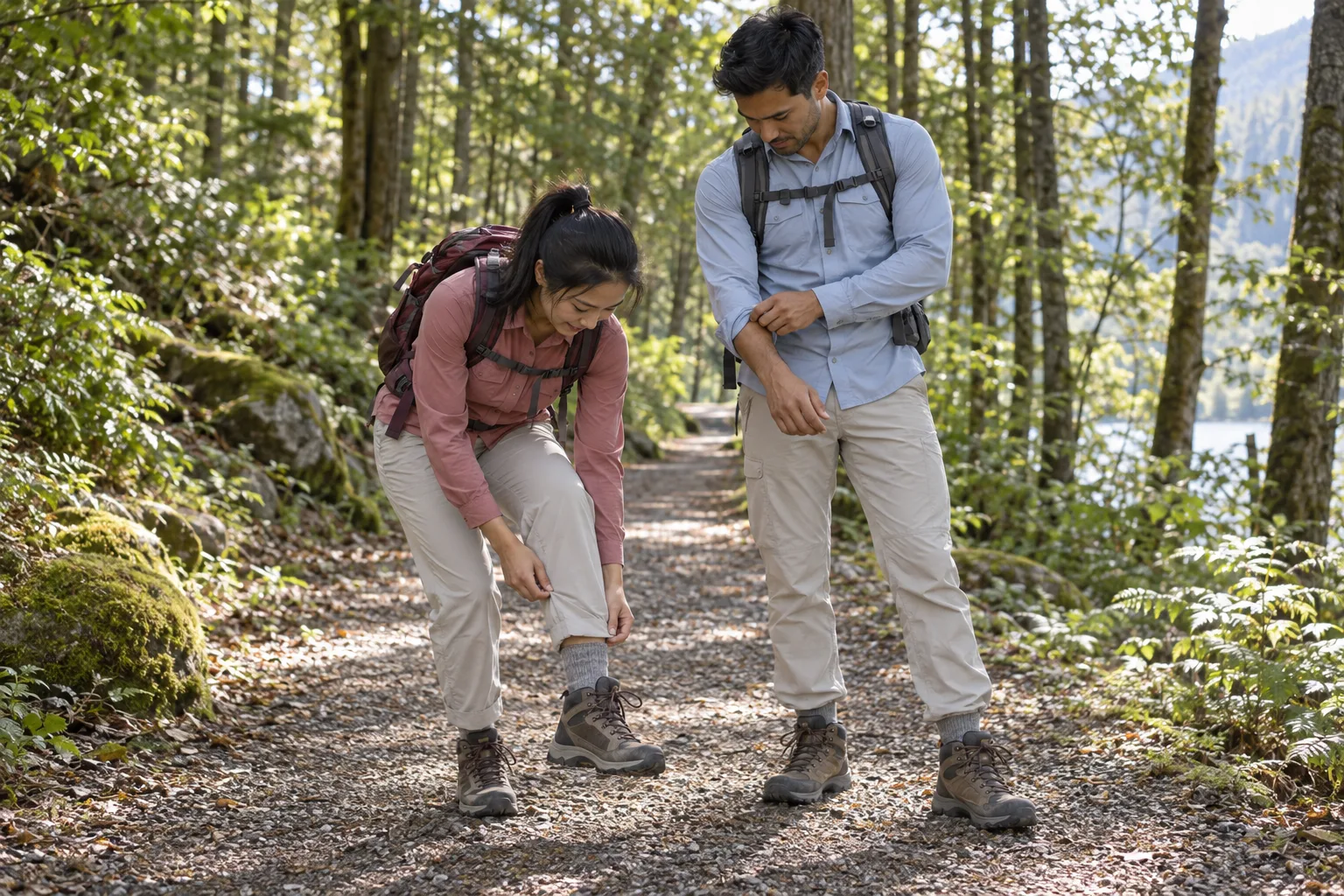
For a honeymoon with woodland walks, safari stops or countryside cycling, put tick precautions beside the activity booking. Pack appropriate clothing, repellent and fine-tipped tweezers, then leave time to check your skin and clothing afterward. If you find an attached tick, remove it promptly and record where and when the exposure happened.
Review the activities and destination
CDC's 2026 Yellow Book explains that tick-borne encephalitis risk depends strongly on itinerary and activities. Exposure can occur during hiking, cycling, camping and other activities in forested areas of affected destinations. [1]
Take a day-by-day activity list to the travel appointment. Include the region, season, rural accommodation, guided outings and repeated outdoor exposure. Ask the operator about current local advice, clothing requirements and access to care, then check health advice with a qualified professional.
A short trip can still include frequent exposure. The clinician needs to know whether “three nights in a city” includes daily woodland cycling or only urban sightseeing. A country name alone cannot describe the route.
CDC recommends tick-borne encephalitis vaccination for travelers to endemic areas with extensive tick exposure, and says it may be considered for some others after individual risk assessment. TICOVAC has been approved in the United States since 2021. [1]
Ask early about whether vaccination is indicated and how its schedule fits departure. Do not interpret a vaccine for one disease as protection against every infection transmitted by ticks. The travel-vaccine guide can help organize that consultation.
Choose clothing for the route
The National Park Service recommends protective clothing, including long sleeves and pants, light colors that help you spot ticks, and tucking pants into socks. It advises walking in the middle of trails to reduce contact with vegetation. [2]
Check the outfit before packing: can you walk comfortably, manage the temperature and inspect the fabric? Closed footwear and suitable socks should fit the terrain. Keep a separate outfit for dinner so you do not have to choose between a tick check and a reservation.
CDC identifies 0.5% permethrin products for treating clothing and gear, or commercially treated items as an alternative. [3] Use a product intended for those items and follow its application, drying and laundering instructions.
CDC says not to apply permethrin products directly to skin. [4] Do not use a clothing-treatment bottle as your skin repellent or assume a concentration from a different type of pesticide is interchangeable.
EPA explains that treated clothing protects the covered area against pests listed on its label. It still advises an appropriate skin repellent for exposed areas and notes separate laundering instructions for treated clothing. [5]
Keep the garment's treatment information with your packing notes. If you do not have time or suitable space to treat an item correctly, ask about a suitable alternative rather than spraying it while wearing it.
Check that the repellent covers ticks
CDC recommends EPA-registered repellents and advises applying sunscreen first, then repellent. [3] Check the exact product label for tick protection and its instructions, rather than assuming every mosquito product has the same claim.
EPA advises against applying repellent under clothing, over cuts or irritated skin, or near the eyes and mouth. Spray into your hands before applying to the face, and follow the label for amount and reapplication. [6]
If you have eczema, another skin condition or a previous reaction, discuss a suitable approach with the clinician. Do not apply a new spray across inflamed skin to test whether you can tolerate it on the hike.
Carry the selected product where you can reach it during the excursion, within transport and import rules. Ask the operator whether there will be a suitable place to apply it. A bottle in checked luggage or back at the hotel cannot help with the morning walk.
The repellent and sunscreen guide covers the separate labels and application plan in more detail.
Make time for a full check after being outdoors
CDC recommends checking clothing, gear and the whole body. Look under arms, around ears, in the belly button and hair, behind knees, between legs and around the waist. A mirror helps you inspect less visible areas. [3]
Arrange privacy, lighting and a mirror at the accommodation. Ask your partner for help with areas you cannot inspect if you are comfortable doing so. Include the check before changing straight into evening clothes.
CDC says showering within two hours of coming indoors can reduce Lyme disease risk and may help remove unattached ticks. It also provides an opportunity to check. [3] Showering does not remove every attached tick or replace inspection.
For dry clothing, CDC recommends a high-heat dryer cycle of ten minutes to kill ticks; damp items may need longer. Cold or medium-temperature washing does not kill ticks. [3]
Check garment care and equipment availability before relying on that method. Do not put a heat-sensitive item into a high-heat cycle or assume a hotel laundry service used the requested settings. Inspect the daypack and other gear as well.
Remove an attached tick promptly
CDC's June 2026 instructions say to remove an attached tick as soon as possible instead of delaying removal to reach a clinician. Use clean fine-tipped tweezers to grasp it close to the skin, avoiding the body, and pull with steady, even pressure. Do not twist or jerk. [7]
Clean the bite area and your hands afterward. CDC says to leave mouthparts alone if they cannot be removed easily with tweezers. Do not crush the tick with your fingers or use heat, petroleum jelly or nail polish to make it detach. [7]
Pack the tweezers and cleaning supplies together. Save CDC's instructions offline before leaving reliable reception. If removal is difficult or you have concerns about the site, seek appropriate advice without repeatedly digging into the skin.
Record the removal date and time, the location on your body and the place you were outdoors. If practical, take a clear photograph and contain the tick securely for identification if the clinician requests it. Do not delay removal while arranging a photograph.
CDC cautions against using commercial tick-test results for treatment decisions: a positive result does not prove you were infected, and a negative result can offer false assurance. Do not wait for such results if you become ill. [7]
Ask about preventive treatment without waiting for symptoms
CDC says a single dose of doxycycline may reduce Lyme disease risk after certain tick bites in areas where Lyme disease is common. A healthcare professional should determine whether it is appropriate. [8]
Its clinical decision aid considers where the bite occurred, whether removal was within the previous 72 hours, engorgement, whether the tick could be an Ixodes tick and whether doxycycline is suitable. Identification can be difficult, and an unavailable tick does not automatically end consideration. [9]
Contact the clinician promptly with the details you have. Explain any medicine allergy, pregnancy possibility or breastfeeding. Do not wait until the end of a holiday weekend or until a rash appears to ask about that time-sensitive decision.
This assessment concerns Lyme disease prevention after selected exposures. It does not establish a universal antibiotic plan for every tick bite or replace evaluation of symptoms. Do not start leftover antibiotics or assume a partner's prescription applies to you.
Report illness during the trip or after returning
CDC describes early Lyme symptoms occurring three to thirty days after a bite, including fever, chills, headache, fatigue and muscle or joint aches. Symptoms can occur without a rash, and an expanding rash does not always have a classic target appearance. [10]
Seek medical attention for concerning symptoms after possible exposure. Tell the clinician the countries and regions visited, dates, activities, removal details and any preventive medicine you received. Not remembering a bite should not prevent you from describing the outdoor exposure.
CDC also lists severe headache with neck stiffness, facial weakness, palpitations, dizziness and shortness of breath among possible later Lyme manifestations. [10] New severe or rapidly worsening symptoms need urgent care; do not use an online rash comparison to decide whether to wait.
Keep the travel record after you return home. A bite discovered on the last morning can matter at an appointment weeks later. Put the care contacts and exposure note somewhere both of you can find without relying on one phone.

Physical Book (No Download)
Bridegenic: The Glow-Up Guide for Brides on GLP-1s
$12.95 + Free Shipping
Order NowThis article provides general education, not a diagnosis or an individual treatment plan. Medication information refers to US sources. Talk with your prescriber, pharmacist or dermatologist about decisions for your care.
Read next
Honeymoon & BeyondHoneymoon Vaccines: Plan the Consultation Around Your Itinerary→Honeymoon & BeyondHoneymoon Insect Repellent and Sunscreen: What to Pack and How to Use Them→Sources
- Tick-Borne Encephalitis, 2026 Yellow Book, April 23, 2025Centers for Disease Control and Prevention↩ Back to text
- Ticks and Tickborne Diseases, April 11, 2023National Park Service↩ Back to text
- Preventing Tick Bites, August 28, 2024Centers for Disease Control and Prevention↩ Back to text
- Preventing Mosquito Bites, including permethrin precautionsCenters for Disease Control and Prevention↩ Back to text
- Repellent-Treated ClothingU.S. Environmental Protection Agency↩ Back to text
- Using Insect Repellents Safely and Effectively, November 10, 2025U.S. Environmental Protection Agency↩ Back to text
- What to Do After a Tick Bite, June 9, 2026Centers for Disease Control and Prevention↩ Back to text
- Treatment and Intervention for Lyme Disease, June 25, 2026Centers for Disease Control and Prevention↩ Back to text
- Lyme Disease Prophylaxis After Tick Bite, clinical decision aidCenters for Disease Control and Prevention↩ Back to text
- Signs and Symptoms of Untreated Lyme Disease, May 15, 2024Centers for Disease Control and Prevention↩ Back to text