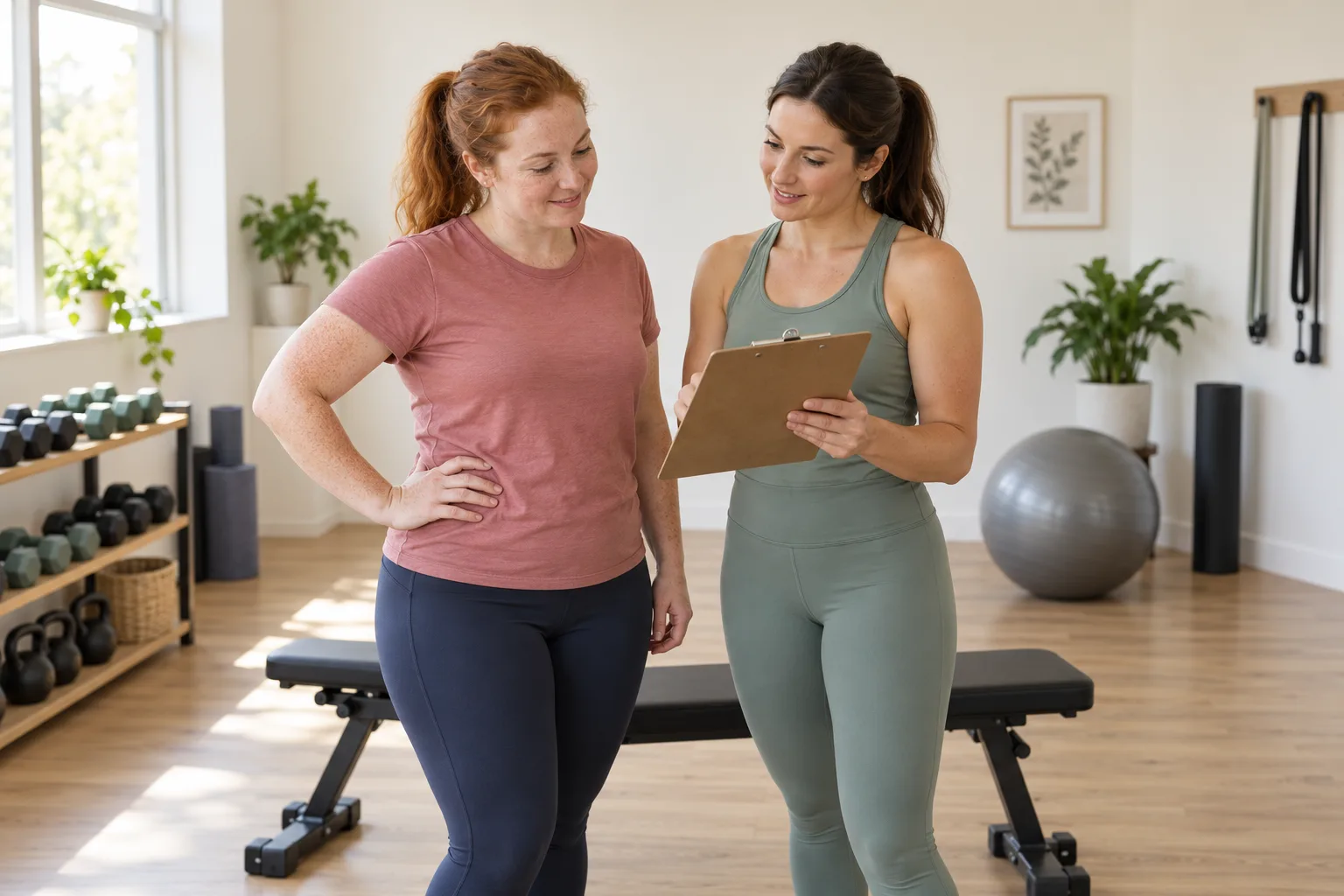
Wedding planning can fill the evenings you once used for exercise. If you also take a GLP-1 medicine, headlines about muscle loss may make every missed session feel consequential. Start with a routine you can learn and attend, and a way to report changes in strength or energy. An unfamiliar bridal workout challenge is unlikely to answer those needs.
Read lean-mass headlines with the measurement attached
A 2025 SURMOUNT-1 body-composition report analyzed 160 participants with DXA measurements at baseline and week 72: 124 received tirzepatide and 36 received placebo. Approximately 75% of the weight lost was fat mass and 25% lean mass in both groups, although total weight loss was greater with tirzepatide. [1]
That describes the composition of weight lost, not loss of 25% of a participant's starting muscle. It also describes group averages from a substudy, not what every person experiences.
Body-composition researchers distinguish fat-free components from individual tissues such as skeletal muscle. Lean or fat-free mass and skeletal muscle should not be treated as interchangeable measurements. [2] Nor is a DXA mass measurement a test of how much you can lift.
Bring concerns about declining strength, difficulty with ordinary tasks or unexpectedly low energy to your clinician. Describe the task that changed and when you noticed it. A consumer scale's body-composition estimate should not be the sole basis for changing treatment.
Use activity guidance as a planning reference
CDC adult guidance includes at least 150 minutes of moderate-intensity aerobic activity weekly, or an equivalent amount of vigorous activity, plus muscle-strengthening work on at least two days. Some activity has benefits even when you cannot currently meet the full recommendation. [3]
Strengthening work should involve the major muscle groups: legs, hips, back, abdomen, chest, shoulders and arms. Resistance can come from weights, bands or your own body weight. Brisk walking can contribute to aerobic activity, but it does not replace every strengthening task. [4]
The 2025 joint nutrition advisory for GLP-1 treatment emphasizes structured resistance exercise with appropriate nutrition. It cautions that increasing protein alone is unlikely to preserve muscle adequately without strength training. The advisory proposes regular strength training at least three times weekly, alongside aerobic activity. [5]
The CDC benchmark and the advisory's proposed GLP-1 care approach answer different planning questions. Ask your care team and exercise professional what frequency, effort and progression fit you. Do not jump to demanding sessions simply because one source lists a higher number.
If you have a chronic health condition, CDC advises discussing appropriate types and amounts of activity with your clinician. It also advises review before vigorous activity in certain circumstances, including after inactivity. [3]
Make the first instruction session specific
Tell the instructor what you currently do, what equipment you can access, and whether pain, mobility, balance or symptoms affect activity. Ask about their qualifications and experience adapting exercise for people with your needs. A physical therapist or other clinician may be the appropriate starting point for some limitations.
Ask to learn a short list of movements and how to set them up. Depending on your assessment, examples to discuss might include a chair sit-to-stand, a supported pulling movement or a wall push. These are conversation examples, not a routine that fits every reader.
For each agreed movement, leave with the starting position, equipment, range, amount of work and rest instructions written down. Ask the instructor to watch you demonstrate it back. If a home variation is proposed, confirm that your actual chair, band anchor or available space is suitable.
Ask what to do if a movement hurts, what effort should feel like and when to stop. CDC gives sets and repetitions as ways to organize strengthening work; the appropriate starting amount and technique still need to fit your ability. [4]
Put the routine into a week you actually have
Choose the place first. Check transport, opening hours, cost, accessible changing space and whether the equipment you need is available at your usual time. At home, identify where equipment can stay without blocking a walkway.
Then choose provisional calendar slots with travel and changing time included. If your agreed plan uses two sessions, a Tuesday and Saturday arrangement may be easier than trying to squeeze both into consecutive evenings. This is a scheduling example; your instructor should set the appropriate spacing and workload.
Identify one alternative slot before the week starts. If a fitting moves into your exercise time, you then have a concrete option. Ask the instructor how to handle a missed session rather than doubling the next one.
For a busy week, ask which parts of the established routine can be shortened. Keep the written version available so you are not inventing a new workout at the end of a tiring day.
If you train with a partner, agree on the useful help: transport, encouragement, learning equipment together or protecting the calendar time. Ask them to leave appearance commentary out if it makes exercise harder to enjoy.
Give symptoms and nourishment a place in the plan
The joint advisory identifies reduced intake, gastrointestinal symptoms and nutritional adequacy as issues requiring attention during GLP-1 care. Exercise planning belongs alongside that assessment. [5]
Tell the prescribing team if nausea, vomiting or poor intake interferes with activity. Ask for instructions suited to your medicines and health, including diabetes management where relevant. Do not use an article to change a dose or substitute a workout for a meal.
A dietitian can help adapt eating opportunities around your schedule and tolerance. Bring an ordinary day's pattern, including missed meals, rather than only the menu you hope to follow. The small-appetite protein article includes label-reading and meal-planning questions.
For the exercise appointment, arrange food and drink access in a way that follows your care plan. Check whether you have enough time to eat comfortably before leaving home and what will be available afterward. A calendar reminder helps with access; ongoing inability to eat needs clinical review.
Track a few useful details
Keep a brief record of the agreed exercises, resistance or variation, amount completed and any symptoms. Note whether the setup felt controlled or whether you needed help. This gives the instructor something specific to review.
Ask when to progress and which variable to change. It might involve resistance, repetitions or another adaptation, depending on the plan. Confirm the next step before adding several changes yourself.
Choose a functional observation you care about, such as using stairs, carrying a familiar bag or rising from a chair. It is information to discuss, not a home diagnostic test. Report deterioration rather than assuming every difficult day is a motivation problem.
If tracking becomes another source of distress, ask for a simpler record. You can maintain a useful exercise plan without recording every calorie a device estimates.
Keep wedding week familiar
Ask your instructor how to adjust your established routine around travel, sleep and the event schedule. Include any medical aftercare restrictions from other appointments. Avoid letting separate professionals assume someone else has reviewed the whole calendar.
Decide where equipment and shoes will be if you plan activity away from home. Check the hotel facility before relying on it. If it cannot accommodate your routine, ask for an appropriate alternative in advance.
There is no evidence in the sources here for a last-minute exercise schedule that guarantees a particular arm shape, dress size or facial contour. Use the final week to follow a familiar plan that fits your health and time.
Bring the notes back when the routine becomes too difficult, too easy or hard to attend. Those are specific problems you and the relevant professional can work on.

Physical Book (No Download)
Bridegenic: The Glow-Up Guide for Brides on GLP-1s
$12.95 + Free Shipping
Order NowThis article provides general education, not a diagnosis or an individual treatment plan. Medication information refers to US sources. Talk with your prescriber, pharmacist or dermatologist about decisions for your care.
Read next
Food & EnergyProtein With a Smaller Appetite on a GLP-1: Portions, Labels and Easy Meals→Wedding WeekSleep During Wedding Week: A Schedule, a Handoff and a Backup Plan→Sources
- Body composition changes during weight reduction with tirzepatide in SURMOUNT-1 (2025)Look and colleagues, Diabetes, Obesity and Metabolism↩ Back to text
- Fundamental Body Composition Principles Provide Context for Fat-Free and Skeletal Muscle Loss With GLP-1 RA TreatmentsTinsley and Heymsfield, Journal of the Endocrine Society↩ Back to text
- Adding Physical Activity as an AdultCDC↩ Back to text
- What Counts as Physical Activity for AdultsCDC↩ Back to text
- Nutritional priorities to support GLP-1 therapy for obesity: joint advisory (2025)American College of Lifestyle Medicine, American Society for Nutrition, Obesity Medicine Association and The Obesity Society↩ Back to text