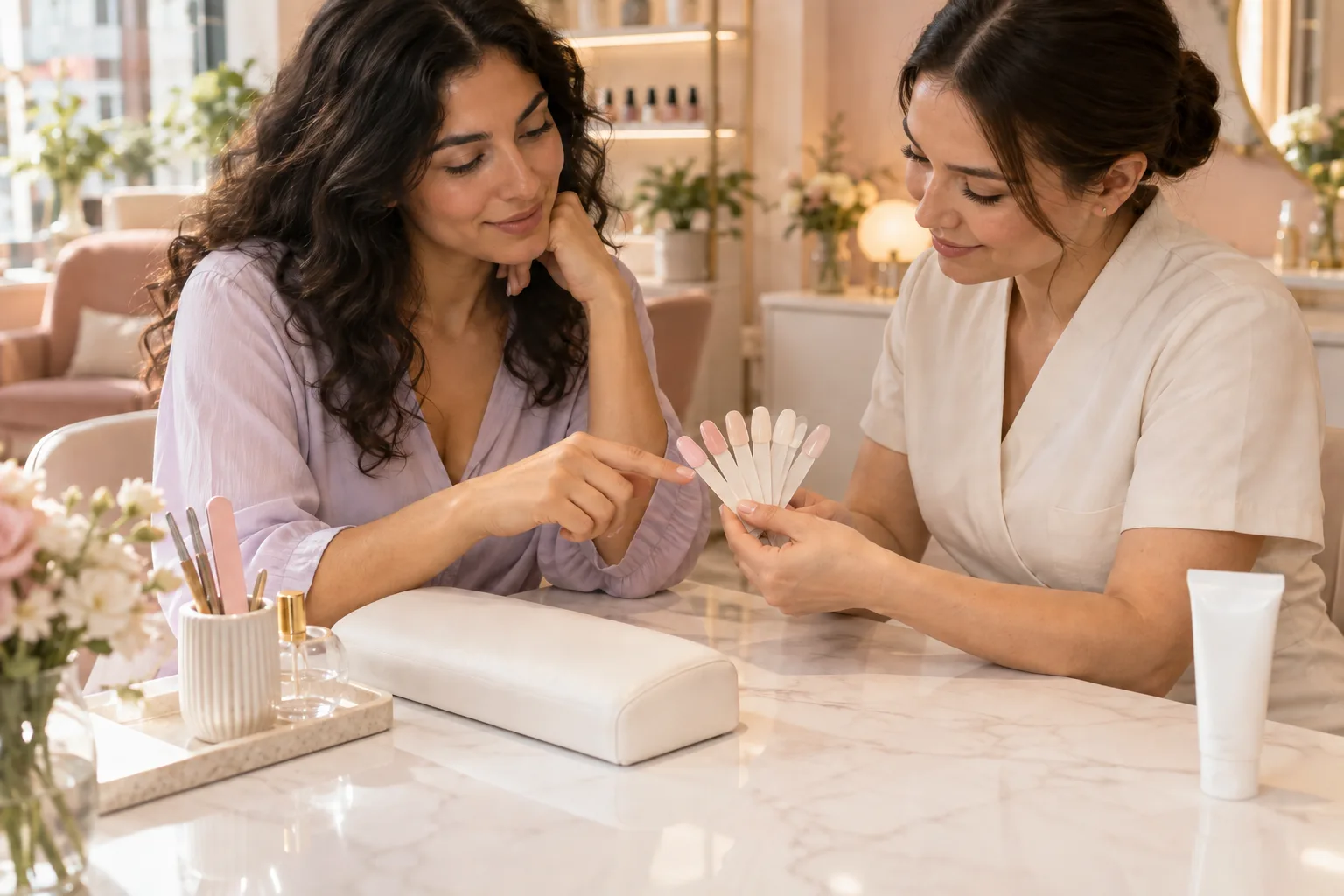
Your ring photographs may show the manicure, but your hands also need to fasten jewelry, handle contact lenses and help you get dressed. Before choosing gel for the wedding, check the condition of your nails, the exact product, how it will be removed and what you would do if your skin reacts.
Start with your current nails
The American Academy of Dermatology (AAD) warns that covering brittle, soft or damaged nails with artificial nails can worsen existing problems. Preparation, repeated touch-ups and removal can also damage the nail. [1]
Tell the technician about splitting, soreness, lifting, discoloration and previous reactions. If something has persisted or changed, seek a dermatologist's assessment rather than asking the salon to hide it under another coating.
Bring the previous product name if you know it. “I reacted to a manicure” leaves several possibilities; a dated photograph, ingredient list and description of when symptoms began gives the clinician more to work with.
Decide what you need from the appointment: shaping and a familiar polish may be enough. You do not have to add extensions, a new length or a different coating because the package is called a bridal service.
Ask which gel system is being used
Write down the brand, product line, base, color and topcoat. If extensions or adhesive are added, include them too. Ask what lamp and curing instructions belong to that system and how the technician follows them.
Do not assume every product described as “gel” has the same removal method. AAD distinguishes soak-off gel from products that must be filed off when discussing artificial-nail choices. [1] Ask which you are booking before buying remover for the honeymoon.
At the trial, keep the intended length and shape practical. Try the clasp on your necklace, the phone keyboard, the small buttons or hooks you expect to handle and any personal-care task that involves your fingertips. If a length makes ordinary handling difficult, shorten it while there is time.
Photograph the finished color in daylight beside a comparable fabric sample if available. Record the exact shade rather than relying on a phone picture alone; lighting can change how a pale pink or ivory appears.
Keep uncured product off the skin
FDA explains that reactive methacrylate monomers in some artificial-nail products can cause reactions in people who have become sensitive. It advises avoiding skin contact to minimize allergy risk and describes possible redness, swelling and pain around the nail bed. [2]
Ask the technician how they prevent product from touching the skin and what they do if it does. Do not ask them to continue through burning or pain because you have another appointment afterward.
If you develop a reaction, obtain the product list and contact a healthcare professional. FDA advises reporting nail-product reactions to a clinician and the agency. [2] A different color name is not enough information to decide that another product avoids the cause.
For an at-home kit, follow its labeled directions and do not improvise a test by curing product on your skin. If you have a suspected allergy, ask the dermatologist about assessment and suitable alternatives instead of trying another kit before the wedding.
Ask about tools and cuticles
AAD's gel-manicure guidance advises asking about tool sterilization and checking that tools are cleaned and disinfected between clients. It also advises against pushing or cutting cuticles because this can lead to inflammation or infection. [3]
Make that preference clear at the start, before the technician reaches for the tool. If a service description includes cuticle cutting, ask whether it can be omitted.
Ask what is single-use and what is reused, and how reusable equipment is processed. Give yourself time to leave if the answers or working conditions do not suit you. The appointment deposit should not decide whether you accept an uncomfortable procedure.
Read lamp research without turning it into a prediction
A 2023 laboratory study exposed mouse and human cell models to a UV nail dryer and found DNA damage and mutations. Its exposure protocols included repeated 20-minute sessions. The authors explicitly said the cell study did not provide direct evidence of increased cancer risk in people. [4]
That finding does not calculate your chance of cancer from one wedding manicure, and it should not be converted into a personal “safe number” of appointments. A March 2023 correction changed an abstract statement about earlier experimental work; the corrected paper remains the source used here. [5]
AAD notes that LED curing lights also emit UV, even though they can cure more quickly. [1] An LED label alone does not mean there is no UV exposure.
AAD recommends broad-spectrum, water-resistant SPF 30 or higher sunscreen on the hands before gel manicures, or dark, opaque gloves with the fingertips cut off. [3] Ask the salon how to incorporate protection into the appointment while following the product system's application instructions.
If you prefer to avoid a curing lamp, ask for an ordinary polish service. Compare the actual process rather than choosing from package names that sound similar.
Book removal before you need it
AAD advises against picking gel polish and recommends arranging removal when it starts to come off. [3] Confirm who will remove it, what that costs and whether the appointment falls before or after travel.
For soak-off gel polish, AAD's home-removal guidance describes acetone with cotton cut to the size of each nail to limit surrounding skin exposure, plus petroleum jelly around the cuticles. It cautions that picking, filing or scraping with an orange stick can damage nails. [6]
Those instructions concern gel polish and should not be assumed to fit every extension or hard-gel product. Ask your technician which method applies and follow the manufacturer's directions. If a coating resists the intended removal, do not turn a hotel bathroom into a filing session.
Read remover warnings and consider the work surface as well as your skin. AAD notes that acetone can damage furniture and countertops. [6] Keep supplies in labeled packaging, with ventilation and storage as directed, and away from children.
If you will be abroad when removal is due, ask about options before departure. A familiar polish that you can manage under its directions may fit the trip better than a system requiring a service you have not arranged.
Leave room for nail care after the photographs
AAD recommends a break from polish for one to two weeks or longer between gel manicures and moisturizing the nails and cuticles. [3] Ask how your current nail condition affects the next appointment rather than booking repeated applications automatically.
Keep a record if a problem appears: date, symptoms, products, removal method and photographs if useful. A clinician can assess the concern with that history. Do not assume a new color or stronger coating treats the underlying problem.
For the wedding bag, pack only supplies that fit the chosen manicure and instructions. Tell your helper where they are. A loose decorative piece can be a reason to change the appearance plan without attempting an unplanned glue repair on sore skin.
Use the record to repeat the choice you liked and tolerated. If the plan changes, update the product and removal details instead of carrying forward instructions for a different manicure.

Physical Book (No Download)
Bridegenic: The Glow-Up Guide for Brides on GLP-1s
$12.95 + Free Shipping
Order NowThis article provides general education, not a diagnosis or an individual treatment plan. Medication information refers to US sources. Talk with your prescriber, pharmacist or dermatologist about decisions for your care.
Read next
Face & SkinColored Contact Lenses for Wedding Photos: Fitting, Makeup and Backup Plans→Face & SkinSunscreen Under Wedding Makeup: What to Test Before Outdoor Photos→Sources
- Artificial nails: Dermatologists’ tips for reducing nail damageAmerican Academy of Dermatology↩ Back to text
- Nail Care ProductsFDA↩ Back to text
- Gel manicures: Tips for healthy nailsAmerican Academy of Dermatology↩ Back to text
- DNA damage and somatic mutations in mammalian cells after irradiation with a nail polish dryerZhivagui et al., Nature Communications, 2023↩ Back to text
- Author Correction, March 14, 2023Nature Communications↩ Back to text
- Dermatologist’s secret for removing gel nail polish at homeAmerican Academy of Dermatology↩ Back to text