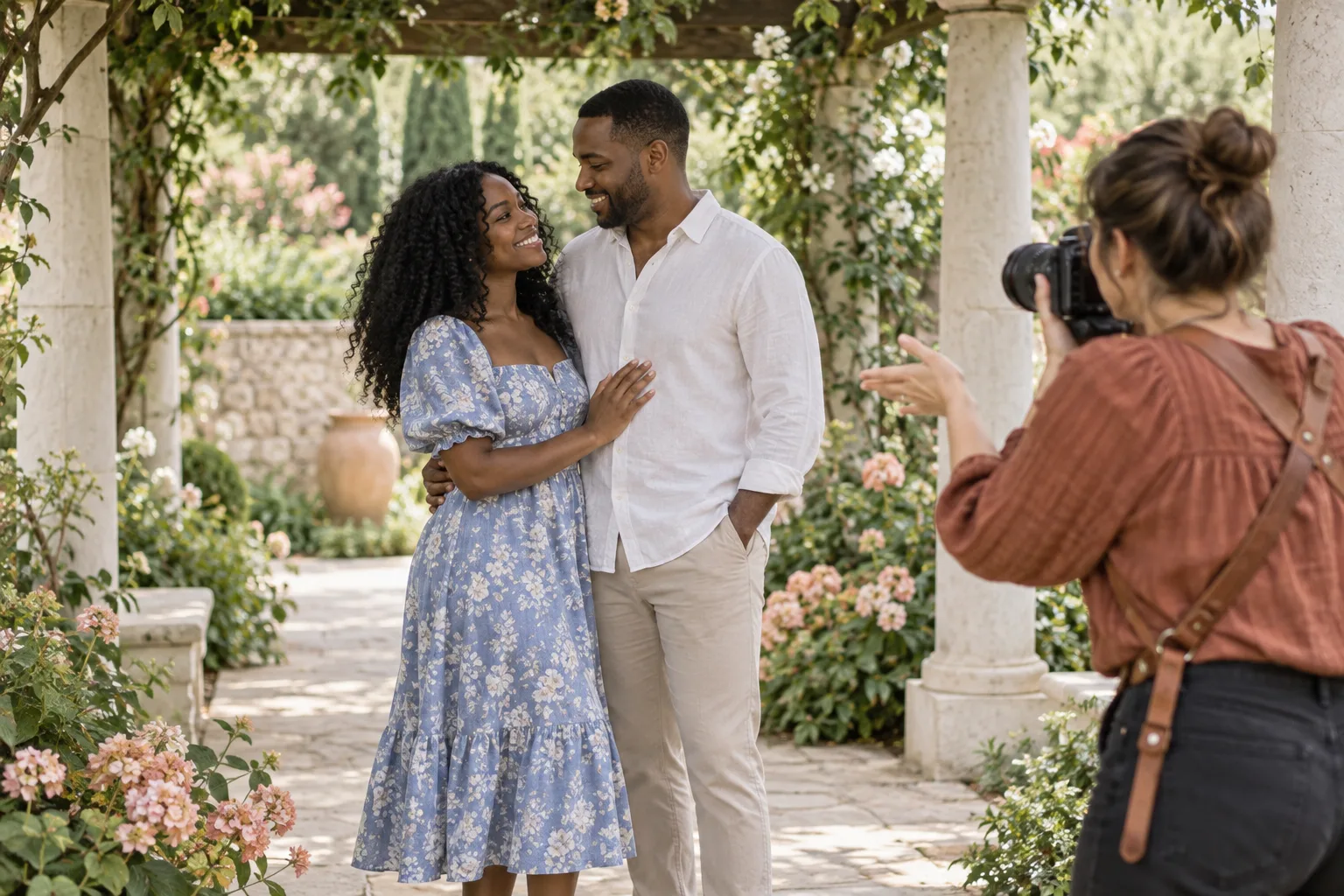
You like the expression in one engagement photograph and barely recognize yourself in a close phone picture taken the same day. If your face or body has changed during the engagement, choosing what to ask a photographer can feel difficult. Start with the pictures you want to keep, the direction you find useful, and the conditions in which you will be photographed.
A close selfie is a particular camera view
A 2018 research letter in JAMA Facial Plastic Surgery used a mathematical model to examine facial projection at different distances. At twelve inches, the model predicted a larger nose-to-face-width ratio than at a long viewing distance; the difference was minimal at five feet. [1]
This was a model of projection, not a study showing that every person's face changes by the same percentage in photographs. It did not study brides or GLP-1 treatment. Its useful point for a photo discussion is that camera distance affects proportions in the image.
If a close phone picture worries you, ask the photographer how they will make close portraits and how far away the camera will be. Let them choose appropriate equipment. A tight crop does not have to mean placing the camera close to your face.
For comparing pictures over time, note whether distance, light, expression and framing were similar. If you have a physical symptom or change you want medically assessed, bring it to your clinician rather than asking a photograph to establish the cause.
Ask to see a full session in similar conditions
A few portfolio favorites tell you what a photographer chose to display. Ask to see a delivered gallery with lighting and a setting similar to yours: an indoor room, a garden at midday, or an evening reception. Notice whether you like skin tones, shadows, close portraits and pictures of people moving.
Nikon's portrait guidance explains that a bright background can leave the subject's face dark, while changes to lighting or background can alter the result. It also demonstrates softer illumination with bounced light and warns against distracting objects behind the head. [2]
Turn those points into questions: “What happens if this room is darker than expected?” “Where would you photograph us if the garden light is harsh?” “Can you show me an example of the flash look you use at receptions?”
Ask whether the location has a workable shaded or indoor alternative, where you can sit, and how much walking is involved. A beautiful example from another venue may depend on a route or lighting setup unavailable at yours.
Give the photographer pictures whose style you like and explain why: soft shadows, an ordinary laugh, a close frame or space around the couple. Avoid sending a large collection with conflicting looks and expecting them to guess which detail matters.
Describe the cues you want to hear
Useful direction is something you can do. Ask for instructions such as where to stand, how to turn, where to put your hands, and when to look at your partner. If a position hurts or makes breathing uncomfortable, say so and ask for another.
If appearance commentary is unwelcome, put that in the brief. For example: “Please use movement and placement cues. I don't want instructions about making my body look smaller.” The photographer can then plan how to direct you without discovering that preference halfway through.
You can share the preference without discussing medicine or weight history. If there is an access or health need affecting the session, provide the practical detail required to plan it.
Ask your partner to follow the same approach. A useful job might be adjusting the jacket when asked, carrying the bag, or helping you get to a seat. Inspecting a preview together for every perceived flaw is a different task and may be one you do not want.
Choose a short priority list and a break location
Write down the images that matter most: the two of you walking, a close portrait, the ring, or a photograph at a place with personal meaning. Put them in order. If weather or energy changes the session, the photographer can protect the first few.
Ask how long the proposed route usually takes, including walking and outfit changes. Check where the nearest bathroom and seat are. If you need a food or drink break, include it in the agreed schedule with the supplies accessible.
Try the outfit sitting and walking before the session. Check pockets, straps, closures and what happens to the neckline as you move. Bring walking shoes for transport if useful, and allow time to change into the photo pair.
Ask who carries the bag and where it can be set down. An unattended tote behind a shrub is not a dependable place for your keys or a medicine you need to keep with you.
If previews help, ask whether you can review a few at one agreed point. If they distract you from the session, ask the photographer to continue without repeated screen checks. Choose the arrangement with them ahead of time.
Define retouching before the files arrive
Ask what “editing included” covers: color and exposure, temporary blemishes, background distractions, skin texture, or changes to facial and body shape. These are different services and may involve different charges.
State any limit clearly, such as “Please keep skin texture and do not reshape my face or body.” If you want a particular temporary mark removed, identify it. Ask whether there is a review step before extensive retouching and how a correction request is handled.
Request an example if the studio's terminology is unclear. A polished gallery does not tell you which changes were applied to the people in it.
Also ask about file sizes, printing, download access and the delivery date. If you want a picture for invitations, confirm the deadline and format before choosing a session date.
Discuss permission and use in the agreement
The US Copyright Office explains that the photographer is generally the initial copyright owner, with exceptions such as qualifying work made for hire. Owning a copy or being the person pictured does not itself transfer copyright. [3]
Ask which uses your agreement allows: personal printing, invitation design, social sharing, cropping and adding filters. Confirm whether a print release or other license is included. Do not assume paying for a session gives every possible usage right.
Make a separate request about the studio's portfolio and social posts. If you prefer no public use, raise it before signing and ask how the agreed restriction will appear in the contract. Copyright ownership, privacy and permission for promotional use are different questions; local law and the actual agreement matter.
For family members, a practical request can be specific: “Please wait until we share our chosen pictures, and ask before posting photographs of me.” Discuss whether there are images you want only in a private album.
Ask the photographer to confirm the brief and flag any request outside the package. Keep that answer with the booking so the person photographing you has the same instructions you agreed on.

Physical Book (No Download)
Bridegenic: The Glow-Up Guide for Brides on GLP-1s
$12.95 + Free Shipping
Order NowThis article provides general education, not a diagnosis or an individual treatment plan. Medication information refers to US sources. Talk with your prescriber, pharmacist or dermatologist about decisions for your care.
Read next
Family & FriendsWhen Wedding Guests Comment on Your Weight or GLP-1 Medication→Face & SkinSunscreen Under Wedding Makeup: What to Test Before Outdoor Photos→Sources
- Nasal Distortion in Short-Distance Photographs: The Selfie Effect (2018)Ward and colleagues, JAMA Facial Plastic Surgery↩ Back to text
- Take Better PortraitsNikon, featuring photographer Gary Small↩ Back to text
- What Photographers Should Know about CopyrightUS Copyright Office↩ Back to text