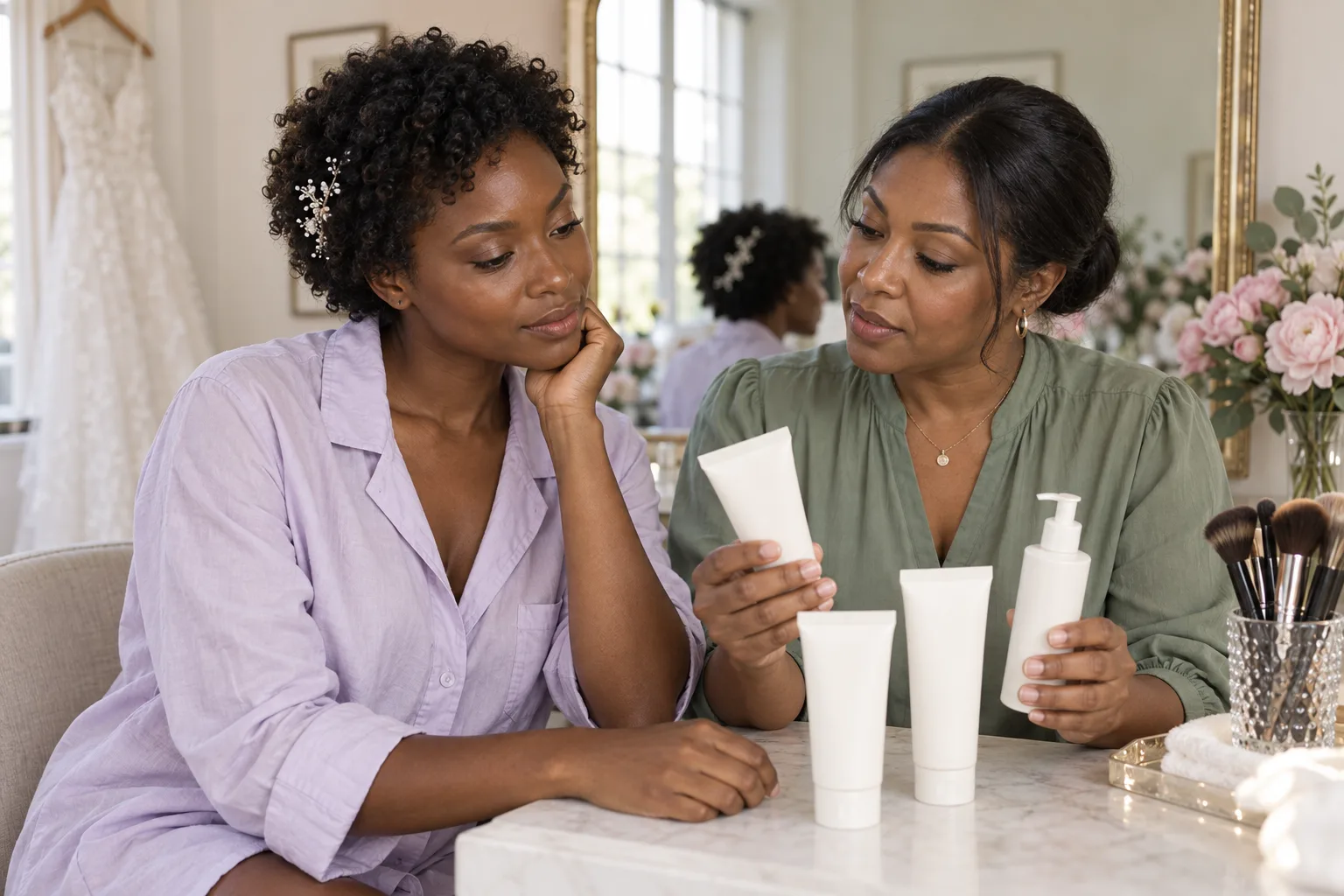
If eczema affects your face, hands or the skin under your dress, plan treatment and the makeup appointment together. Tell the clinician where symptoms occur, what you have tried and when the wedding and honeymoon take place. Tell the makeup artist which products and techniques have been agreed, including what to leave off during a flare.
Check the diagnosis when the pattern changes
Atopic eczema can cause itching, dryness, cracking and thickening. Its color varies with skin tone, including red, purple, grey or altered pigmentation. NHS guidance recommends medical review when treatment is not helping. [1]
Describe symptoms beyond their appearance in photographs. Include itching that interrupts sleep, discomfort when washing, cracking when you bend your fingers and soreness under clothing. Take dated photographs if helpful, with a list of the products used before symptoms changed.
Facial eczema has several possible forms. Eczema UK notes that persistent facial eczema warrants consideration of allergic contact dermatitis, even in someone with a longstanding eczema tendency. [2]
The American Academy of Dermatology's current adult diagnostic guidance supports reassessment when presumed atopic dermatitis does not respond to optimized treatment. It identifies patch testing, biopsy and skin scraping as tools considered in particular clinical situations. [3]
Ask what the clinician suspects and whether testing would change care. You do not need to request every test. A rash near the eyes after a new product deserves a different conversation from a familiar elbow flare responding to your usual plan.
Write down the treatment for each area
AAD's adult topical-treatment guidance strongly recommends moisturizers, topical corticosteroids, topical calcineurin inhibitors and certain other prescription anti-inflammatory treatments. Its 2025 focused update adds recommendations for newer therapies. [3]
That range of options is a reason to review uncontrolled symptoms with the prescriber. It does not identify which treatment is suitable for your eyelids, neck or hands, or establish how quickly your skin will respond.
Ask for instructions that identify the product, body area, amount, frequency, duration and follow-up. Clarify what to use during a flare and what continues when symptoms improve. Keep the names of medicines separate from cosmetic product names in the appointment note.
Ask how makeup, moisturizer and sun protection fit around the prescribed treatment. Do not mix a medicine into foundation, borrow a stronger cream for facial skin or stop a prescription because a bridal checklist says to avoid new products.
For travel, ask the pharmacist about the exact medicine's storage and quantity. Keep it identifiable and accessible. Check refill timing before the week fills with fittings and appointments.
Keep the daily routine specific
AAD recommends a fragrance-free cream or ointment rather than lotion for atopic dermatitis, and moisturizing after bathing while skin is damp. It suggests short, warm baths or showers of five to ten minutes. [4]
Use the products and frequency that suit your clinician's instructions. Put the familiar cleanser and moisturizer in the preparation-room kit and honeymoon packing list. Hotel toiletries and an artist's preferred skin-preparation range should not become automatic substitutions.
AAD distinguishes fragrance-free products from unscented products, which can contain fragrance used to mask an odor. [4] Read beyond the front label and check known allergens.
FDA cautions that terms including “hypoallergenic,” “fragrance-free” and “for sensitive skin” have no federal standard or definition governing their use in the United States. It requires ingredient declarations on retail cosmetics, although individual fragrance components may appear under a collective term. [5]
Those points serve different purposes: fragrance-free is a useful selection preference in eczema care, while the wording alone does not certify your tolerance. Ask the manufacturer about an unclear ingredient and bring known allergy information to the clinician.
Plan the trial around suitable skin
Eczema UK advises avoiding cosmetic products when facial eczema is active. It also warns that “natural,” “organic” and “dermatologically-tested” claims do not guarantee freedom from irritation. [2]
Tell the artist before the trial if you have active symptoms. Ask the clinician whether the appointment should be postponed and what can be used on unaffected areas. Do not scrub a flaky patch to create a smoother surface for foundation.
When a trial is appropriate, record the exact cleanser, moisturizer, sunscreen, primer, foundation, eye products, setting products and remover. Include any adhesive or applicator that touches skin. Photograph labels so the wedding-day kit can be checked against the trial.
AAD's ordinary skin-care use test involves a small area on the inner arm over seven to ten days. [4] Ask your clinician whether and how to assess a new product with your eczema. A home use test does not diagnose an allergy or certify an adhesive, prescription product or procedure.
FDA describes medical patch testing as a clinician-directed assessment for contact allergy that generally requires multiple visits. Active eczema at the test site can affect its usefulness. [5] Leave time for an assessment if one is recommended; a dab behind the ear at the salon is a different exercise.
After an appropriate makeup trial, note discomfort during wear, what happens after removal and any later symptoms. Contact the clinician about a reaction rather than repeatedly applying the suspected product to confirm it.
Check fabrics, heat and the preparation room
AAD recommends eczema-friendly clothing and fragrance-free, dye-free laundry detergent. Its advice includes loose cotton clothing and avoiding wool against skin. [4]
Use that advice where it fits the day, such as the preparation outfit or a change of clothes. For a structured gown, discuss an irritating seam or lining with the alterations specialist and clinician. Ask what adjustment is possible without compromising the garment.
Have ordinary washable new clothing cleaned according to its label. A wedding dress with specialist care requirements needs its own garment-care advice; do not put it through a household wash because a general skin-care list recommends washing new clothes.
Heat can worsen eczema symptoms. [1] Ask where you can cool down during preparation and between outdoor photographs. Include transport and waiting areas when reviewing the schedule, using the outdoor heat plan for the venue discussion.
NHS guidance warns that emollient residue on clothing, bedding and dressings can make fabrics catch fire more easily. [1] Keep cigarettes and naked flames away, including candles near the preparation area. Ask about garment transfer separately; a fabric mark and a fire precaution are different concerns.
Agree what happens if skin flares
Write the clinician's flare instructions where you can find them. Add the practice's contact details and an alternative source of care during travel. Tell a helper where the kit is, without asking them to decide which medicine to use.
Agree with the artist that worsening skin can change the makeup plan. Record who can move the appointment, which products can be omitted and how you will communicate a new clinical instruction. Include removal in that conversation, rather than leaving it to an unfamiliar wipe late at night.
NHS advises against changing your diet for eczema unless a doctor tells you to. [1] Do not remove several food groups during wedding week in an attempt to identify a trigger. If you suspect a food problem, discuss assessment and adequate nutrition with the clinician.
The wedding skin-care guide can hold the appointment schedule, but your eczema instructions should identify the treatment and response for your own symptoms.
Seek care for possible infection
Obtain urgent assessment if eczema becomes blistered, crusted, leaking or pus-filled; painful, swollen or warm; suddenly worse or more extensive; or accompanied by fever or feeling unwell. NHS identifies these as possible signs of infection or eczema herpeticum. [1]
Do not cover these changes with makeup and wait until after the ceremony. Tell the treating professional when symptoms began and what products or medicines you have used. The assessment should determine the cause and treatment.
FDA says to call 911 immediately for anaphylaxis symptoms after cosmetic exposure. These can include breathing or swallowing difficulty, lightheadedness or loss of consciousness. [5] Follow your prescribed allergy emergency plan if you have one.

Physical Book (No Download)
Bridegenic: The Glow-Up Guide for Brides on GLP-1s
$12.95 + Free Shipping
Order NowThis article provides general education, not a diagnosis or an individual treatment plan. Medication information refers to US sources. Talk with your prescriber, pharmacist or dermatologist about decisions for your care.
Read next
Wedding WeekOutdoor Wedding Heat Planning: Shade, Cooling Breaks and When to Get Help→Face & SkinYour Wedding Skincare Plan: From Engagement Photos to Makeup Removal→Sources
- Atopic Eczema, reviewed September 6, 2024NHS↩ Back to text
- Facial EczemaEczema UK, formerly National Eczema Society↩ Back to text
- Atopic Dermatitis Clinical Guideline, including 2025 focused update and adult diagnostic guidanceAmerican Academy of Dermatology↩ Back to text
- Atopic Dermatitis Skin CareAmerican Academy of Dermatology↩ Back to text
- Allergens in CosmeticsU.S. Food and Drug Administration↩ Back to text